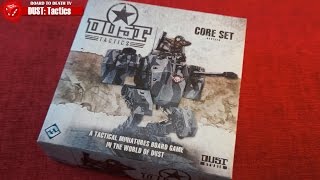
Dust Tactics box art

Dust Tactics

Game ID: GID0108094
Game Info
Year
2010
Collection
Rating
Mechanic profile
Not enough video data yet
Vibe profile
Not enough video data yet
Description

The year is 1947. Throughout the world, three major superpowers fight to claim exclusive control over a revolutionary source of power: Vk. Elite troops and massive combat robots wage violent battles to control these energy reservoirs...

Dust Tactics is a tactical miniatures board game for 2-4 players. In an alternate 1940s reality, alien technology fuels gigantic machines of war as the forces of the Axis and Allies clash over rare mineral deposits that could inevitably decide the outcome of the war. With over 30 highly detailed miniatures, nine double-sided terrain boards, 12 custom dice, unit cards, terrain, and plastic scenery, Dust Tactics delivers everything you need to wage battles in the immersive world of Dust.

A deep and engaging game setting, featuring stunning artwork by Paolo Parente, will draw players into a world desperately at war... and the highly detailed miniatures only add to this immersion. Eight included scenarios and nearly limitless customization ensures hundreds of hours of replayability, while scalable rules offer a satisfying experience for players of all levels.

• Over 30 highly detailed miniatures
• Nine double-sided boards to customize your own battle
• A deep and engaging setting
• A battle book including eight unique scenarios
• Quick-start rules to get into the action quickly

Description

The year is 1947. Throughout the world, three major superpowers fight to claim exclusive control over a revolutionary source of power: Vk. Elite troops and massive combat robots wage violent battles to control these energy reservoirs...

Dust Tactics is a tactical miniatures board game for 2-4 players. In an alternate 1940s reality, alien technology fuels gigantic machines of war as the forces of the Axis and Allies clash over rare mineral deposits that could inevitably decide the outcome of the war. With over 30 highly detailed miniatures, nine double-sided terrain boards, 12 custom dice, unit cards, terrain, and plastic scenery, Dust Tactics delivers everything you need to wage battles in the immersive world of Dust.

A deep and engaging game setting, featuring stunning artwork by Paolo Parente, will draw players into a world desperately at war... and the highly detailed miniatures only add to this immersion. Eight included scenarios and nearly limitless customization ensures hundreds of hours of replayability, while scalable rules offer a satisfying experience for players of all levels.

• Over 30 highly detailed miniatures
• Nine double-sided boards to customize your own battle
• A deep and engaging setting
• A battle book including eight unique scenarios
• Quick-start rules to get into the action quickly

Ask a Rules Question
All mentions
Browse transcript mentions, sentiments, pros/cons, mechanics, topics, quotes, and references.
Total mentions: 10
This page: 10
Sentiment: pos 5 · mix 0 · neu 2 · neg 0
Mentions per page
Showing 1–10 of 10
Video oe-7r-R7fEQ watch it played Rules Teach at 0:18 sentiment: neutral
video_pk 66040 · mention_pk 160505
watch it played - Dust Tactics video thumbnail
Click to watch at 0:18 · YouTube ↗
Overall sentiment (raw)
neutral
Pros
  • Tournament rules allow players to influence conditions and objectives.
  • Orders can be optional.
  • Heroes can always be given orders.
  • Radioman ability allows orders outside command range.
  • No line of sight required for issuing orders.
  • Opponent cannot react to orders during the command phase.
  • Multiple platoons can share command pool orders.
  • Unit can potentially regain formation and remove suppression.
  • Jump ability ignores obstacles up to a certain height.
Cons
  • If a unit leader is lost, one order must be lost, and a new leader must be nominated.
  • New unit leader's command range is reduced to 6 inches.
  • Units with suppression tokens have fewer actions.
  • If a unit has more suppression tokens than models, it retreats.
  • If a unit touches the table edge during retreat, it is removed from play.
  • Leaderless units can cause issues when opponent needs to identify a leader.
Thematic elements
  • warfare
Comparison games
none
Mechanics (from transcript analysis)
  • Actions — Units can take actions like move, attack, sustained attack, or march move. The number of available actions is reduced by suppression and reaction tokens.
  • command pool — Dice rolled during the initiative phase carry over into the command phase, representing the number of special orders a player can issue.
  • command range — Orders can only be issued to units within 12 inches of the command section's unit leader, with exceptions for heroes and units with a radioman.
  • end phase — Actions required by the scenario are taken, and one suppression token and all reaction tokens are removed from each unit.
  • initiative roll — Players roll dice equal to the number of units alive, with the player rolling fewer hits becoming the initiating player.
  • orders — Orders can be 'take action' (attack or move), 'regroup' (remove suppression and reaction tokens, reassign leader), or 'special order' unique to platoons.
  • reaction tokens — A unit receives a reaction token after being issued a 'take action' order.
  • Retreat — If a unit has more suppression tokens than models left, it retreats towards the closest table edge.
  • scenario play — Players can use pre-made scenarios, custom scenarios guided by the book, or create their own objectives and conditions.
  • Suppression Tokens — Units can have suppression tokens which affect their actions. Removing suppression tokens involves rolling dice.
  • Unit Activation — In the unit phase, the initiating player activates each of their units one at a time, followed by the responding player.
  • unit leader — Each unit has a leader, which can be reassigned if the original leader is removed. The absence of a unit leader can lead to penalties or opponent's choice of a new leader for a specific action.
Video topics + discussion points
No key topics recorded for this video.
Quotes (from this video)
  • we haven't yet discussed how do i win this game
  • basically allows both players to have an influence over the conditions and the objective of the battle
  • the player at the end of five rounds who has most completed the objective would then win
  • the first thing you need to know about a round is it's divided up into four phases
  • the player with the least number of hits that's me becomes the initiating player
  • these hits that i've rolled will carry over into what is now the command phase
  • the number of hits that i've rolled with my command pool represent the number of special orders that i get to issue
  • you don't have to have line of sight to the unit that you want to give the order to
  • after issuing a take action order to a unit if they don't already have a reaction token then you have to give them one
  • once a unit has been given an order it is not allowed to receive a second order during the same command phase
  • an opponent is not allowed to react to the orders that you give to your units
  • if you happen to have another hero in your army you can have the hero be the new unit leader and command section without having to spend an order
  • heroes like being in charge
  • the command range will now be reduced to 6 inches
  • the first thing we have to do is check to see if the unit leader is missing
  • we have to give that unit a suppression token
  • next the player moves any models outside of leadership range of the unit leader the minimum distance directly towards the unit leader
  • a unit has a chance to remove some suppression
  • if a unit had a hero attached to it then when rolling to remove suppression you would instead count the misses as hits
  • if a hero list unit like this one has more suppression tokens than models left alive in the unit again like this one the unit is going to retreat
  • the unit is going to retreat a retreat involves the entire unit taking a move action towards the closest table edge relative to the unit leader
  • the unit can then take up to two actions subtracting one if it has any suppression tokens and another one if it has a reaction token already
  • when you take actions you must declare what actions you're going to be taking up front
  • then from each unit on the table you remove one suppression token and all of the reaction tokens
  • this is the longest instructional series we have done from watch it played so far
References (from this video)
No references stored for this video.
Video _4e9w_CLJwo watch it played Rules Teach at 0:32 sentiment: positive
video_pk 66039 · mention_pk 160504
watch it played - Dust Tactics video thumbnail
Click to watch at 0:32 · YouTube ↗
Overall sentiment (raw)
positive
Pros
  • The veteran soldiers reference manual helps with rules reminders and order of play.
  • Index in video descriptions helps find specific gameplay elements.
  • Army point totals between 200-400 provide a meaty but not overly long game.
  • Terrain provides interesting tactical choices.
  • Scenario point system allows customization of objectives, deployment, and conditions.
Cons
  • Not all special weapons and abilities are covered in the rules overview.
  • Two pieces of terrain cannot be placed shorter than 4 inches apart unless impossible.
Thematic elements
  • veteran soldiers
Comparison games
none
Mechanics (from transcript analysis)
  • Army Point Total — Players decide on an army point total, typically between 200 and 400 points, to determine the scope and length of the game.
  • Deployment zones — Deployment zones are determined by the number of scenario points spent on deployment, affecting where units are initially placed.
  • Dice rolling — Dice are used to determine turn order for assigning scenario points and for placing terrain.
  • Objective Completion — The game is won by the player who has most completed their objective after five rounds.
  • Round Tracking — Five tokens are used to track the game rounds, with one removed at the end of each round.
  • Scenario Point System — Players use scenario points, determined by dice rolls, to influence objectives, deployment zones, and game conditions.
  • Terrain placement — Players alternate placing terrain pieces on the battlefield, with restrictions on how close pieces can be placed to each other.
Video topics + discussion points
No key topics recorded for this video.
Quotes (from this video)
  • if you've been following this series and you feel like you understand the rules so far but you're not confident you'd remember them once you sat down and played don't worry I feel the same way
  • I created this document I call it the Dust Warfare veteran soldiers reference manual
  • we're not going to be covering all of the rules at the end of this episode we have covered I'd say about 95% of them but I'm not going to go over each special weapon and each special ability
  • The rule book provides you with scenarios you can play and create but I want to tell you how to play the game tournament style
  • you also want to make sure you have enough terrain for the table this provides both players with interesting tactical choices to make as they move across the battlefield
  • then it's time to deploy your forces to the setup Battlefield
  • If you have any questions about dust Warfare please don't hesitate to ask them in the YouTube comments below
References (from this video)
No references stored for this video.
Video X-eTzPsb6Wk watch it played Rules Teach at 10:50 sentiment: positive
video_pk 66041 · mention_pk 160506
watch it played - Dust Tactics video thumbnail
Click to watch at 10:50 · YouTube ↗
Overall sentiment (raw)
positive
Pros
  • The game allows for strategic army building with customizable platoons and hero units.
  • Special abilities add depth and unique gameplay opportunities.
  • The point value system helps ensure balanced gameplay.
  • Platoon upgrades offer further strategic advantages.
Cons
  • The transcript mentions an error in the stats for the hero Rhino in the rulebook.
Thematic elements
  • World War II with fantastical elements
Comparison games
none
Mechanics (from transcript analysis)
  • Army point value system — Units have an Army point value that contributes to a total budget for building an army. Players and their opponents agree on a point value to ensure balanced gameplay.
  • Hero units — Heroes can act independently or join other units. They possess unique weapons, skills, higher health, and courage, meaning they don't take suppression tokens unless attached to a unit. Heroes can also serve as the command section of certain platoons.
  • Platoon building — Players construct armies by selecting one or more platoons, which are made up of different sections (command, first, second, third) and support units. The organization of these platoons and the units within them are detailed in the game's manual.
  • Platoon upgrades — Players can spend leftover Army points on upgrades for their platoons, such as 'airdrop,' which allows a unit to be held back and deployed strategically later in the game.
  • special abilities — Units can have special abilities that bend or break the game's rules, offering strategic advantages. Examples include ignoring suppression tokens, reducing cover effectiveness, adding dice to armor rules, or increasing movement.
  • Unit Stats — Units have stats for movement, armor classification, attack, and health. These stats are important when considering which heroes can join them and how they will perform in combat.
Video topics + discussion points
No key topics recorded for this video.
Quotes (from this video)
  • build your army it has to be made up of one or more platoons
  • the total value value of your army doesn't exceed the budget that you and your opponent picked
  • special abilities allow you to bend and sometimes break the rules of the game creating new opportunities for you to make strategic decisions
  • I'm really excited about the next episode because I'm going to get to take everything put it all together and show you how a game round works in dust warfare
References (from this video)
No references stored for this video.
Video fxnjONcbL_4 watch it played Rules Teach at 0:17 sentiment: positive
video_pk 66033 · mention_pk 160496
watch it played - Dust Tactics video thumbnail
Click to watch at 0:17 · YouTube ↗
Overall sentiment (raw)
positive
Pros
  • Custom unit cards are recommended for easier gameplay, providing weapon and unit stats to avoid page flipping.
Cons
  • Some stats for weapons were missing in the rulebook, requiring reference to FAQs and corrections.
  • Close combat can have unrealistic elevation scenarios that players may agree to ignore.
Thematic elements
Comparison games
none
Mechanics (from transcript analysis)
  • Actions — Units can take actions, potentially two under ideal conditions. One action can be an attack. Units can combine actions for a March move or sustained fire. Sustained fire allows rerolling miss dice once.
  • Armor Roll — After hits are scored, the defending unit makes an armor roll to negate damage. The number of dice rolled for the armor roll is based on the unit's armor rating. Each hit rolled negates one point of damage.
  • Close Combat — Units can choose to engage in close combat, which requires them to be within 3 inches of the target unit. This type of combat uses specific close combat weapons and cover does not provide protection.
  • cover — Units can benefit from cover, which can be soft (trees, bushes, fences) or hard (buildings, vehicles). Cover provides automatic successes in addition to armor rolls, with hard cover providing more benefits than soft cover. Suppressed units can have their cover status upgraded. Vehicles may not benefit from cover in the same way as soldier models.
  • Damage Assignment — Damage is assigned to models within the unit. Models that are not obscured must be assigned damage before obscured models. Models that are completely blocked from line of sight cannot take damage from that attack. Each model has a health value indicating how much damage it can take before removal.
  • Line of sight — Line of sight is determined from the model's point of view to the highest point at the center of the target model. Obstacles like terrain can block line of sight. Models can attack in any direction regardless of facing.
  • Ranged Combat — Units can perform ranged attacks using their equipped weapons. A single unit can split its attack between multiple targets. This type of combat considers range, line of sight, and cover.
  • Suppression — If at least one potential hit was rolled, a suppression token is added to the unit, indicating they are ducking or seeking cover. Vehicles do not take suppression tokens; instead, they undergo a second roll against a vehicle damage table based on potential damage and cover.
  • Unit Stats — Units have stats including movement, weapon types (close combat and ranged), and armor rating. Some units also have special abilities like 'Team', which can upgrade cover benefits.
  • vehicle combat — Vehicles have specific rules for cover and damage. If more than half of an attacking unit's bases are in the rear arc of a vehicle, the vehicle cannot make an armor roll. Vehicles use a separate damage table based on potential damage after cover is applied.
Video topics + discussion points
No key topics recorded for this video.
Quotes (from this video)
  • you want to do close combat you have to be within 3 in of the unit that you're targeting
  • if at least one model in the unit being attacked is within that 90° Arc that unit can then be attacked
  • as long as you can see some part of the model you have line of sight to it
  • if at least half of the models in the unit being attacked are obscured they will gain the benefits of cover
  • models in the same unit do not obscure the view to other models in that same unit
  • soldiers can only provide obscurity for other soldiers
  • basically soldiers can only provide obscurity for other soldiers now that said vehicles on the other hand certainly do provide terrain cover
  • models that are not obscured must be assigned damage before models that are obscured and models in a unit that had line of sight totally blocked from all of the attackers cannot take damage from an attack
  • even if all of the potential damage is blocked by armor absorb by cover we're going to see cover in a moment as long as at least one hit was originally rolled that unit is still going to take a suppression token
  • soft cover provides the player with one automatic success in addition to their armor roll
  • hard cover is is automatic two successes in addition to your armor roll
  • units that have a suppression token like our poor laser grenadiers over here they're ducking for cover so you upgrade their cover status One Step
  • basically the backs of the vehicles do not have as much protective armor as their fronts
  • cover does nothing to prevent damage from a close combat weapon
  • if the defender wanted he could assign one point of damage to this zombie and one a point of damage to this zombie which is actually outside of close combat range with these models
  • if a unit has two actions it cannot do two separate attack actions but again it can combine them to do a sustained fire
References (from this video)
No references stored for this video.
Video g-3tQaq6dHE watch it played Rules Teach at 0:19 sentiment: neutral
video_pk 66034 · mention_pk 160497
watch it played - Dust Tactics video thumbnail
Click to watch at 0:19 · YouTube ↗
Overall sentiment (raw)
neutral
Pros
none
Cons
none
Thematic elements
Comparison games
none
Mechanics (from transcript analysis)
  • Elevation Changes — When measuring distances, only horizontal measurements are used. A restriction exists that elevation cannot change by more than 3 inches from where movement began, unless players agree otherwise or for movement between floors in a building with a ladder or climbable area. This change in elevation does not affect the unit's standard movement.
  • Movement — The movement stat determines how far a miniature is capable of moving, typically allowing for two actions per unit activation (e.g., move and attack, or attack and move). Units can move up to their full movement stat, not required to travel full distance, and can move in non-straight lines. Movement can be pre-measured. Soldier units can move through friendly Soldier units but not through vehicles. Models cannot move within 1 inch of an enemy unit. All models in a unit must end their movement within 6 inches of the unit leader. March moves double the normal movement stat and can ignore difficult terrain. Terrain affects movement; open terrain has no impact, difficult terrain reduces maximum movement, and impassible terrain cannot be crossed. Soldier units are less affected by terrain than vehicles. Changes in elevation do not affect horizontal measurement, with a restriction of no more than 3 inches change in elevation unless agreed upon by players or for movement between floors in a building. Vehicles have specific movement rules including arcs, facing adjustments, and the ability to back up at reduced movement. Vehicles can perform a vehicle overrun if their base moves over an enemy model, resulting in dice rolls against the overrun unit.
  • terrain — Terrain is categorized as open, difficult, or impassible. Open terrain has no impact on movement. Difficult terrain impedes movement and reduces the maximum amount a unit can move. Impassible terrain cannot be moved through. Different units are affected differently by terrain types. For example, a stone wall is difficult terrain for a soldier, reducing their maximum movement to 3 inches. A tank trap is impassible for a vehicle. Players should clarify terrain types before a game. March moves can ignore the effects of difficult terrain.
  • Units — A fighting force is made up of one or more platoons, divided into smaller units. Each unit has a designated model as its leader and typically consists of 3-5 figures, but can be smaller (e.g., two-man teams) or comprised of a single model (vehicles, heroes). Units can be sold individually or in sets. Leaders are clearly identified in the rulebook and can be marked for easy identification. Unique hero miniatures can act as their own unit or join certain single units. Different models from different units cannot be combined to form a custom unit.
  • Vehicle Overrun — A vehicle overrun occurs when a vehicle's base moves over an enemy model. The vehicle must then be moved so it is at most 1 inch away from the overrun unit's base. The vehicle then rolls a number of dice equal to its vehicle type against the overrun unit(s), gaining one suppression token for each hit rolled. This mechanic also affects friendly units if they are overrun. The effects of suppression tokens will be discussed in future episodes.
  • vehicles — Vehicles have additional movement and facing rules compared to soldiers. They have four arcs: front, rear, left, and right, determined by the model's hull. Vehicles can normally move into their front arc, adjusting facing up to 90 degrees. They can also 'spot turn' to adjust facing up to 360 degrees without moving. Backing up is possible but reduces movement to a hard 3 inches, regardless of terrain. March moves for vehicles allow movement backwards up to 6 inches, ignoring difficult terrain. Vehicles cannot move through other vehicles. They can move over enemy soldiers but must end their movement at most 1 inch away, initiating a 'vehicle overrun' which involves rolling dice against the overrun unit(s) and potentially applying suppression tokens. Vehicle type determines the number of dice rolled for overruns.
Video topics + discussion points
No key topics recorded for this video.
Quotes (from this video)
  • The Miniatures are made up of two key components the figure itself and then the base
  • your total fighting force is going to be made up of one or more platoon and those platoon are going to be divided up into these smaller units
  • the models themselves within a unit tend to also share a similar look and style which can help you keep them organized
  • you can't otherwise take different models from different units and make a custom unit
  • when you activate your units on the battlefield typically they'll be able to take two actions and usually that will be to move and attack or to attack and then move
  • to determine how far miniature is capable of moving you look at its movement stat which is represented by this symbol
  • Soldier units that is units that are not Vehicles can move through friendly Soldier units as long as they end their movement in an empty area
  • a model also cannot move or its movement within 1 in of an enemy unit
  • all of the models in the unit must be within 6 in of the lader
  • if you want to forgo attacking you can instead do a double move this is known as a March move
  • most of the terrain you see on this table is flat grassland and this is known as open terrain it has no impact on a unit's movement
  • there is also difficult terrain and impassable terrain
  • a model that must cross difficult terrain will have its maximum movement reduced to 3 in
  • if you're really desperate to get where you're going you do have an option you can instead of issuing in a move action issue one of those March move actions the double move if you have the extra action to spare that will allow you to ignore all the effects of difficult train
  • when you measure distances in dust Warfare you only measure them horizontally
  • the only restriction is that when you finished your movement you cannot have changed elevation by more than 3 Ines from where you began
  • Vehicles do have four different arcs a front a rear a left and a right Arc and this will influence both movement and attacking
  • Vehicles don't care about such restrictions when it comes to other enemy soldiers
  • this kind of movement is called a vehicle overrun and this means that the vehicle will then roll a number of dice equal to its vehicle type and then overrun units will gain one suppression token for each hit rolled
References (from this video)
No references stored for this video.
Video O2RAxRXDpwI Watch It Played Rules Teach at 0:21 sentiment: positive
video_pk 66035 · mention_pk 160498
Watch It Played - Dust Tactics video thumbnail
Click to watch at 0:21 · YouTube ↗
Overall sentiment (raw)
positive
Pros
  • Introduces new players to the miniatures hobby.
  • Offers a unique alternate history setting.
  • Provides tactical depth through terrain.
  • Has a significant hobby aspect with customization options.
  • Miniatures come pre-assembled and pre-primed.
Cons
  • Can be complex with many unit stats and rules.
  • Acquiring all necessary terrain and miniatures can be expensive.
Thematic elements
  • World War II with advanced alien technology leading to giant walking robots.
  • An alternate 1947 where World War II has been raging for nearly a decade and involves giant walking robots.
Comparison games
  • Dust Tactics
Mechanics (from transcript analysis)
  • Counters — Uses colored beads or photocopied counters to track game elements.
  • Dice rolling — Uses custom combat dice with blank and hit sides, where rolls of 5 and 6 are hits. Regular six-sided dice can be substituted.
  • Miniatures combat — Involves individual unit stats for defense, health, and movement, with special abilities and weapon rules.
  • Terrain utilization — Terrain provides tactical options, cover, and influences gameplay.
Video topics + discussion points
No key topics recorded for this video.
Quotes (from this video)
  • In the next series of videos, I'm going to teach you how to play the tabletop miniatures game Dust Warfare by Fantasy Flight Games.
  • strip away all the trappings of a board game, and instead play the game on open terrain of your own creation.
  • It's the year 1947, and World War II has raged for nearly a decade, spreading to every continent on the planet.
  • Most notably, it changed when the German forces discovered a crashed alien spaceship in Antarctica and used a newly discovered mineral to create giant walking robots that allowed them to styy the Allied defensive and then crush the Russians in Stalenrad, turning the war in their favor.
References (from this video)
No references stored for this video.
Video 52jktB4p2EY watch it played Discussion at 0:38
video_pk 66032 · mention_pk 160492
watch it played - Dust Tactics video thumbnail
Click to watch at 0:38 · YouTube ↗
Pros
none
Cons
none
Thematic elements
Comparison games
none
Mechanics (from transcript analysis)
Mechanics unknown.
Video topics + discussion points
No key topics recorded for this video.
Quotes (from this video)
  • family first right
  • Almost like they had spies in our house to know what size shirts we wear scary
  • M of fluffies
  • Hulk smash spoiler don't read until you've opened the box
References (from this video)
No references stored for this video.
Video VGSppFtptao watch it played Unboxing at 1:51
video_pk 66036 · mention_pk 160500
watch it played - Dust Tactics video thumbnail
Click to watch at 1:51 · YouTube ↗
Pros
  • Comes with really nice miniatures
Cons
none
Thematic elements
Comparison games
  • Dust Warfare
Mechanics (from transcript analysis)
  • Board game with miniatures — Described as more of a board game that comes with nice miniatures.
Video topics + discussion points
No key topics recorded for this video.
Quotes (from this video)
  • welcome back to watch it played everyone
  • I don't review games on here but I will review apps and this is a great app I've been really enjoying it playing it probably too much
  • if you invite me to a game just make sure you set the game length to 14 days
  • I've been waiting for this box to come because it is full of Miniatures that I can't wait to show you
  • Daniel crane at the discount game store is certainly one of those for me he's been very generous with us as an early supporter not just with the products but also his time
  • he's going to take 30% off of your dust order how awesome is that
  • please be sure to check out their website it's at www. miniatur model.com
  • if you want painted midies but you just don't have the inclination or like me sometimes you just don't have the time uh to do it yourself I think these guys are a fantastic option
References (from this video)
No references stored for this video.
Video VGSppFtptao watch it played Unboxing at 4:32 sentiment: positive
video_pk 66036 · mention_pk 160499
watch it played - Dust Tactics video thumbnail
Click to watch at 4:32 · YouTube ↗
Overall sentiment (raw)
positive
Pros
  • Comes with a lot of miniatures
  • Can be used for two games (Dust Tactics and Dust Warfare) with the right book
  • Models designed for Dust Tactics also work for Dust Warfare
Cons
  • Need to pick up extra miniatures to create an official platoon
  • Might be a harder sell for local gaming groups compared to other miniatures games
Thematic elements
Comparison games
  • War machine
  • Dust tactics
  • Space Hulk
Mechanics (from transcript analysis)
  • miniatures wargame — The discussion revolves around a miniatures game and the associated models, with mention of a rulebook for 'dust Warfare'.
Video topics + discussion points
No key topics recorded for this video.
Quotes (from this video)
  • welcome back to watch it played everyone
  • I don't review games on here but I will review apps and this is a great app I've been really enjoying it playing it probably too much
  • if you invite me to a game just make sure you set the game length to 14 days
  • I've been waiting for this box to come because it is full of Miniatures that I can't wait to show you
  • Daniel crane at the discount game store is certainly one of those for me he's been very generous with us as an early supporter not just with the products but also his time
  • he's going to take 30% off of your dust order how awesome is that
  • please be sure to check out their website it's at www. miniatur model.com
  • if you want painted midies but you just don't have the inclination or like me sometimes you just don't have the time uh to do it yourself I think these guys are a fantastic option
References (from this video)
No references stored for this video.
Video caPstRBwEPw watch it played Announcement at 1:44
video_pk 65649 · mention_pk 159370
watch it played - Dust Tactics video thumbnail
Click to watch at 1:44 · YouTube ↗
Pros
none
Cons
none
Thematic elements
Comparison games
none
Mechanics (from transcript analysis)
Mechanics unknown.
Video topics + discussion points
No key topics recorded for this video.
Quotes (from this video)
  • My first tip for you is never tip this box on its Edge despite the good box control inside of here there are probably now lots of little bits that are floating around the Box in places they shouldn't be.
  • This game has been around for a little while now but it's a really fun uh Gateway game.
  • I love sometime to be able to do a Miniatures game as part of this video series one of the challenges though with the format that we use here is that Miniatures games there's often a lot of back and forth so it's very hard to establish upfront here's what I want to do for my entire turn because things can change depending on what the other person does.
  • From what I read online is this was a great game but people had a lot of rules questions.
  • I would really like to challenge myself to see if I can kind of come up with the definitive helpful tutorial on how to play this game.
  • What is wrong with our economy that you cannot pay for things with board games I ask you or at least meeples or something.
  • Thanks for all that thanks for helping to make this series what it is now I hope to continue to improve it and bring you lots of great content in the future.
References (from this video)
No references stored for this video.
Transcript Navigation
Top
Showing 1–10 of 10
View on BoardGameGeek