/pic7617054.jpg)
Resistance fighters in the Netherlands work together to outsmart the occupation forces in a non-violent way.
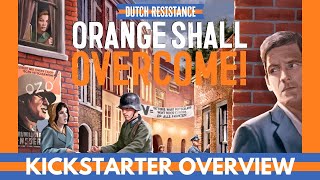
In a period when most people were too afraid to oppose the occupying Nazi forces, some decided they did not want to sit idly by. To keep morale high and show they did not accept the occupation, they wrote a secret message OZO (Oranje Zal Overwinnen, translated as Orange Shall Overcome) on the walls. They formed groups and found ways to sabotage the occupiers' plans. You are one of those resistance fighters.
Dutch Resistance: Orange Shall Overcome! is a scenario-based cooperative game about the Dutch Resistance during the Second World War. The main mechanisms are pick-up and deliver and resource management.
The game has five very different highly replayable scenarios. They are not directly connected to each other but focus on different aspects of the resistance work. Each scenario has its own goals, special rules, cards, and other elements.
Each player controls a character that is based on a real resistance fighter. These ten different characters have their own deck of three unique Character cards, based on what this person did during the war.
Orange Shall Overcome!
—description from the publisher


- Extremely clever morale track mechanism.
- World War II Resistance
Mechanics (from transcript analysis)
- Group actions — Describes a system where group actions can be taken by any player at any time, even when it's not their turn, contributing to the game's cleverness.
Video topics + discussion points
Quotes (from this video)
- I don't think Project L should have the video theme category applied to it. I don't think so.
- my solo cadet mode for captain's chair is the best video to watch to learn how to play the game.
- you only score points for your tracks if you have completed at least one of your missions.
- Many of you, especially Mage Knight fans, will know Ricky because he did the solo playthroughs of Mage Knight, which helped make Mage Knight what it is today.
- I have news. I am not allowed to share that news. I am under um effectively an NDA.
- Marvel Champions is a fantastic, fantastic game.
- The stream was crashing and literally every 30 minutes the stream would crash and my software would crash and people would be in the chat saying the stream's gone down.
- Too Many Bones is a good game, but me being so far out of my comfort zone that I literally cannot understand how to play the characters that I'm playing whilst hosting a live stream. Yeah, I don't want to do that again. That was uh that was horrible.
- Monopoly is in that situation where it's popular because it's popular.
- It's still a terrible game. It is. It is a terrible, terrible, terrible game.
- The Lord of the Rings: Fate of the Fellowship, the new pandemic style game from Matt Leo. I'm going to pick that one. But caveat, I've only played it once and I haven't actually played that many games that technically have come out from 2025.
- You can't. There's too many games coming out every week.
- If you are not a Patreon supporter and you want to support me directly, you can for as little as $1 a month or $3 a month if you want access to the Slack channel, patreon.com/gamingrules.
- The secret word for this month is the game that arrived this afternoon that none of my patron supporters were able to guess.
References (from this video)

- Blew reviewer away with quality
- Strong thematic integration
- Clever shared action selection
- Varied missions
- Customizable difficulty
- Good rulebook and tutorial
- Some players might find the shared action selection complex initially
- Resistance efforts and covert missions during WWII
- Dutch resistance at the end of World War II
- The game uses 'halt cards' with flavor text and stories that present choices.
- Pandemic
Mechanics (from transcript analysis)
- action selection — Features a shared action selection mechanism where players can take actions on others' turns.
- cooperative play — Players work together to achieve common goals.
- Mission-based gameplay — The game is structured around completing various missions.
- Moral/Alibi Tracking — Player actions impact morale and alibi stats.
- Resource Management — Players collect resources to complete missions.
Video topics + discussion points
Quotes (from this video)
- It's very clever in the way that it works between rounds because in between rounds, once you've played most of your cards, one of them passes to the player to the right, and then you will pick up the stacks of cards, but you will keep them in the order in which they are.
- my initial impression was that I was disappointed.
- So, yeah, it's a light card game. It plays really well. I have some minor concerns about replayability just because there's not that many cards in the shared deck, but having played three times now, and every game did play differently for me, yeah, it's fine for for what it is. It's fine.
- It is a little bit more complex than your normal trick taking game, but not so much that it's going to be a problem.
- Agamonia, it's still fantastic.
- I absolutely love this game and I love what they've done with this game.
- But that feels non-theatic and also a bit too punishing.
- Life is short. I have limited time and if we were to play Primal with the official rules, then that campaign playthrough won't be 12 parts. It will be 25 parts and it will take us two years to do it.
- I think this game is a little bit special.
- It'll be good to go to Essen for a for a rest.
References (from this video)

- really, really good game
Mechanics (from transcript analysis)
- Cooperative — Players work together to complete missions during World War II.
Video topics + discussion points
Quotes (from this video)
- Movie Tricks is really good. Movie Tricks is from Chitty Fox Games. It's a trick taker, but it's got a bit of a kick and I really like that.
- Severton is a game from Vlades Shaattle. You may have heard of Vlad Shaattle, but he's got a new game this year called Severton. It's the first time he's had a new game published for about 10 years. And a little bit like Dutch Resistance: Orange Shall Overcome, it's a cooperative game where you're trying to complete missions. And it's really, really good. And not many people are talking about it.
- The new version for me is an improved version of the game. So, if you like Ingenious or Genal, whatever you want to call it, then have a look at the 3D version. That was really good.
- we played this game called drop alter and I absolutely blitzed it. I mean I think I won I think I won six of five of the six rounds that we played or something like that.
- In general, I don't play abstract games. But there are certain ones which I do play and I do like.
- Project L is another really really good game and I really like Project L and uh and that is a completely abstract game.
- I dread the day when I have to play on Mars again because I don't have the time, mental energy, everything else to go back and relearn on Mars.
- Talisman. 34 year gap between playing it.
- as much as A Trespass Odyssey was the most complicated game that I've ever played and some of the rules were extremely confusing and we weren't sure of some of the rules after 25 games, that game had things in it which I have never had that experience from any other game ever.
- And I've heard that Kingdoms for Lawn offers a similar experience.
- But when I'm playing it solo, if I'm not live streaming it, my brain because of the weird memory issues that I have, literally gets to a point and I go up and it just stops and my short-term memory disappears and I'm like, I have no idea not only what I was doing, but where we are, what phase we're on, or anything like that.
- live streaming it and talking to the audience and keeping things going is the only way that I can actually get my brain to, you know, work and be able to cope with playing the actual game itself.
References (from this video)
- strong cooperative emphasis requiring player coordination
- historical theming with tangible connections to WWII Netherlands
- multiple scenarios and solo modes increase replayability
- distinct character powers and unique action decks add variety
- integration of forger/identification and hiding mechanics creates tension
- clear thematic ties between narrative and mechanics
- board state and danger progression create strategic pacing
- complex rules and setup can be daunting for new players
- heavy reliance on hidden information may slow play or complicate communication
- solo mode may not fully replicate the social dynamics of multiplayer
- cooperative resistance efforts, nonviolent forms of resistance, secrecy, resource management under occupation
- Nazi-occupied Netherlands, early 1940s (World War II context)
- historical fiction-inspired, scenario-based co-op with character-driven powers and real-world references
Mechanics (from transcript analysis)
- alibi and resources management — Characters carry resources and maintain alibi to avoid suspicion; resources impact location safety and chances of raids.
- Cooperative action selection — Players share a pool of actions (via action cards) and must coordinate to advance goals while mitigating danger.
- forger and identification system — Genuine-looking documents must be collected and converted into identification cards to rescue hidden men.
- location-based actions — Each location offers a unique action (e.g., gathering documents, moving, obtaining helpers) with strategic trade-offs.
- morale and safety tracks — Morale affects available actions and can trigger additional actions; safety tracks influence raid risk and penalties.
- occupier cards with hidden effects — Each turn reveals and resolves an occupier card, introducing unpredictable challenges and requiring secrecy between players.
- raid and patrol resolution — Raid cards and patrols drive enemy activity, with dice rolls determining which locations are raided and outcomes.
- Resource Management — Characters carry resources and maintain alibi to avoid suspicion; resources impact location safety and chances of raids.
- solo modes — Two distinct solo modes simulate different support structures, including helper cards and alternate win conditions.
- Track Advancement — Morale affects available actions and can trigger additional actions; safety tracks influence raid risk and penalties.
Video topics + discussion points
Quotes (from this video)
- The base game comes with five scenarios for your first game.
- There are two other solo modes that allow you to play with only one character.
- Dutch resistance comes with various characters you can play each with their own unique player powers and unique set of three action cards.
- Thematic tie-ins to actual history and the cool factor of being tied to real events.
References (from this video)
- strong thematic storytelling
- tension-filled, meaningful decision points
- potentially long play time
- learning curve for new entrants
- resistance decision points and moral choices
- World War II Netherlands, non-violent resistance
- story-driven with crossroads-type decisions
- Dead Winter
- Dead of Winter
Mechanics (from transcript analysis)
- Cooperative Game — players collaborate to achieve shared objectives
- cooperative play — players collaborate to achieve shared objectives
- crossroads storytelling — narrative crossroads cards guide major decisions
- out-of-turn actions — a few moments per round let players act out of turn
Video topics + discussion points
Quotes (from this video)
- Prelude expansion came out for this—game changer in expansions for me.
- The vineyards expansion expands the board so all of a sudden you don't just focus on the board as much—you go over to your little vineyard.
- This is one of those games that we went through all the effort to get every expansion and organize it, and we still pull it out.
References (from this video)
- Historically flavored scenarios
- Engaging cooperative play with tactical decisions
- Availability and access may be limited
- underground resistance and sabotage
- World War II Netherlands; resistance movement
- scenario-driven with historical flavor
- Other WWII resistance-themed games
Mechanics (from transcript analysis)
- scenario-based play — Multiple scenarios offer varied challenges.
Video topics + discussion points
Quotes (from this video)
- My number 10 is Bomb Busters.
- It's a cooperative game where you are all bomb diffusing agents and you're trying to go in and work together to diffuse this bomb.
- You're going to be able to recognize the mechanisms from the pandemic system by the time you finish, but it feels thematic by then.
- This is a great one if you're a Christian and you enjoy Tableau Builders more than anything else.