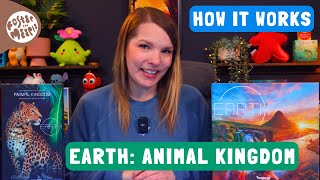
Earth is a tableau builder for 1 to 5 players with simple rules and countless strategic possibilities. With its encyclopedic nature and a near-infinite number of tableau combinations, every single game will allow you to discover new synergies and connections, just as our vast and fascinating world allows us to do!
Over thousands of years of evolution and adaptation the flora and fauna of this unique planet have grown and developed into amazing life forms, creating symbiotic ecosystems and habitats.
It’s time to jump into these rich environments and create some amazing natural synergies that replicate and extrapolate on Earth’s amazing versatility and plethora of natural resources. Create a self-supporting engine of growth, expansion and supply where even your unused plants become compost for future growth.
—description from the publisher
AWARDS & HONORS
2023 Dice Tower Game of the Year Winner
2023 Dice Tower Strategy Game of the Year Winner
2023 BoardGameOfTheYear.org Game of the Year Winner
2023 People’s Choice at Dice Tower #1 Game of the Year, EoY voting)

2023 Dice Tower Seal of Excellence
2023 Board Game Arena Best Forest game Winner
2023 Deutsher Spiele Preis 4th Place
2023 Best of Gen Con Gaming Trends
2023 C’ludik expert Game of the Year Winner
2023 Poulie d’Or Expert Game of the Year Winner
2023 Coup de coeur Ludovox
2023 Dod d’Or Winner
2024 Board game Hangover #1 Nature Game
2024 Coup de Coeur Expert Festival Alchimie du jeu de Toulouse
2024 BIG Awards Game of the Year Winner
2024 BIG Awards Best artwork Winner
Earth - Review in 2
Earth - Playthrough & Review
- Engaging simultaneous play with zero downtime
- High replayability through many species and ecosystems
- Large card pool can be daunting for new players
- ecosystem development, resource management, and ecological growth
- Ecosystem-focused theme rooted in nature and sustainability
- engine-building with ecological flavor
- Wingspan
Mechanics (from transcript analysis)

- High-card variety — Over 400 cards presenting diverse ecosystems and interactions.
- Multi-use cards — Over 400 cards presenting diverse ecosystems and interactions.
- Simultaneous action selection — Active player actions are complemented by simultaneous actions from others.
- Simultaneous Actions — Active player actions are complemented by simultaneous actions from others.
- tableau building — Players build a tableau of cards to generate ongoing benefits.
Video topics + discussion points
Quotes (from this video)
- It's approachable enough that new players can learn it in one session, but deep enough that you're still finding new strategies after 30 plays.
- The expansions add modules instead of replacing the base game. So, you're building a collection, not cycling through versions.
- It's Dune. That IP isn't going anywhere. As long as people are watching Dune movies, they're going to want to play Dune games.
- The magic is in the gear shift mechanism.
- It's creating a new genre, strategic deduction.
- "No, you're a ghost now. You still matter."
- "The objectives change every game."
References (from this video)
- Explicit thematic integration—theme informs mechanics and scoring clearly.
- Engaging engine-building with multiple viable paths and high player involvement.
- Very strong, high-quality components and attractive artwork.
- A couple of actions (blue and yellow) are rarely chosen, reducing perceived variety.
- early complexity can be overwhelming; some may find setup and rule exploration lengthy.
- environmental stewardship, climate-driven scoring, and ecosystem growth
- Earth-like planet redevelopment through ecological tableau-building; themes of climate action and biodiversity
- multi-objective engine-building with simultaneous action selection
- Terraforming Mars
- Wingspan
- Ark Nova
Mechanics (from transcript analysis)
- End-game canopy layering — Canopies require meeting specific conditions to gain bonus points; multiple scoring routes exist.
- Event/disaster cards — Event cards can impose penalties or alter resource flows, adding variability and strategic decisions.
- Events — Event cards can impose penalties or alter resource flows, adding variability and strategic decisions.
- Simultaneous action selection — Actions are chosen each turn with impact across all players, enabling shared benefits and competition.
- Simultaneous Actions — Actions are chosen each turn with impact across all players, enabling shared benefits and competition.
- Sprouts, soil, compost, and canopy track — Resource tracks (Sprouts, Soil, Compost, Canopy) drive action costs and end-game scoring; progression reveals benefits.
- tableau building — Players assemble a tableau of cards that generate ongoing effects and end-game scoring opportunities.
- tableau-building — Players assemble a tableau of cards that generate ongoing effects and end-game scoring opportunities.
- Track advancement — Resource tracks (Sprouts, Soil, Compost, Canopy) drive action costs and end-game scoring; progression reveals benefits.
Video topics + discussion points
Quotes (from this video)
- this is a mumble game
- top shelf billing was a coined a while ago and this is going to be called Mumble games
- I would skip it
- I really really like Earth
- Earth I'm going to keep playing it for a while
- it's an own it for me
- this is a play it for me
- the quality of cards is among the best I've ever seen in any game
- the artwork is great
References (from this video)
- high engagement through dynamic engine-building
- can be played relaxed or highly competitive
- many cards and ecosystems create replayability and variety
- large card deck can feel unwieldy
- can be lengthy depending on group and expansions
- engine-building with public action synergy
- ecological development and habitat management
- tableau-driven with shared action effects
Mechanics (from transcript analysis)
- Compound Scoring — scoring is derived from a large set of cards and ecosystems
- multi-path scoring — scoring is derived from a large set of cards and ecosystems
- shared-action trigger — the most powerful form of an action is taken by the active player and triggers color-based effects on others
- tableau building — players build and optimize a personal tableau of actions
Video topics + discussion points
Quotes (from this video)
- this is my number one game of all time right now.
- And the art is beautiful. The world building is so interesting.
- Expeditions, however, from what I've heard, is one that you only want to play at lower player counts cuz it gets long.
- the tableau isn't set in stone. It's constantly moving.
- We love a co-op.
References (from this video)
- Array
- Array
- Environmental and growth-inspired tableau-building
- Array
- Tableau-building on a 4x4 grid
- Array
- Array
- Array
- positive
Mechanics (from transcript analysis)
Video topics + discussion points
Quotes (from this video)
- geometry in the game is amazing
- oh so so good
- it's such a beautiful game
References (from this video)
- Stunning visual design and tactile components
- Excellent rulebook with diagrams and beginner mode
- High engagement due to simultaneous play and engine-building depth
- Huge variety of cards and strategies leading to strong replayability
- Balanced design with meaningful theme integration
- End-of-game scoring can feel like a chore to tally
- Some icons/symbols (like the leaf/compost symbolism) can be confusing
- Storage and organization of many small components can be cumbersome without bags
- Initial learning curve is steep for new players
- Iconography for Flora and some symbols could be clearer
- ecosystems, habitats, and ecological management
- Islands and natural environments focused on ecology and biodiversity
- educational, nature-simulation flavor with flavor text and learning elements
- Wingspan
- Splendor
- Parks
- Terraforming Mars
- Last Light
- 7 Wonders
- Yu-Gi-Oh
Mechanics (from transcript analysis)
- engine building — Players build an engine of actions by activating color-coded card interactions and card effects to generate points and chain reactions.
- engine-building — Players build an engine of actions by activating color-coded card interactions and card effects to generate points and chain reactions.
- hand management — A large hand of cards with many potential activations requires careful selection, timing, and discards.
- hand_management — A large hand of cards with many potential activations requires careful selection, timing, and discards.
- Resource management — Dirt/soil, growths, sprouts, and other resources are managed to enable actions and scoring opportunities.
- resource_management — Dirt/soil, growths, sprouts, and other resources are managed to enable actions and scoring opportunities.
- set_collection_and_pattern_formation — Points are earned from ecosystems, terrains, and habitat combinations that fit specific patterns on the island.
- Simultaneous Actions — Turns are effectively simultaneous; players select a color/action and execute in a flow that reduces downtime.
- simultaneous_play — Turns are effectively simultaneous; players select a color/action and execute in a flow that reduces downtime.
- tableau building — Players construct an Island by placing cards in rows/columns to optimize synergies and point opportunities.
- tableau_building — Players construct an Island by placing cards in rows/columns to optimize synergies and point opportunities.
Video topics + discussion points
Quotes (from this video)
- Earth is a Masterpiece
- simultaneous gameplay
- the huge amount of combo goodness there
- Earth actually feels really well balanced
- end game scoring can be a chore
References (from this video)
- Adds seeds and a germinate action for targeted scoring objectives
- Sixth player support with a new mat and tokens
- 70 new Earth cards with floor terrain and events for more interaction
- Storage Sprouts feature increases flexibility and scoring options
- New events and abilities that can affect both owner and opponents
- Prototype status means final production could change
- Increased complexity and component count may lengthen play time
- Germinate/search mechanic may slow early-game flow for new players
- ecology, ecosystem-building, resource management
- Island-based ecosystem development with an environmental theme
- procedural engine-building with scoring objectives
Mechanics (from transcript analysis)
- card drafting — Draw and use cards to activate actions and trigger effects.
- card drawing/management — Draw and use cards to activate actions and trigger effects.
- Compound Scoring — Final scoring is driven by personal objectives and board interactions.
- engine building — Players construct an action engine by acquiring cards that expand actions across the grid.
- engine-building — Players construct an action engine by acquiring cards that expand actions across the grid.
- grid-based action triggering — Actions apply to all players following a top-left to bottom-right sequence on the grid.
- Objective-based scoring — Final scoring is driven by personal objectives and board interactions.
- Resource management — Manage soil, Sprouts, Seeds, and Leaf tokens to grow and score.
Video topics + discussion points
Quotes (from this video)
- abundance of Joy
- Earth is an engine building game
References (from this video)
- adds meaningful interaction with Earth base
- new seeds mechanic is flavorful and clever
- scales well with more players
- expansion complexity adds some crunchy depth
- not a casual add-on for newcomers
- environmental handiwork and planetary stewardship
- Ecological resource development and interdependence
- engine/interaction-driven with simultaneous play
Mechanics (from transcript analysis)
- neighbor interaction — player interactions influence each other through shared resources and actions
- neighbor_interaction — player interactions influence each other through shared resources and actions
- Resource management — managing diverse resources and seeds to activate benefits
- resource_management — managing diverse resources and seeds to activate benefits
- Simultaneous Actions — players perform actions in parallel rather than strictly alternating turns
- simultaneous_action — players perform actions in parallel rather than strictly alternating turns
Video topics + discussion points
Quotes (from this video)
- it is truly the gamer Paradise
- we ended up playing 40 games between the two of us
- the brain fog is real
References (from this video)
- Innovative action selection with simultaneous resolution that keeps the pace snappy
- Deep engine-building via planting, composting, watering, and growth
- High replayability due to large card pools, fauna, and ecosystem cards
- Engaging solo mode against Gaia with a strong sense of multiplayer parity
- Clear or intuitive end-game trigger and multiple scoring avenues
- Heavy iconography can be overwhelming for new players and creates a learning curve
- Iconography and symbols may require dedicated onboarding or reference sheets
- Some players may experience analysis-paralysis due to the breadth of choices
- Ecology, ecosystems, plant growth, resource management
- Open-world ecological engine-building on Earth, focusing on flora, trees, soil, and climate interactions
- Informational and enthusiastic product-style discussion within a review
- Race for the Galaxy
- Aries Expedition
- San Juan
Mechanics (from transcript analysis)
- Action selection with simultaneous resolution — The active player selects one action; all other players perform a smaller version of that same action simultaneously, creating a fast, synchronized tempo.
- Composting to gain dirt/soil and buy cards — Composting yields soil that can be used to purchase new cards, feeding the engine and scoring opportunities.
- Deck-to-table planting and 4x4 tableau — Players choose cards from hand to place into a 4x4 grid in front of them, driving engine-building and hand management.
- End-game trigger via planting a 16th card — When a player completes their 4x4 tableau (plants 16 cards), the game ends and scoring proceeds.
- Growth and canopy heighting — Growth tokens are placed on cards to raise tree height; reaching the canopy caps yields high victory points when tall enough.
- Multi-use cards — Rainbow Cards enable activations across multiple action spaces, intensifying strategy and synergy.
- Public fauna and personal objectives scoring — Public fauna cards and personal objectives provide diverse scoring paths, creating a point salad of options.
- Rainbow Cards and multi-space activations — Rainbow Cards enable activations across multiple action spaces, intensifying strategy and synergy.
- Simultaneous Actions — The active player selects one action; all other players perform a smaller version of that same action simultaneously, creating a fast, synchronized tempo.
- tableau building — Players choose cards from hand to place into a 4x4 grid in front of them, driving engine-building and hand management.
- Watering and growth — Watering activates growth growth on cards, delivering growth tokens, which contribute to scoring and resource generation.
Video topics + discussion points
Quotes (from this video)
- Earth is an open world engine builder
- Massive amount of replayability there are so many combinations of fauna cards
- I've played it with the solo variant as well... against Gaia and it feels like a multiplayer game for sure
- The points are everywhere
References (from this video)
- Greater agency and options than Wingspan in many areas
- Dense interdependence of resources and card effects creates a deep strategic puzzle
- Balanced design with thoughtful card balancing and minimized obvious exploitability
- Pace can feel aggressive; anticipation and micro-deliberation may be harder to cultivate
- Scarcity and tension can be undercut by steady engine progression
- High cognitive load and continuous action can be draining for some players
- Growth, ecology, and expanding a landscape through planting and card interactions
- Ecological growth and cultivation on a 4x4 grid-driven tableau
- Growth-centric and nature-forward design that scales through card placement and adjacency
- Wingspan
Mechanics (from transcript analysis)
- actions_and_shared_effects — Four core actions (planting, composting, watering, growing) influence an engine for all players, with color-coding driving activation across the tableau
- adjacency_and_tree_growth_scoring — Scoring is driven by adjacency between cards and by completing growth structures on cards
- card_types_and_event_cards — Terrain, Flora, and Event cards provide a mix of one-off and ongoing effects that interact with the engine
- engine_activation_order — When an engine is activated, cards trigger in a left-to-right, top-to-bottom sequence, making placement order consequential
- Resource management — Soil functions as currency; sprouts, growth pieces, and soil enable card play and engine progression
- resource_currency_and_trade — Soil functions as currency; sprouts, growth pieces, and soil enable card play and engine progression
- tableau building — A 4x4 grid where players place cards to form their engine; placement rules emphasize adjacency and scoring opportunities
- tableau_building — A 4x4 grid where players place cards to form their engine; placement rules emphasize adjacency and scoring opportunities
Video topics + discussion points
Quotes (from this video)
- Earth is a game that is standing on the shoulders of wingspan like many games do and that's kind of how we keep getting games to Market we take ideas and expand upon them and I think Earth has absolutely done that the designer clearly had a love for engine building Tableau building action selection and there are similarities to a bunch of different games but when wingspan in particular feels like the closest relative
- everything's a point and everything's a resource
- I imagine Earth will get an expansion
- Wingspan was my very first true entry into modern board gaming
- it's just not the game for me
- there's broken cards and broken combinations between Franklin's goal kill deer and the Ravens
- the pace of the game... the simultaneous actions make you always doing something
References (from this video)
- Brisk, interactive pace with meaningful player-to-player interaction
- Thematic and visually appealing execution
- Fresh take on tableau-building with integrated shared effects
- Ecological balance and environmental management
- Isolated island with geographic and climate characteristics to manage
- Tableau-building with simultaneous actions and color-coded choices
- Wingspan
- Meadow
Mechanics (from transcript analysis)
- color-coded action selection with simultaneous actions — active player picks a color; everyone performs the corresponding secondary action
- shared and private objectives — public objectives plus private objectives influence scoring and strategy
- Simultaneous Actions — active player picks a color; everyone performs the corresponding secondary action
- tableau building — trigger cards in your tableau that match the color of the action; go top-to-bottom, left-to-right
- tableau triggering — trigger cards in your tableau that match the color of the action; go top-to-bottom, left-to-right
Video topics + discussion points
Quotes (from this video)
- when I rate games I rate them on five attributes theme mechanics and complexity
- five games that are better than wingspan
- Birds of a Feather my number one recommendation for a game that is better than Wingspan
- it's called birds of a feather
- this is actually a micro version of wingspan
- an elegant adaptation of a portable version of wingspan and I had to cover it
- Earth is another Tableau building game right
- it's such a light game
- Meadow is a card drafting game and much like wingspan you're drafting cards of animals that would belong in a habitat
- Trailblazer the John Muir Trail is just so satisfying in its artistic and natural beauty
References (from this video)
- engaging engine-building with shared action effects
- highly interactive for players who enjoy tableau-based games
- can be complex for newcomers
- ecology, resource management, environment
- island-building tableau
- engine-building driven by card interactions
Mechanics (from transcript analysis)
- engine building — On a turn, a player triggers cards matching the color of the chosen action, affecting all players.
- engine-building — On a turn, a player triggers cards matching the color of the chosen action, affecting all players.
- tableau building — Players assemble a personal tableau to drive engine growth.
Video topics + discussion points
Quotes (from this video)
- the game is called raising robots
- it's Wingspan if Wingspan was played with everyone taking their turns simultaneously
- every round you get to perform the two actions that you selected as well as any actions that other players selected
- Earth is another Tableau Builder game where players are building an island
- there's a lot of engine building in here because on one person's turn they are selecting an action and triggering every card that matches the color of that action
- every other player is doing that too
- it's possible to buy two copies of this game and combine them so that you can play up to eight players
- it requires a few modifications to the rewards
- Rainforest City players are building an ecosystem and attracting animals into their rainforest City
- each round four pairs of cards are dealt to the center of the table and one player chooses the pair of cards that they're going to add to their own City but their choice dictates how the other three pairs of cards get given to their opponents
- the objective of the game is to place animals in ecosystems in such a way that their food chain is supplied
- the big difference if you're familiar with pandemic then you know that it's everyone taking one turn at a time and because everyone's taking one turn at a time it kind of lends itself to that Alpha player problem
- everyone has a hand of cards and everyone is playing their cards simultaneously
- they can take as many actions as they want until they choose to stop but while everyone is playing simultaneously there can be taable talk
References (from this video)
- strong value for money (bang for buck)
- robust endgame objective variety
- solid solo mode option
- abstract theme may not appeal to all players
- ecology, nature stewardship, growth
- tabulaeu-building theme focused on nature and ecology
- abstract engine-building with endgame objectives
Mechanics (from transcript analysis)
- end game bonuses — four endgame objectives plus two public objectives influence final scoring.
- endgame_objectives — four endgame objectives plus two public objectives influence final scoring.
- Simultaneous Actions — all players act in parallel on their turns rather than taking sequential turns.
- simultaneous_play — all players act in parallel on their turns rather than taking sequential turns.
- tableau building — players place or layer cards to create a personal tableau that drives scoring paths.
- tableau_building — players place or layer cards to create a personal tableau that drives scoring paths.
Video topics + discussion points
Quotes (from this video)
- Earth is a fantastic bang for your buck.
- Tableau building with simultaneous play is great.
- I love this game so so much.
- I could talk about this for hours on end because I love this game so so much.
- I hate the way the game looks but I absolutely love the game play.
- Please ignore the look of it, try Concordia, I promise you you will enjoy it.
- Stardew Valley is a cooperative game, a great one to bring to the table if you have people in your life who aren't into board games.
- Cartographers is one of my favorite role and write games and will always have a special place in my heart.
- Near and Far is a campaign game; Francis and I have played through quite a few maps and we love this game.
- Tapestry is probably one of my favorite games right now; it's just so satisfying to me.
References (from this video)
- Engaging engine-building that scales with the growing tableau
- No downtime; players stay involved and interact throughout
- High replayability due to numerous objectives and variable card draws
- Strong visual presentation and photography
- Good player count dynamics (4–5 players) and sustained involvement
- Some components exhibit fit/finish issues (warped boards, moving tokens)
- First-time teaching can be nontrivial due to layered objectives
- Theme feels abstract rather than literal, which may disconnect from artwork
- Growth tokens can be finicky to stack and manage cleanly
- Requires substantial table space; clutter can hamper play
- Ecology and adaptation expressed through abstracted card effects and growth mechanics
- Isolated island ecosystem with configurable climate and geography
- Abstract/theme-driven rather than literal storytelling; emphasis on system interactions
- Wingspan
- San Juan
- Gizmos
- Terraforming Mars
Mechanics (from transcript analysis)
- Action selection with global triggers — Active player selects one of four actions; each action prompts minor actions by other players, then resolves color-matched card effects.
- Card-driven scoring and objectives — Public, private, and terrain objectives provide ongoing scoring opportunities tied to card choices and placements.
- Compound Scoring — Public, private, and terrain objectives provide ongoing scoring opportunities tied to card choices and placements.
- Discard mechanics: compost versus personal discard — Discarded cards enter a personal discard or compost pile with distinct end-game point implications.
- engine building — Growth tokens, sprouts, soil, and compost interactions create a scalable engine that rewards synergies between cards.
- Engine-building through growth and resources — Growth tokens, sprouts, soil, and compost interactions create a scalable engine that rewards synergies between cards.
- Resource management — Multiple interdependent resources require balancing and strategic timing to maximize points.
- Resource management: soil, growth tokens, sprouts, compost — Multiple interdependent resources require balancing and strategic timing to maximize points.
- Simultaneous Actions — No downtime; while actions are chosen, players continually take productive turns and effects resolve in sequence.
- Simultaneous/continuous play — No downtime; while actions are chosen, players continually take productive turns and effects resolve in sequence.
- tableau building — Players assemble a personal tableau of cards; card colors trigger effects across all players as the tableau grows.
Video topics + discussion points
Quotes (from this video)
- I would give this game about a five for the component rating
- this is a real engine builder but before we talk more about what these actions are let's take a look at the anatomy of a card
- no downtime it's not boring and you're constantly playing
- it's extremely efficient
- what the game wants to accomplish it does it in a way that's fun for me
References (from this video)
- Strong ecological theme
- Interesting integration of thematic elements with mechanics
- Not deeply described in detail in the segment; limited information
- Eco-systems and natural processes
- Natural ecosystems with environmental framing
- Earthy, ecological
- Wingspan
- Gizmos
- Redwood
Mechanics (from transcript analysis)
- Resource management — Players manage resources to influence environments and scoring
- Resource production and area control — Players manage resources to influence environments and scoring
Video topics + discussion points
Quotes (from this video)
- there already exists an objective and widely accepted metric for measuring one quality of board games
- the five elements complexity is one of those elements and probably the most conventional
- it's an objective way that you can describe how you feel about a game that is agreeable to everyone it's because it doesn't say something about the game it says something about you
- the driving mechanic of the game is blocking other players by preventing water flow getting to their dams
- it is so thematically involved that I would rather go outside and actually take photographs of animals than than go through the mechanics of the calipers and the framing of the shot and all of that stuff
- this is a game about Wildlife Photography
References (from this video)
- Great variability and replayability
- Large number of unique cards and animal interactions
- High production value and thematic integration
- Complex for newcomers
- Scaling challenges with higher player counts
- Environmental balance through resource management and animal interactions.
- Global ecosystem with diverse habitats, climates, and animal cards.
- systems-driven with interlocking engines
- RER Kinesia (joke)
Mechanics (from transcript analysis)
- card drafting — Choose cards to shape your tableau and strategies.
- engine building — Players create interconnected engines to generate resources.
- engine-building — Players create interconnected engines to generate resources.
- set collection — Collect animal cards and common goals to score.
Video topics + discussion points
Quotes (from this video)
- Earth is already a game that feels like an intricate set of gears, all moving, and being affected, where you're running multiple engines simultaneously.
- Every animal in the set is unique, which is a fantastic amount of variety, and it is fascinating on how they inform your decisions on how to shape your ecosystem.
- Now we have another special spark of variety in the form of these animals.
- Bottom line, if you enjoy Earth and you want to add some thinkiness in a gorgeous production, one that packs a cornucopia of possibilities in a relatively small package.
- If you just love the animals, then Animal Kingdom will be for you.
- What are you waiting for? It's fantastic.
References (from this video)
- thematic concern with real-world issues
- solid euro-style decisions
- rule density can be heavy
- apparent complexity for casual players
- resource management in a global context
- geopolitical/environmental themes in an abstracted world
- educational and strategic
- Life of Amazonia
- Wingspan
Mechanics (from transcript analysis)
- Resource management — rule-based resource management with global impact
- tile/resource management — rule-based resource management with global impact
Video topics + discussion points
Quotes (from this video)
- the hobby is in its nature physical tax and takes place in meat space you can't
- there are no MP3 players that will save you where you can just discard that entire collection
- I envy you cuz I remember what it was like when I got started and every game was exciting
- some of these games have a very unique mechanic or aesthetic
- Collector's Editions Kickstarter exclusives do you have games that you've invested to that serve as a feature in your collection
- I gave away Dominant Species to a high school kid to start a board game club at school
References (from this video)
- abundance expansion adds depth
- base game variability relatively limited
- environmental stewardship
- global ecological and resource allocation
- simulation-like with abundance expansion
Mechanics (from transcript analysis)
- card drafting — draw and select actions toward abundance-oriented goals
- drafting / card selection — draw and select actions toward abundance-oriented goals
Video topics + discussion points
Quotes (from this video)
- Rulebooks are the least favorite part of the job; they can be frustrating and hinder learning.
- Patreon support pays for all of this equipment and production.
- The secret word is whatever animal that is.
- Comments are always important; engagement matters for publishers.
References (from this video)
- Accessible next-step from traditional Euros
- Maintains Rosenberg design DNA with approachable complexity
- Mechanics can feel abstract without play experience
- Not as thematic as some peers
- Eco-aware development through shared systems
- Resource-driven world-building with eco-centric goals
- Engine-building with simultaneous actions
- Katan
- Glass Road
Mechanics (from transcript analysis)
- Simultaneous action selection — Players select actions concurrently to advance their boards
- Simultaneous Actions — Players select actions concurrently to advance their boards
- tableau building — Players construct a personal set of actions and resources
- Tableau-like building — Players construct a personal set of actions and resources
Video topics + discussion points
Quotes (from this video)
- "Bonanza does a great job of putting that negotiation forward and creating more of a social interactive experience that I feel like Katan offers as a Euro game that is somewhat unique amongst Euro games today"
- "Katan by creating that social interaction the fluidity and the kind of non-scripted approach to that"
- "Sleeping Gods is an amazing experience very reminiscent of an open world game"
- "This is definitely a step up in complexity"
References (from this video)
- Quicker than Wingspan in play and setup
- Streamlined, accessible while feeling clever
- Less thematic depth than Wingspan for some players
- Card-driven tableau growth and activation chains
- Ecology / nature tableau building
- Wingspan-like activation with simultaneous actions
- Wingspan
- Race for the Galaxy
Mechanics (from transcript analysis)
- Simultaneous Actions — All players act in parallel by activating their tableau
- tableau building — Build and activate cards for points and effects
Video topics + discussion points
Quotes (from this video)
- my top 10, my go-to games that I've played that I call a weeknight Euro game
- Zapotech is a very Euro game. It is not as thematic as I would want it to be
- I would play it again if I had the chance, and I would do so on a week night.
- the weekn night euro is something that offers a lot of these opportunities in a board game
- Harmonies I feel does what Cascadia does, but it's quicker
- Earth plays a lot like Wingspan but faster
References (from this video)
- Deep engine-building with meaningful interactions between cards and actions
- High replayability due to hundreds of unique cards and thousands of setup configurations
- Smooth, fast-paced turns with little downtime between players
- Clear path from setup to scoring and growth, aided by a strong tableau system
- Accessible entry point for fans of Wingspan and Meadow while offering more engine depth
- ecology, growth, and game-based environmental stewardship
- Ecological terraforming and ecosystem management on a developing Earth
- procedural engine-building with tableau-driven progression
- Wingspan
- Meadow
Mechanics (from transcript analysis)
- Action Following — On each turn, the active player chooses one primary action while other players gain benefits from a secondary, recurring action affecting the whole tableau.
- action_selection — On each turn, the active player chooses one primary action while other players gain benefits from a secondary, recurring action affecting the whole tableau.
- color-matching_and_triggering — The Chosen color governs which card effects are activated, creating color-based synergies and planning constraints.
- engine building — Players execute a main action each turn that triggers a cascade of card effects, building a growing engine of actions and resources.
- engine-building — Players execute a main action each turn that triggers a cascade of card effects, building a growing engine of actions and resources.
- Matching — The Chosen color governs which card effects are activated, creating color-based synergies and planning constraints.
- public_and_private_scoring — Players navigate scoring objectives on their board and within their tableau, balancing visible and hidden goals.
- tableau building — Each player composes a personal tableau of cards that interact with soils, flora, and scoring cards to maximize efficiency and synergy.
- tableau-building — Each player composes a personal tableau of cards that interact with soils, flora, and scoring cards to maximize efficiency and synergy.
Video topics + discussion points
Quotes (from this video)
- Earth is a one to five player Tableau building game
- Earth will give you a lot to do with little or no time spent waiting for your turn
- Earth feels a lot like Wingspan or Meadow with all the waiting removed
References (from this video)
- Highly recommended for solo play; accessible yet deep.
- Not extensively played in this stream.
- Environmental management and life on Earth; solo play options highlighted.
- Eco-themed strategy game centered on nature and planetary stewardship.
- Solo exploration and appreciation; discussion of Earth as a solo puzzle.
- Three Sisters
Mechanics (from transcript analysis)
- solo mode — Single-player rules with AI interactions and scoring nuances.
Video topics + discussion points
Quotes (from this video)
- Edith is the absolute worst
- Edith is evil
- my favorite game is Seven Wonders but I haven't won a game of it yet
- you don't have to be good at board games to enjoy them
- I love three sisters
References (from this video)
- engaging tableau and action-selection dynamic
- keeps players active with minimal downtime
- thematic integration and visual appeal
- some players may prefer non-simultaneous clash
- expansion availability may affect long-term value
- ecology and planetary development
- Earth tableau-building environment/economy
- strategic planning with shared action selection and variable terraforming goals
Mechanics (from transcript analysis)
- action_selection — on your turn you choose an action for everyone, with the chosen action being strongest for you and weaker for others
- Resource management — manage and deploy resources to develop your tableau and advance on tracks
- resource_management — manage and deploy resources to develop your tableau and advance on tracks
- tableau building — players assemble a personal tableau of actions/cards to maximize scoring opportunities
- tableau_building — players assemble a personal tableau of actions/cards to maximize scoring opportunities
Video topics + discussion points
Quotes (from this video)
- Darwin's Journey is my number one game of 2023
- Raising Robots is wonderful
- this is such a good game
- Barcelona is absolutely stunning and the chaining is satisfying
- Expeditions is not like Scythe
- the art project is absolutely fantastic
References (from this video)
- fast to play with many players
- satisfying for fans of simultaneous games
- art style not loved by everyone
- environmental/objective-driven landscape building
- Simultaneous-action game with nature-themed objectives
- calm, puzzle-like
Mechanics (from transcript analysis)
- Compound Scoring — various objectives score based on card interactions and layouts
- iconography-based scoring — various objectives score based on card interactions and layouts
- multi-objective cards — cards provide different goals and paths to scoring
- Simultaneous Actions — all players act concurrently, creating a quick, table-friendly flow
- Simultaneous Play — all players act concurrently, creating a quick, table-friendly flow
Video topics + discussion points
Quotes (from this video)
- I love this game so much
- I freaking love it
- you are somebody's reason to smile
- I will see you guys in the next board game video
- bye friends
References (from this video)
- Very replayable with variability
- Endless strategic depth with different action combos
- engine-building with ecological tasks
- Abstract planetary eco-engineering world
- busy, always-active gameplay
- Terraforming Mars
Mechanics (from transcript analysis)
- action selection — Choose actions with cascading effects on the map
- end game bonuses — Scoring tiles and contracts shape final scoring
- End-game Bonuses — Scoring tiles and contracts shape final scoring
- engine building — Chain actions to gain efficiency and growth
- engine-building — Chain actions to gain efficiency and growth
Video topics + discussion points
Quotes (from this video)
- The perfect board game collection doesn't exist until now.
- This game's got a ton of replayability as well because every single time you play, you're going to set up a different module and it's going to change how you play.
- And remember, corporai never dies.
- Code Names. You can play this game wherever, whenever, with whoever.
- Spirit Island is the greatest cooperative game ever made.
References (from this video)
- Engaging ecosystem-building via card-driven action loops
- Smooth and concise rulebook with a clear 'you are ready to play' marker
- High replayability with broad card variety and scalable complexity
- Beautiful production and art with an educational angle
- Solid solo and beginner modes for progressive learning
- No significant drawbacks discussed in transcript; potential for learning curve for newcomers not explicitly addressed
- Ecology and ecosystem management with a focus on plant life and environmental balance.
- A planetary ecosystem development environment where players cultivate flora, manage resources, and trigger cascading ecological actions through card-driven gameplay.
- Educational and exploratory, presenting real-world flora and ecological concepts through gameplay.
Mechanics (from transcript analysis)
- Deck building — Players assemble and optimize a deck of cards representing ecological actions and resources, enabling future plays.
- deck-building — Players assemble and optimize a deck of cards representing ecological actions and resources, enabling future plays.
- engine building — Engine is developed by chaining card actions to generate more actions, resources, or effects on subsequent turns.
- engine-building — Engine is developed by chaining card actions to generate more actions, resources, or effects on subsequent turns.
- scalability/replayability — The game features a high degree of variety in cards and setups, leading to many distinct experiences across plays.
- solo-play — A solo mode is included to let a single player explore the ecosystem and optimize strategies without opponents.
- tableau building — Cards laid out and arranged to create a cascading sequence of actions and triggers, building momentum and chain reactions.
- tableau-building — Cards laid out and arranged to create a cascading sequence of actions and triggers, building momentum and chain reactions.
Video topics + discussion points
Quotes (from this video)
- it's one of the best games on the planet
- Earth you're developing an ecosystem through cards you perform a variety of actions and manage your card Tableau in a way to create even more actions in cascading chain reactions
- Earth is a beautiful looking game with an Exquisite set of mechanisms
- it's streamlined clean design with high replayability is of a quality hardly ever achieved
- one of the easiest tens I've ever given a game
- from this point you are 90 ready to play and it outlines what the rest of the rule book does include
- I do love the succinct nature of saying at this point you're ready to play
References (from this video)
- Promotes positive player interaction through shared action types
- Creates tension via indirect competition and anticipation of others' choices
- Encourages strategic foresight and group dynamics
- Ambiguity around balance and specific rules due to lack of publisher/designer details
- Potential for analysis paralysis with multiple players benefiting from the same action
- Environmental stewardship and planetary action
- Unknown (environmental/resource management framing)
- Procedural strategy with globally shared effects
- Apiary
- Downforce
Mechanics (from transcript analysis)
- action drafting — The active player selects one action type; all players subsequently activate all abilities of that action type on their turns.
- Action-type drafting — The active player selects one action type; all players subsequently activate all abilities of that action type on their turns.
- Shared-effect activation — Choosing an action type affects every player, creating collective stakes and indirect competition.
Video topics + discussion points
Quotes (from this video)
- the player whose turn it is is choosing an action type, and all players get to activate all abilities of that action type.
- almost every single action in Apiary is built around concepts of positive player interaction, especially in terms of positive interaction.
- Even if you lose the race, you can win the game.
- I love talking about positive interaction. Those are three examples.
- Huddle the Fantasy Football Game... the box doesn't show you that much
References (from this video)
- well-regarded by the crew
- strong theme and presentation
- not every player loves the heavy tableau feel
- Earth/biome creation
- tableau-building ecosystem
- tableau-building with thematic cohesion
- Couture
- Santa's Workshop
Mechanics (from transcript analysis)
- tableau-building — players build a tableau of ecosystems
Video topics + discussion points
Quotes (from this video)
- It's a Gateway game.
- Black history is American history.
- This hobby deserves that innovation and theme.
- World Wonders is a fantastic game and we love it.
- Steam Up wonderfully done game.
References (from this video)
- large-scale Euro feel with quicker pacing
- complex and heavy in scope; can be punishing for new players
- Seventh Continent
- Arc Nova
Mechanics (from transcript analysis)
- hand management / action selection — Players build an island with varied flora; soil is used to pay for plant cards and actions.
- Simultaneous Play — Actions are resolved in a simultaneously or near-simultaneous manner to keep pace with the turning decisions.
Video topics + discussion points
Quotes (from this video)
- Twilight Inscription feels like forever ago we reviewed it.
- Planet Unknown is a polyomino game with a lazy Susan.
- Mind Bug is a simple card game that replicates the collectible card game play
- Star Wars deck building wow that's high
- Nemesis retaliation wow this game is not out yet
- it's a heavy game there’s a lot of rules
References (from this video)
- No downtime creates constant engagement
- Rich interaction between players
- Energetic and lively play experience
- Complex card interactions can demand careful rule references
- Pile of cards can feel daunting to new players
- environmental action and planetary management
- Earth-themed strategic card/board interaction with persistent player state
- tension-filled, interaction-heavy, with no downtime
- Distant Suns
Mechanics (from transcript analysis)
- High interaction card play — Many cards interact with others' actions, creating dynamic play
- No downtime / reactive play — Anytime someone does something, others can respond; turns feel continuous
Video topics + discussion points
Quotes (from this video)
- we're a sucker for two-player card games
- the art, the art, really yeah
- pre-constructed decks the rules are very easy to follow
- there's some hidden strategy in there, great combos
- it's like Connect Four but for hobby gamers
- Earth has no downtime because anytime somebody does something to do something
- we'll be back later
- a nice little cute little family game that's like Connect Four
References (from this video)
- excellent engine building
- minimal downtime
- simultaneous action selection keeps engagement
- multiple paths to victory
- good interaction despite card focus
- excellent solo mode
- one hour playtime
- scalable difficulty
- good graphic design
- takes time to score
- needs experienced players for best play
- not for everyone
- nature
- ecosystem
- Wingspan
Mechanics (from transcript analysis)
Video topics + discussion points
Quotes (from this video)
- theme wise couldn't really care less
- I never thought I'd say it but yeah Great Western Trail yes
- really surprised me probably one of the biggest surprises of the previous year
- Deep Rock Galactic is a brilliant poster child example of how to treat your IP right
- just such a good amount of variety
- this is one of the most fun convention games I can take
- I can remember stories of how certain games went even like years ago
References (from this video)
- recent acquisition; potential thematic interest
- no concrete details available in transcript
- eco-systems and sustainability
- environment / planetary system
- contemporary/sci-fi
Mechanics (from transcript analysis)
- Resource management — core gameplay around ecological and planetary resources.
Video topics + discussion points
Quotes (from this video)
- "Point City... looks like this really cool game about pretty tactical about building up a really streamlined engine and just trying to get a bunch of points"
- "I’ve been fatigued by rolling rights"
- "the more you pull back or pull me back from being like in instruction mode the faster you’re going to find I end up"
- "Nostalgia definitely does apply"
References (from this video)
Mechanics (from transcript analysis)
Video topics + discussion points
Quotes (from this video)
- Thunderbolt Apache Leader has sadly dropped to 199 on this list.
- John Company solo is great.
- Mr President is the biggest table hog—it's like one of the most ridiculous but like in an awesome way games I have ever seen.
- Paperback Adventures jumped up 560 spots this year.
- Pavlov's House changed the course of my videos and my gaming habits.
- Earth is going to rise up next year.
References (from this video)
- Engine builder's delight
- Massive card pool with many scoring paths
- Feels clever when chaining effects
- Unique island setup mechanics
- High replayability
- Very loose and chaotic
- Information overload with many cards
- Terrible for analysis paralysis players
- Can feel swingy and unbalanced
- Lacks tightness despite being an engine builder
- Island
- Ecology
- Flora
- Fauna
- Biodiversity
- Daybreak
- Arc Nova
Mechanics (from transcript analysis)
- action selection
- card management
- engine building
- set collection
Video topics + discussion points
Quotes (from this video)
- This is the Undisputed king of light war games
- The order system Nails this ambiguity perfectly
- Earth is an engine Builder's Delight
- It's a brilliant game for couples
- Cascadia is in many ways a perfect game
- Too comfy for me
- Wormspan is a tight engine building game
- Most delightful and pleasant games available
References (from this video)
- Puzzle-like engine-building with high replay potential
- Two-player play is tight and fast with clear interaction
- Rich theme and fauna/flora variety via many card combos
- Dependency on card draws leads to potential luck and delays
- Endgame scoring and tracking can be complex
- Higher player counts feel more multiplayer-solitaire and chaotic
- Ecosystem formation, plant life, symbiotic relationships.
- A designed ecosystem on a 4x4 grid where players curate flora and fauna to optimize endgame scoring.
- Engine-building card-driven puzzle with adjacency-driven scoring.
- Ark Nova
- Wingspan
- Arc Nova
Mechanics (from transcript analysis)
- card_drafting_and_draw — Active player selects actions; players draw and manage decks.
- engine_building — Activating top abilities of cards while bottom parts of actions trigger for others.
- grid_placement — Players place cards on a 4x4 grid with adjacency rules and growth tokens.
- personal_ecosystem_cards — Each player has ecosystem cards contributing endgame bonuses.
- resource_management — Soil, sprouts, growth tokens govern placement and activation.
- scoring_mechanics — Endgame scoring via canopies, growth, sprouts, and fauna objectives.
Video topics + discussion points
Quotes (from this video)
- mass enjoyable is because it's really just feeding off of these goals
- this game's endgame scoring is high and can swing a lot of points
- it's sandboxy in a sense
- puzzle-like interplay among cards drives the experience
References (from this video)
- cards with multiple uses
Mechanics (from transcript analysis)
Video topics + discussion points
Quotes (from this video)
- Remember it's only a game
- I am very much one of these people that if you go after my family or friends there will be hell to pay
- Five out of ten is average, it's a game that I would still play if you put it on the table
- I do really like closed drafting in games
- I love the way that you plan for this sort of stuff
- Power Grid is the worst contender for this, auctions in this just refuse to freaking end
- I want to see it more - the typewriter mechanic
- Area control is just kind of meh
- It's just so many of these games are just like oh we need to make a quick buck
References (from this video)
- Fits Vital Lacerda’s heavier weighting with clear tactile components
- Interesting track of progress with meaningful decisions
- Heavy, may require multiple sittings to complete
- High learning curve for new players
- Strategic resource and policy planning
- Global-scale environmental and societal dynamics
- Mechanism-first, with thematic backdrop
- Terminus
- Lisboa
- Weather Machine
Mechanics (from transcript analysis)
- action_selection_and_tile_placement — Players select actions and place influence tiles to impact outcomes.
- engine_building_and_optimization — Cascading effects from actions improve later turns.
Video topics + discussion points
Quotes (from this video)
- there are hundreds and hundreds of board games he has set up, alphabetically the way they were organized was unbelievable
- The Gamers Ranch... Bland, Missouri... you ain't got to bring a game, there are hundreds of games here
- Inventions... the board is laid out in such a way that it's one of those I'm not even trying to explain what it is
- Terminus... the heaviest game that Vital has asked to play, and it's going to come out on Kickstarter in June
- karaoke night... a lot of show tunes... it was amazing
- shrimp and grits was amazing, but the texture was surprising; grits look gross but taste good
References (from this video)
- engaging, open-world engine-building feel
- moments when synergies click create satisfying chains
- beautiful components and thematic presentation
- learning curve can be steep for new players
- some turns may feel underwhelming if no strong synergy is available
- environmental management and resource development
- open-world engine-building on Earth with environmental themes
- cooperative/competitive engine-building with active player interaction
- Earth is contrasted with other engine-building experiences in the discussion
Mechanics (from transcript analysis)
- engine-building — players develop their own tableau/settings to generate ongoing benefits
- open-world scale — player actions influence a broad system with many potential paths
- tile/card synergy — cards and tiles create evolving opportunities and combos; players trigger secondary actions
Video topics + discussion points
Quotes (from this video)
- it's a Sid Saxon classic
- open world engine building
- it's the cutest thing
- I don't see Connect Four at all
- it's a brain burner
- it's work replacement too
- it's hot for a reason
References (from this video)
- accessible entry point to heavier euro design
- strong thematic resonance
- some players may find it heavier than expected
- ecology and planetary engineering
- Earth-focused terraforming
- educational yet strategy-forward
Mechanics (from transcript analysis)
- engine building — resource and action chain optimization
- engine-building — resource and action chain optimization
- tile placement — tile and resource placement to achieve milestones
- tile placement / area influence — tile and resource placement to achieve milestones
Video topics + discussion points
Quotes (from this video)
- This is what it looks like to actually play a game.
- Step up your game. You're kind of you're kind of bad in games.
- The vibe is very very uh pleasant and is a lot of collegiality.
- It's amazing when you hear your mother in your ear, man. This is crazy town.
- Thank you for hosting this amazing event.
References (from this video)
- Collectible promo card with OFPG branding adds collectability
- Appreciation for environmental themes
- Promo card specifics not deeply discussed
- cooperative world-building and resource management
- Ecology and planetary stewardship
- environmental/public policy feel
Mechanics (from transcript analysis)
Video topics + discussion points
Quotes (from this video)
- Stara is a splendor master.
- I like to reserve cards.
- The cards act as emotional bridges, letting players tackle complex topics without having to find the perfect words first.
- Earth promo card with the red fox and badger promo card is a collector's item.
- Thunder Road Vendetta is a blast. Yes, it is the best.
References (from this video)
- Massive, deep engine-building with strong interaction
- High replayability via varying cards and islands
- Scales from two to several players without excessive downtime
- Initial setup can be overwhelming; rulebook indexing can be tricky
- Eco/4x-like engine-building with card-driven scoring
- Planet-scale terraforming and planetary development
- Dense, highly interactive engine-building with scoring depth
- Planet Unknown
- Terraforming Mars
Mechanics (from transcript analysis)
- Compound Scoring — A mix of fauna/environment cards and public/private objectives drive endgame scoring.
- shared engine development across a 4x-like grid — Activation of one action by one player fuels a larger engine for all players across colored actions.
- tile/card-driven scoring and environment cards — A mix of fauna/environment cards and public/private objectives drive endgame scoring.
- variable map/actions with tile placement dynamics — Players place and trigger actions that interact with a shared system, offering high interactivity.
Video topics + discussion points
Quotes (from this video)
- It's a vibe. It's a vibe.
- the exploration in this game is honestly one of the most fun exploration feels in a board game I've played.
- this is the definitive Clank experience
- it's alive. It's alive.
- such a simple push your luck dice game
References (from this video)
- Animal kingdom expansion adds meaningful strategic depth and interaction
- Two-player mode remains tense and engaging
- Global animal abilities create interesting engine-building choices
- Thematic growth and flora mechanics are visually satisfying
- Rule complexity can be memory-intensive and easy to forget mid-game
- Color naming debates (e.g., olive as a color) can cause confusion and discusssion
- End-game scoring can feel tight; some paths may lock in late, reducing suspense for newcomers
- Ecology, biodiversity, growth engines, and environmental management
- A stylized ecological system where players nurture plants, animals, and habitats across a growing landscape.
- Abstract ecosystem-building with thematic animal bonuses
Mechanics (from transcript analysis)
- action_selection — On each turn one player selects an action; the other player executes the action in a stepped-back way.
- animal_abilities_as_global_effects — Each animal provides a global ability that can be activated periodically, adding engine-building depth.
- area_and_feature_placement — Leaves, animals, and flora are placed on a growing grid to activate abilities and gain points.
- card_drafting_and_development — Players draft and play cards to grow their board, manage resources, and trigger effects.
- end_game_condition_and_scoring — Game ends when 16 cards fill a 4x4 grid; scoring covers cards, bonuses, growth, and terrain features.
- resource_management — Dirt, compost, sprouts, trees, bushes, and growth tokens must be managed to optimize actions and scoring.
Video topics + discussion points
Quotes (from this video)
- animals are cute
- Olive is a color
- Rainbow is not a color
- diagonally is adjacent
References (from this video)
- environment and ecological growth.
- Earth setting with ecosystem-building using cards in a tableau.
- systemic and strategic with card-driven tableau construction.
Mechanics (from transcript analysis)
- tableau building — Arranging cards to create an ecological system; implied tableau mechanics.
- tableau_building — Arranging cards to create an ecological system; implied tableau mechanics.
- unknown — Transcript notes use of cards in a tableau to build an ecosystem; specific mechanics are not enumerated.
Video topics + discussion points
Quotes (from this video)
- this weekend we're playing 16 games 16 games that are gonna be at gen con
- be a great way for you to get a look at some of the games releasing at Gen Con
- thank you to Folded Space for sponsoring the digital demos
References (from this video)
- Rich engine-building depth and high replayability
- Clear interaction between actions and scoring through tableau organization
- Structured complexity primarily within cards for digestible learning
- Can be overwhelming for new players due to multiple interacting systems
- Longer play times at higher player counts
- Ecology and environment management within a tableau engine-building framework
- An island environment being developed by players to optimize ecological scoring
- Abstract, engine-building with environment focus
Mechanics (from transcript analysis)
- Action Following — On each turn, a player chooses one of the top four actions; other players may perform a related secondary action.
- Action_selection_with_secondary_actions — On each turn, a player chooses one of the top four actions; other players may perform a related secondary action.
- Column/row activation — Actions activate from top-left to bottom-right as you reveal and use matching cards in your tableau.
- Compound Scoring — Fauna cards provide various scoring conditions that players aim to meet through engine-building.
- engine building — Players build a 4x4 tableau of plant cards to generate ongoing benefits and scoring opportunities.
- engine_building — Players build a 4x4 tableau of plant cards to generate ongoing benefits and scoring opportunities.
- Fauna_card_scoring — Fauna cards provide various scoring conditions that players aim to meet through engine-building.
- tableau building — Actions activate from top-left to bottom-right as you reveal and use matching cards in your tableau.
Video topics + discussion points
Quotes (from this video)
- abundance is like a hot fix for a video game; it's coming in and the designer is kind of saying like here's some pain points we saw, here's the solution we're going to pump this out and it's going to fix all these things
- Earth is a great game there is absolutely nothing wrong with just having the core game of Earth but I think that that game just goes up a notch with abundance
- abundance gives you more control, more power, not in an overpowered way but in a way that makes you feel like you are the architect of your fate
References (from this video)
- Clear engine-building flow
- Thematic packaging with flavor text
- Rules depth may intimidate casual players
- Environmental stewardship and resource engine-building
- Earth-centric tableau-building environment
- Flavorful with card flavor text
- Terraforming Mars
Mechanics (from transcript analysis)
- action selection — Choose from a set of four actions each round to grow your engine
- Simultaneous action resolution — Many players act in the same moment with lead actions providing power
- Simultaneous Actions — Many players act in the same moment with lead actions providing power
- tableau building — Build a personal tableau of cards for ongoing effects
Video topics + discussion points
Quotes (from this video)
- Creature Comforts is a cozy family worker placement game
- Spirit Island ... it's a Cooperative game where all players play together
- Earth you build well your island essentially it's a tableau building game through and through
- Wingspan... it's an action selection game
- Life of Amazonia is a big game it's essentially a bag building deck building game
References (from this video)
- Strong drafting mechanic
- Accessible yet strategic
- Similar to Terraforming Mars in feel, may be repetitive for some
- Ecology and landscape development
- Planetary terraforming with card drafting
- Transparent, systems-driven
- Terraforming Mars
Mechanics (from transcript analysis)
- card drafting / tableau building — Acquire and place cards that shape your tableau and actions.
- Resource management / action selection — Choose actions that impact your board and scoring potential.
Video topics + discussion points
Quotes (from this video)
- this is work replacement at its finest it's simplest it is satisfying and it is a euro
- it's a town full of dragons
- by far the heaviest
- the best Euro game there is I'll tell you what the best is number five Great Western Trail
- Earth is also a card drafting but you're getting a lot of cards
- Eclipse is a space game... this is its Euro cousin
- Juniper Imperial it's a hybrid game
References (from this video)
- High thematic appeal for environmental and planetary scale decisions
- Preview excitement and ongoing development signals
- As a Kickstarter project, long-term availability and components may vary
- Rule complexity could be high for new entrants
- Environmental stewardship and planetary scale decisions
- Futuristic/eco-conscious engineering world
- Strategic simulation with narrative realism
- World Breakers
- Summit
Mechanics (from transcript analysis)
- engine-building/development — Players develop cycles and infrastructure to achieve planetary goals.
- resource allocation — Careful distribution of limited resources to optimize outcomes.
Video topics + discussion points
Quotes (from this video)
- Summit it's a big one and it's competitive cooperative
- we loved earth and we did a preview for it and we can tell you now since without a preview we love that you love it
- Sea Change first one is called sea change
- what game do you most hope to play at dice tower west
- it's an investment in family
- we will spend money on what we want
- board games are an investment in family
- we're going to video a lot
- don't be afraid to go into board game stores
- beyond monopoly quit talking about monopoly, get beyond it
References (from this video)
- Very good game
- Huge success
- High replay value
- Not highest priority for speaker
- Other games in genre preferred
- Abstract
Mechanics (from transcript analysis)
- polyomino placement — Placing polyominoes on board
Video topics + discussion points
Quotes (from this video)
- I love Huton. Oh my gosh.
- Oh my gosh, I am in love with that game.
- It knocks out of the water.
- One of the better games I've played in a long time.
- The components are so much better. It makes a better game.
- It's a fun little like watch the world fall apart and burn and see who can survive that process the longest.
- One of my favorite party games, if not my favorite party game.
- It's a lot going on. Very thinky. But very rewarding, too, at the same time.
- When trick taking gets to a point where I feel like I'm just trying to math out every probability and it starts to feel like homework, I start to like it less.
- I cannot wait to play it again.
- My ideal would be combining the best parts of Bruges and Hamburg into one game, but I can't do that.
- It's just easy, straightforward, satisfying.
- There's not quarterbacking, there's assisting, because it's so much happening at once and so much daisy chaining that the quarterbacking is almost impossible.
References (from this video)
- engaging tableau engine with clear thematic integration
- beautiful artwork and photography
- strong in both solo and multiplayer formats
- can be fiddly for newcomers
- learning curve to optimize the engine
Mechanics (from transcript analysis)
- deck-building / tableau building — players curate a tableau of flower cards to generate actions and resources
Video topics + discussion points
Quotes (from this video)
- Earth I really like Earth
- I hated Brussels 1893 before and I still hate it now boring as hell
- spoiler alert I like the game
- Treron is one of my friends' favorite games
- Wayfarers of the South Tigress is up there with possibly my favorite Garfield game
- Hegemony is a contender for game of the year at this point
- This is the four-player game with two new players and we had tight scoring
References (from this video)
- Strong player interaction and multiple scoring avenues
- Accessible yet deep with companion in-game objectives
- Point inflation potential in some plays
- environmental/ecosystem growth with interlocking scoring
- 4x4 tableau landscape-building
- systems-driven, collaborative competition
Mechanics (from transcript analysis)
- Action Following — Action selection by one player enables follow-up actions for others.
- Leeching/Follow-up actions — Action selection by one player enables follow-up actions for others.
- tableau building — Players build a grid of cards that score in multiple ways.
Video topics + discussion points
Quotes (from this video)
- I think out of all of these videos that I've done this is probably the highest quality list that I've done in terms of game recommendations
- gorgeous production I mean the pieces here are absolutely lovely on the table
- one of my favorite deduction games of all time if not my favorite game
- I like how pure and simple it is
- it's criminally underrated
- this one is an absolute absolute belter
- I could not recommend it enough
References (from this video)
- Smooth core rules and rewarding engine
- High payoff when players know the game
- Heavy for new players, especially with expansions
- Novice players slow down game pace
- Environmental stewardship and development
- Global civilization building with a focus on sustainability
- Engine-building with resource management and planning
Mechanics (from transcript analysis)
- card drafting — Choose cards to perform actions and synergy effects
- card drafting / hand management — Choose cards to perform actions and synergy effects
- engine building — Plan and optimize actions to grow your civilization
- engine-building — Plan and optimize actions to grow your civilization
- Resource management — Balance resources to fulfill objectives
- variable setup / card interactions — Cards interact in many ways and require flexible planning
Video topics + discussion points
Quotes (from this video)
- Spirit Island's fantastic it is one of my favorite co-ops of all time
- it's not for everybody
- I love teaching games
- I just want a nice Speedy game
- The Crew is a great trick taking game
- Scythe is not a fun one to teach
- it's got the most stuff in it which also makes it the harder one to play with Noobs
- ironically the first game I ever played at a board game club that got me into the hobby was Seven Wonders with leaders included where I actually won the game
- it's a fantastic fun game
- I've played this game a lot