










Ecos: First Continent Deep Dive
What the Community Thinks About Ecos: First Continent
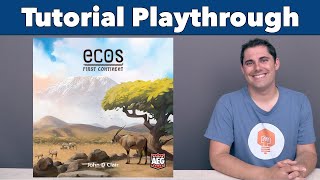
Ecos: First Continent, designed by John D. Clair and published by AEG, asks two to six players to remake the planet from the beginning. Reviewers describe it as a game about a shared landscape that keeps changing, played with a simultaneous rhythm that keeps every seat involved. Watch It Played frames the premise as starting over as a force of nature, shaping the earth, growing the animal kingdom, and sometimes destroying parts of your own creation. Going Analog called it a really fun game with all sorts of crazy stuff happening on the table. Meeple University said the game carries the signature style of its designer, with a push-your-luck edge, a random element, and little downtime between turns.
Core Mechanics That Define Ecos: First Continent
Tile Placement
Tile placement is the physical core of Ecos: First Continent. Each round the Harbinger draws element tokens from a bag, and the revealed symbol decides what every player can do. Getting Games walked through a full playthrough to show that a matching symbol lets a player cover a spot on a tableau card with an energy cube, while a player without a match rotates a dial instead. New land and water tiles must touch at least one existing tile, and placement arrows then put mountains, trees, and animals onto specific terrain. Watch It Played stressed the spatial rules, noting that trees cannot go on water, deserts need a mountain before they can hold a tree, and each animal has its own habitat. The Discriminating Gamer described the appeal as creating a continent, one land tile, mountain, tree, and creature at a time.
Bingo
The second defining mechanic is a bingo-style matching system. Each revealed element is a symbol that players try to fill on their tableau cards, and a completed card resolves its effects from top to bottom. The Discriminating Gamer called this a bingo mechanic in which scoring depends on how the board is configured, and later described the whole design as a riff on bingo. Meeple University also leaned into the comparison, choosing a bingo password for its giveaway because the game felt like bingo to them. When more than one player completes a card in the same round, each resolves their effects in clockwise order from the Harbinger. Watch It Played explained that calling out "Eco" pauses the game for those resolutions, so a single draw can finish one player's card while others are still chasing different symbols.
The Ecos: First Continent Experience
Interactive and Dynamic
Simultaneous play defines how the game feels at the table. Pair of Dice Paradise summarized the structure: each round, one player reveals an element token, and all players can complete a card from their tableau at once. Getting Games made the same point from the play side, noting that even a drawn tile that does not suit your tableau still leaves you something to do, such as gaining an energy cube, playing a card, or rotating your dial. The Discriminating Gamer stressed the social side of this design: there is always something everybody is doing, and players stop to settle effects while the others keep moving. Turns therefore feel less like a queue and more like a shared rhythm.
Chaotic
The tension in Ecos comes from the bag. Getting Games showed that the Wild token ends the round, and because a round can last one tile pull or dozens of pulls, the timing of the end is never fully in a player's hands. Meeple University described the design as having a push-your-luck quality mixed with a random element, and its hosts reacted openly to streaks in which the same symbol kept coming up and their plans stalled. Players respond by pivoting, playing cards that let them place elements from their hands, or trading a cube for a flexible option. The unpredictability is part of the game's charm, and the reviewers talk about that uncertainty with enthusiasm rather than frustration.
What Makes Ecos: First Continent Stand Out
A Continent That Is Never the Same Twice
Reviewers repeatedly return to the way the board changes from session to session. The Discriminating Gamer contrasted two sessions, noting that one had more animals, another had more forest, and a third had no water at all, which made each game feel like a different one. Watch It Played explained that the starting landscape is assembled from the map tiles, and that the rules offer alternative starting configurations for players who want variety. Because the land tiles show grass on one side and desert on the other, the same stack can produce very different terrain. Going Analog pointed to the way the animals and terrain interact on the growing map as the source of much of the fun.
Real-World Landscapes From the Expansion
The expansion adds a layer that Meeple University found especially appealing. Its landscape cards recreate real African geography, with a three-mountain triangle standing in for Kilimanjaro, a long grassland for the Serengeti, a small island surrounded by water for Madagascar, and a three-tile river for the Nile. Players can play these cards out of hand once the matching pattern appears on the board, which gives them an ongoing effect and a new target to chase. Meeple University also noted that the expansion adds a large number of new cards and animals that are shuffled into the existing decks, so the variety grows with the box. Reviewers who played with the expansion described it as making the continent feel more purposeful.
Potential Drawbacks
Variance That Can Feel Uneven
The same randomness that creates tension can also frustrate players. Meeple University's hosts spent parts of their session without the symbols they needed, reporting long stretches in which a row of suns or grasslands kept them from completing a card. Because the Wild token is rare and ends the round when it appears, a player who has drawn poorly for several turns may have little chance to recover before the round closes. Getting Games noted the range in round length as a central feature, but for players who value control, the swings can feel unfair.
Dense Rules and Bookkeeping
Ecos asks players to track many small details. Watch It Played's walkthrough had to define community, habitat, and landmass before the game's effects made sense, and it covered red placement arrows and red-banner cards that can change or destroy the landscape. Cards also have limited uses tracked by leaves, and a card with one leaf is discarded after its final activation. Meeple University used loose dice as counters because the game does not include them, and its hosts noted that flipping cards to track uses made the text hard to read on camera. Experienced players will find the bookkeeping manageable, but newcomers should expect a learning curve.
If You Enjoy Ecos: First Continent
Meeple University identified John D. Clair as the designer of Cubitas and Mystic Vale, and the hosts saw the same design sensibility in Ecos. Fans of that style will recognize the blend of simple turns, card-driven engines, and a table that changes as the game progresses. Pair of Dice Paradise recommended Ragusa, a Capstone Games title in which houses act as workers that trigger three spots at once and build an engine that reactivates when other players build. The same channel highlighted Aqua Mirabilis from Gotha Games, an area control game in which a perfumer turns flowers into essences and completes recipes for the court. Players who enjoy the tile placement and simultaneous decisions in Ecos should find each of these worth exploring.
What Reviewers Are Saying
"In this game you're starting over, and I mean really starting over, as a force of nature. You'll shape the earth, create oceans, mountains and deserts, you'll grow the animal kingdom, and you may even destroy some of your creation along the way."
— Watch It Played
"It's a really fun game, and so there's little animals that you put in the different terrain, and they could eat other animals. You've got all sorts of crazy stuff happening."
— Going Analog
"It grows. It's a wonderful game to see the board, as I say, evolve, to see it grow and change over time. It's never the same, you know, play area twice."
— The Discriminating Gamer