/pic2837103.png)





















Elysium Deep Dive
What the Community Thinks About Elysium
Elysium has quietly earned a devoted following among board gamers who appreciate its deceptively elegant design. Channels like Getting Games, Watch It Played, and The Broken Meeple consistently highlight the game's ingenious tension system and the rewards that come from mastering its card-drafting puzzle. The Greek mythology theme provides rich flavor without overwhelming the strategic core, creating a uniquely balanced experience that appeals to both thematic enthusiasts and pure mechanical thinkers.
Core Mechanics That Define Elysium
Constrained Drafting Through Pillar Management
At the heart of Elysium lies a brilliant constraint. Players begin each epoch with colored pillars representing draft currency. To acquire a card, a player must possess the specific pillar colors shown on that card. The twist comes after acquisition: instead of spending the matching pillar, players choose any pillar to discard. This forces agonizing decisions about which colors to eliminate, gradually limiting future options as the round progresses. Early picks feel open, but by the final turn, the remaining pillars heavily constrain what cards are available. Designed by Brett Gilbert and Matthew Dunstan and published by Space Cowboys, this system gives the game its signature squeeze.
The Domain-Elysium Split and Engine Disruption
Cards acquired go into a player's domain, where they provide powers and abilities. However, scoring only occurs when cards transfer to that player's Elysium. This creates a core tension: powerful cards generate excellent effects in the domain, but their powers vanish once moved down to the Elysium for points. Players must constantly balance exploiting card abilities against banking them for victory points, forcing incremental transfers throughout the game rather than one decisive engine break.
The Elysium Experience
Turn Angst and Meaningful Scarcity
Elysium excels at generating satisfying player engagement through resource limitation. With a small set of pillars and no ability to refresh them mid-turn, every decision ripples outward. Pillar elimination prevents subsequent players from accessing certain cards, creating a subtle form of meaningful indirect interaction. Players spend their turns evaluating not just what they need, but what they can afford to deny opponents, generating the kind of thoughtful decision-making that rewards careful sequencing and planning.
Beautiful Production and Mythological Asymmetry
The game comes with several god families, but each game uses only a subset, creating asymmetrical card pools that change the strategic landscape. Different gods reward different strategies, and players must adapt their domain-building approach based on which gods are in play. Combined with stunning artwork that brings Greek mythology to life, Elysium creates a tableau that looks increasingly impressive as players layer cards and build their legendary sets throughout each epoch.
What Makes Elysium Stand Out
Set Collection With Real Consequences
While set collection appears simple, gathering matching god families or aligned card levels, Elysium transforms this familiar mechanic through the transfer cost system. Moving a card to the Elysium costs gold based on its level, so transferring expensive high-level cards demands significant wealth. This creates a three-way tension between drafting, engine building, and economy management, preventing the game from feeling like a pure luck-based card flip.
Legends and Bonus Cascades
Elysium rewards completion through bonus tiles that cascade as players finish different legend types. The first player to complete a family legend claims the highest-value token; the next takes a smaller one. Level-based bonuses work differently, with tokens passing between players as someone builds a larger set. These cascading incentives create meaningful decision points about whether to pursue completion early or wait for a larger payoff, adding a meta-game layer above the base mechanics.
Potential Drawbacks
Analysis Paralysis and Player Downtime
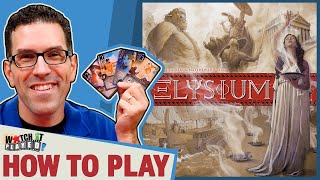
The decision space in Elysium is genuinely deep. Pillar elimination choices have long-term consequences, and evaluating future availability requires forward planning. At the table, this can cause extended turns and notable downtime for other players. New players especially benefit from watching a tutorial before learning the game, as the pillar mechanic and set-building paths need cognitive lock-in before the game flows smoothly.
Variability and Expansion Hunger
With only a subset of god families in play per game, replayability comes primarily from their asymmetric combinations. While the full roster provides mathematical variety, players who log dozens of plays may eventually feel the core challenge has been mastered. The limited stream of additional content means players seeking fresh twists must either house-rule variants or pursue other games, making this less suitable for groups seeking unlimited long-term hooks.
If You Enjoy Elysium
Players drawn to Elysium often gravitate toward 7 Wonders, which shares the satisfying tension of card drafting toward set-based scoring at a faster pace. Ticket to Ride offers similar satisfying set completion with more accessibility and less economic tension. For those craving deeper engine construction, Res Arcana provides comparable decision weight through its play-and-power mechanism, trading Elysium's mythological tableau for a tight magical economy. Finally, Dominion and other deck builders deliver that satisfying engine-building sensation, though they lack Elysium's brilliant constraint on card acquisition.
What Reviewers Are Saying
"The heart of this game is essentially drafting cards into a little engine and then knowing when to destroy that engine. And that's something that I always like, but it's got a couple of interesting quirks on that."
— Getting Games
"It's so tense whether people could take your card from you, such turn angst, and the puzzle of trying to sort out which pillar do I want to get rid of, I don't know, it's a mind bender."
— The Broken Meeple
"I watched a video about eight times and it was Watch It Played, Rodney Smith's channel, which is absolutely unbelievable. If it wasn't for these guys, I wouldn't be able to play board games like Elysium at all."
— Board With Steve