/pic3762134.jpg)



















Empires of the Void II Deep Dive
What the Community Thinks About Empires of the Void II
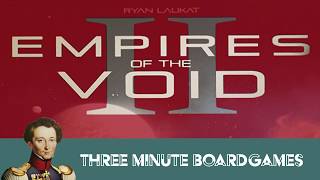
Board game reviewers consistently praise Empires of the Void II as one of the finest space exploration games available. The game stands out in a crowded genre by delivering the sweeping scope of a 4X experience without requiring the eight-hour time commitment of its heavier competitors. What resonates most with players is how the game captures the feeling of discovering and interacting with a living, breathing galaxy where every decision branches into unexpected consequences.
Core Mechanics That Define Empires of the Void II
Dynamic Event Cards and Alien Encounters
The game's signature mechanic involves event cards tied to specific planets. Rather than simply applying static effects, these events create ongoing situations within the galaxy. When players reach a planet, they can battle its native aliens for control, or invest in diplomacy to gain those aliens as allies for future combat. This choice between conquest and alliance fundamentally shapes each player's strategy and opens multiple paths to victory. Event cards range from economic booms to space monsters to planetary self-destruct mechanisms, all shuffled into the deck. This unpredictability makes every game feel different while keeping designer Ryan Laukat's galaxy feeling alive and reactive.
Multi-Layered Resource and Building System
Players manage core resources including credits, command points, and goods. The game features a tight menu of actions: move and attack, research and build, card actions and diplomacy, recruit units, and scavenge. Each action unlocks different advancement paths. Researching technologies and constructing buildings (cities, bases, and academies) not only generates victory points but also increases resource production, creating an engine-building element. The research action lets players either invest goods into technology tracks or fill building tracks, with each path offering unique long-term benefits. This flexibility means two players pursuing identical victory-point totals can employ completely different mechanical approaches, making the game feel fresh across multiple plays.
The Empires of the Void II Experience
Exploring a Galaxy Full of Stories
Empires of the Void II excels at generating narrative moments through its gameplay rather than scripted events. Delivery missions create natural story arcs as players carry cargo across the galaxy, triggering dynamically based on movement choices. Random event cards introduce plot twists that feel consequential: discovering a satellite that reveals all players' hands, or summoning a creature that will destroy a planet unless someone intervenes. These events are not pokes from the designer; they are organic encounters that encourage player interaction. The result is that players naturally tell stories during the game, discussing why they befriended one race while conquering another, or how they narrowly escaped a doomed world. This narrative emergence makes the space exploration fantasy feel tangible and personal.
Beautiful Presentation and Accessibility
The game's visual presentation is immediately striking. The board and components showcase stunning artwork from Ryan Laukat, with a color palette and aesthetic that draws players into the sci-fi setting. Despite its depth, the game remains accessible. Turns flow quickly thanks to the action selection system: one player chooses an action and takes it, then all other players immediately take the same action in turn order. This minimizes downtime even with four or five players. Setup involves explaining a handful of action types rather than complex interlocking systems, and the rulebook, while occasionally needing clarification on specific interactions, provides solid reference support.
What Makes Empires of the Void II Stand Out
Capturing 4X Scope Without the Time Burden
The game achieves what few designers have managed: delivering a genuine 4X experience (explore, expand, exploit, exterminate) in roughly two to three hours. Players spread across planets, discover alien species, develop technologies, and engage in meaningful conflict, all without the glacial pacing of heavier space games. This balance makes it rare among space-themed titles. While games like Twilight Imperium or Eclipse offer deeper mechanical complexity, they demand far more time. Empires of the Void II proves that an epic theme and strategic decision-making can coexist with a reasonable game length, making it a preferred choice for those seeking serious space exploration without sacrificing an entire evening.
Asymmetric Alien Factions and Variable Paths
Each alien planet offers distinct encounter mechanics and ally units. Befriending different races creates unique alliance combinations that influence combat, movement, and special abilities. The technologies players can research, the building types, and the varying mission cards all support multiple viable strategies. One player might rush toward military dominance while another invests in diplomatic influence and technological advancement. A third might focus on completing delivery missions for steady point generation. This mechanical asymmetry ensures that players competing for the same space are pursuing fundamentally different approaches to victory, reducing the feeling of repetition even when the same planets appear in consecutive games.
Potential Drawbacks
Learning Curve and Rulebook Clarity
The rulebook, while comprehensive, occasionally lacks clarity on specific interactions, particularly regarding event card timing and the exact sequence of multi-part actions. New players sometimes misunderstand the delivery mechanic or the interaction between influence and conquest. The initial teach takes around twenty minutes, and the game's flow assumes players are comfortable with moderately complex turn structures. Some gaming groups may find the rule density off-putting compared to lighter space games. These friction points diminish after a play or two, suggesting they represent a one-time investment rather than an ongoing issue.
Limited Solo Support and Variable Player-Count Balance
The game lacks a robust official solo mode, limiting options for players who primarily game alone. While it can be adapted for single-player by controlling multiple factions, this requires extra cognitive overhead. Additionally, the game's balance and length scale differently depending on player count. At two players, the galaxy feels spacious and individual choices more impactful. At five players, board scarcity increases tension but can feel chaotic. Some players note that certain building strategies or racial alliances appear stronger than others in specific configurations, though this observation reflects the game's high player agency rather than poor design.
If You Enjoy Empires of the Void II
If the space exploration theme and branching decision-making resonated with you, consider Above and Below or Near and Far, other Ryan Laukat designs that emphasize narrative emergence through thematic encounters and character-driven storytelling, though in more intimate settings rather than cosmic scope. For players seeking additional 4X depth, Twilight Imperium delivers uncompromising scope, though it expects a significantly longer commitment. Those drawn to the alliance and conquest mechanics might explore Eclipse, which offers deep ship customization and tech trees. Robinson Crusoe provides similar event-driven tension and consequence-tracking, substituting survival challenges for space exploration. For a cooperative alternative with comparable sci-fi atmosphere, ISS Vanguard captures the genre's spirit while shifting the focus from competition to teamwork.
What Reviewers Are Saying
"The single best thing about this game is the event cards. Each one is tailored to a planet and they have colorful and important impacts on the game. The most memorable event for me was one that involved the doom of an entire world."
— Watch Review
"It just creates more of a galaxy full of life. The world is alive and therefore I'm going to get immersed in it. This is definitely one of my favorite space games to date and I love it."
— The Broken Meeple
"The event cards in Empires of the Void II don't poke you with a stick directly. What they do is create some sort of event that is going on in the universe based on that planet. The culture of that planet, the activities of that planet, it makes every game feel just a little bit different and it feels like there's a progression to the setting."
— The Secret Cabal Gaming Podcast