/pic6515523.png)





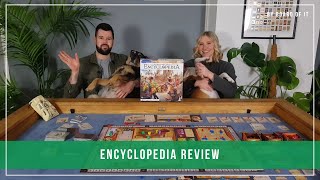








Encyclopedia Deep Dive
What the Community Thinks About Encyclopedia
Encyclopedia stands as a standout achievement in 2022's board game landscape, earning consistent praise from the gaming community. Reviewers consistently highlight the game as hitting a sweet spot of accessibility paired with surprising strategic depth. The game has earned five-out-of-five ratings from established critics and remains a fixture in their collections years after release, still regularly reaching the table. What makes Encyclopedia resonate is how it invites players into a thematic experience while rewarding both newcomers and seasoned gamers. The game's design strikes a careful balance, making it easy to learn but genuinely rewarding to master.
Core Mechanics That Define Encyclopedia
Dice Placement and Worker Allocation
Encyclopedia uses a dice placement system that feels deceptively strategic despite its accessible surface. Players draw four dice, roll them, and place them on their player board across four available slots. The genius lies in the tension between placement and reward: higher-value dice typically yield more benefits when other players take them, but those same dice might be what you need for your own actions. The mechanic works so smoothly that it almost feels effortless, yet every placement carries weight and consequence. Reviewers praise how the dice system manages to be both elegant and tactically rich, creating a steady flow of meaningful choices without overwhelming players.
Expedition and Publication Actions
The heart of Encyclopedia lives in the expedition and publication sequences. After collecting animal cards by matching die colors to specific creatures, players then lead expeditions to continents and research their animals across five major categories: continent, class (mammal, bird, reptile), diet, habitat, and climate. These research phases translate into cubes placed on the publication board. The publication action becomes the critical engine of the game, where players strategically publish researched categories to score points. What makes this brilliant is the compound nature of the scoring: the more cubes grouped in the same publication category, the more points they generate. This creates a cascade of decisions throughout the game as players balance short-term gains against building toward powerful end-game scoring combinations. Reviewers consistently note that while these actions require more planning than the simpler tasks available, they remain intuitive once understood, and the payoff for mastery is genuinely satisfying.
The Encyclopedia Experience
Accessible Yet Rewarding Mastery
Encyclopedia delivers a breezy gameplay experience that welcomes new players while offering genuine strategic satisfaction for repeated plays. The rules themselves are straightforward enough that players can start enjoying the game almost immediately from the box. Reviewers note that you can explain Encyclopedia quickly and players understand the broad strokes right away. However, the actual mastery of the game takes time. There is a meaningful gap between knowing what you are supposed to do and truly understanding how to do it well. This quality makes Encyclopedia a game that improves dramatically with experience, rewarding players who bring it to the table repeatedly. It becomes one of those games where players don't feel like they are rereading rules each time they play; they can simply pull it out and engage immediately while still discovering new strategic depths.
Nature and Wildlife Immersion
The game wraps its mechanics in a genuinely thematic package centered on natural history. Players are not simply moving abstract resources; they are conducting expeditions to discover animals, building knowledge of their characteristics, and publishing findings in an encyclopedia. The art reinforces this constantly, with illustrations evoking the sketched naturalist drawings of historical naturalists' journals. The aesthetic of the cards, board, and components creates a cohesive sense of place and purpose. Reviewers highlight how the theme connects meaningfully with the mechanics, making players feel like they are genuinely advancing scientific knowledge rather than optimizing point systems.
What Makes Encyclopedia Stand Out
Compound Scoring Through Matching
The publication system creates a scoring engine based on matching and grouping that stands apart from typical worker placement games. Rather than simple point-per-action economics, Encyclopedia rewards players who build coherent collections. The need to match characteristics across multiple animal cards and then publish them together creates emergent strategic puzzles. Players must balance grabbing the specific animals they need against remaining flexible as the card market shifts. This creates natural tension and replayability since each game's available animal cards spawn entirely different optimal strategies.
Premium Component Presentation
The production quality reinforces the game's appeal. The artwork features evocative illustrations in a sketched naturalist style that immediately captures attention and draws in players who value visual presentation. Reviewers note the art quality and component quality as significant strengths that enhance the experience every time the game hits the table. The board organization, the clarity of iconography, and the physical appeal of manipulating dice and cubes all contribute to a tactile, sensory experience that feels premium without being excessive.
Potential Drawbacks
Board Size and Table Space
The main board might run slightly large for compact tables. Reviewers note that while the board is not prohibitively oversized, it does consume meaningful table real estate. This is a minor consideration for most groups but worth noting for players working with limited space or in cafe-style settings where table dimensions are fixed.
Time Investment for Strategic Mastery
While Encyclopedia plays quickly in terms of clock time, the learning curve for strategic mastery can create uneven experiences early. New players may find the first play somewhat confusing despite the straightforward rule explanations, particularly around the interacting mechanics of the expedition and publication actions. The game plays best when players have internalized how the different actions interact and how to chain them together effectively. This means early games may feel slower or less satisfying than games five or ten plays in, which some groups may perceive as friction.
If You Enjoy Encyclopedia
Players who appreciate Encyclopedia tend to love medium-weight euros with strong thematic integration. If Encyclopedia resonates with you, explore other dice placement games with elegant design, particularly those that use randomness as a tool for interesting decisions rather than pure luck. Games that reward building coherent collections and compound scoring strategies will also appeal strongly. Additionally, games with naturalist or historical themes wrapped around solid mechanical foundations often attract Encyclopedia fans.
What Reviewers Are Saying
"The game is a dice worker placement game to take actions but you are also trying to gather animal cards to then research them and place that information into the encyclopedia but you get more points for having cubes all of the same spot meaning more of the same characteristic between animals."
— Meeple Mountain
"The use of the dice which just works out so smoothly but also deceptively strategic you place your four random dice on specific locations to gain certain extra bonuses if another player takes them you have a good variety of dice to choose from."
— Meeple Mountain
"The artwork is absolutely stunning, the like sketched kind of artwork is gorgeous there are like animals and different things that are very like sketched artwork, it is absolutely amazing and the artwork is just chef's kiss."
— The Board Game Garden