/pic1615561.jpg)

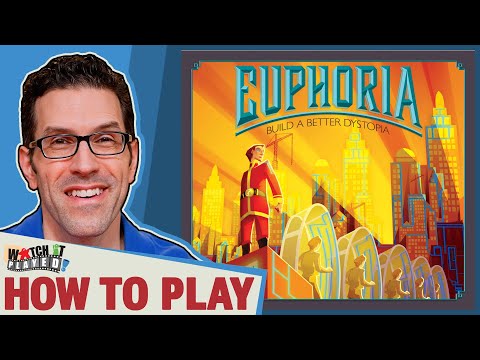





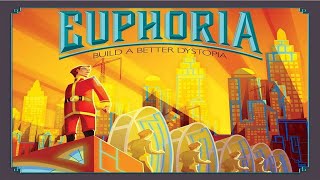




















Euphoria: Build a Better Dystopia Deep Dive
What the Community Thinks About Euphoria: Build a Better Dystopia
Euphoria occupies an interesting place in the board game landscape. Reviewers recognize it as a thoughtfully designed worker placement game with strong thematic integration, though reception has evolved. Watch it Played calls it a classic, while Allies or Enemies notes that after its 2013 release, players found something compelling but raw. The game gained genuine traction once the Ignorance is Bliss expansion refined its mechanics and improved two-player viability. Today, reviewers celebrate Euphoria as a hidden gem, particularly for players who appreciate worker placement mechanics married to cohesive dystopian theming.
Core Mechanics That Define Euphoria: Build a Better Dystopia
Worker Placement with Dice and Bumping
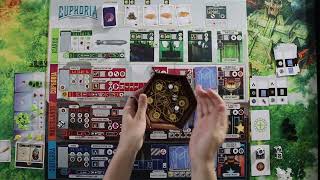
At its heart, Euphoria uses colored dice as workers, each showing a knowledge value via its face. Players place individual workers onto action spaces to gain resources or take actions. What makes this mechanical choice distinctive is the bumping system: when you place a worker on an occupied temporary action space, the current occupant gets bumped back to their owner, who immediately rolls and checks for knowledge overflow. Allies or Enemies describes this as a mechanic where worker bumping creates interesting decisions, sometimes helping and sometimes hindering rival factions through momentum shifts. The mechanic forces constant attention to board state since blocking an opponent one turn might free up their workers for a future play.
Knowledge and Morale as Living Resources
The game's thematic brilliance emerges through the knowledge and morale tracks. Your workers' intelligence directly threatens your control: if collective worker knowledge ever reaches 16 or higher, workers realize their dystopian reality and desert. As Board to Death TV observes, you want workers to remain happy (high morale) but not too smart (low knowledge). This creates constant tension. Meeple University emphasizes that keeping morale high and intelligence down is the paradox of the game, reflecting the dystopian narrative itself. Placing a worker in a commodity area where the accumulated knowledge gets high forces strategic decisions about whether the benefit justifies the knowledge penalty. The more you recruit and develop workers, the more carefully you must manage their awareness, preventing them from becoming liabilities.
The Euphoria: Build a Better Dystopia Experience
Foreboding Narrative Through Mechanics
Euphoria weaves its dystopian setting directly into gameplay rather than simply dressing mechanics in theme. Couple of Board Gamers describes players as middle management who discovered their utopia was actually a dystopia, now planning resistance. The worker escape mechanic embodies this: intelligent workers recognize the system and flee. Stonemaier's artwork adds to this atmosphere with futurist, Orwellian aesthetics. Allies or Enemies notes the dark humor threaded through construction site names like the Agency of Progressive Backstabbing and Storage of Insufficient Capacity, creating a tone that sits between serious dystopian narrative and playful satire.
Engine Building with Interactive Momentum
As players advance their faction allegiances and construct markets, the board develops increasingly powerful action spaces. Watch it Played describes the market construction mechanism as unlocking new actions and placing authority stars on completed markets, creating the satisfying progression of building infrastructure. Stonemaier's expansion addressed this to reduce overly punishing market penalties and increase engagement. The allegiance tracks unlock tier-based bonuses: better commodity yields, tunnel improvements, recruit activation, and star placement opportunities on recruits themselves. Couple of Board Gamers found the game created cycles of interesting decisions, where players would repeatedly visit certain action spaces once allegiance bonuses activated, generating a sense of momentum and engine strength emerging over the mid-to-late game.
What Makes Euphoria: Build a Better Dystopia Stand Out
Recruit Cards Drive Asymmetry and Player Identity
Each player draws recruits representing faction-aligned workers with special abilities. Watch it Played and Meeple University explain that recruits come in face-up and face-down states; face-down recruits can be flipped when allegiance tracks reach certain tiers or tunnels are mined to completion. This creates persistent asymmetry: your faction focus shapes your available bonuses. Couple of Board Gamers' playthrough shows recruits providing meaningful abilities, such as discounting costs or unlocking new action combinations. Recruits give each player a distinct path toward victory, reducing the feel of everyone playing the same puzzle.
Modular Market Variety and Meaningful Penalties
Six markets appear each game via shuffled construction tiles, and each market carries a unique penalty for players who don't participate in its construction. Meeple University stresses that these penalties persist throughout the game unless you earn an authority star on that market. Some penalties force knowledge gains when placing stars; others mandate resource loss on dice rolls. Board to Death TV highlights that the game's replayability stems from these variable penalties, as different market combinations demand different strategic responses. The Essential Edition reduced punishing market penalties, making them accessible obstacles rather than overwhelming threats.
Potential Drawbacks
Complexity and Player Interaction Overhead
Board to Death TV notes that Euphoria is long and strategic, requiring setup that only pays off with players who understand the rules. The sheer number of decision points means that inattention to what others are pursuing can accidentally hand victory to an opponent. The game demands active engagement and board awareness. Couple of Board Gamers found some player groups loved the game while others disliked it intensely, suggesting a polarizing experience depending on group composition and engagement style. Teaching the allegiance tracks, recruit mechanics, and market penalties requires patient explanation.
Dice Variance and Base Game Accessibility
Allies or Enemies observes that while dice rolling is infrequent and lower numbers are often preferable, the game still includes some dice involved in outcomes. More significantly, Allies or Enemies emphasizes that the base game alone struggles with two players and benefits dramatically from the Ignorance is Bliss expansion, which tweaks rules, replaces problematic markets, and includes AI for solo and two-player modes. The newer Essential Edition improved this, but the base experience at lower player counts can feel imbalanced. Watch it Played also notes die quality variance in production, with some dice showing inconsistent angles despite these imperfections having minimal measurable impact.
If You Enjoy Euphoria: Build a Better Dystopia
Players who gravitate toward Euphoria often appreciate Viticulture (same designer, engine-building focus), Eclipse (faction-driven asymmetry and decision depth), and Scythe (thematic dystopian setting with modular faction asymmetry). Tattoo shares the dice-placement and strategic depth. The game appeals to those who enjoy crunchy worker placement where theme reinforces mechanics rather than ornaments them, who value multiple paths to victory through faction focus, and who appreciate games that reward careful resource and knowledge management over pure efficiency optimization.
What Reviewers Are Saying
"You want your workers to have high morale so be happy, but not be too smart because then they'll realize they're working within a dystopia and they'll probably want to escape and get out of there."
— Couple of Board Gamers
"The expansion is a must. Without the expansion this is a fairly okay game for three to six players that can mostly work with two in a pinch, but with the expansion it is a particularly good game that works great at any player count."
— Allies or Enemies
"This is a real hidden gem. The mechanics including the worker bumping, the punishing markets and the way the commodity areas work to sometimes help and sometimes hinder rival factions all make for interesting decisions and the dark theme connects well to the gameplay elements."
— Allies or Enemies