/pic8317636.png)


























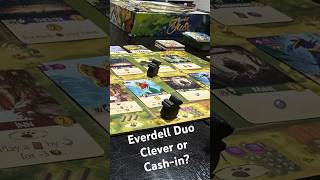


Everdell Duo Deep Dive
What the Community Thinks About Everdell Duo
Everdell Duo has arrived as a bold reimagining of the beloved Everdell, stripping away the multiplayer worker placement system in favor of a focused two-player experience. Reviewers consistently highlight how the game captures what makes Everdell special while introducing mechanics that create direct player interaction and meaningful tension. The consensus is that this is a deliberate design choice that delivers on its promise of a shorter, punchier woodland city-building game that respects the original's charm.
Core Mechanics That Define Everdell Duo
Sun and Moon Token Meadow Drafting
The defining innovation in Everdell Duo is the sun and moon token system that tracks along the meadow. When you place a worker, the sun token advances one space. When you play a card from your hand or from the meadow (if it's adjacent to a token), the moon token advances. Each token can only move six spaces per season, creating a hard stop on available actions. This elegant mechanism transforms the feel of the game from the original's open worker placement into a race against limited turns. The tokens determine which cards you can access from the meadow, adding a layer of strategic gate-keeping that neither player fully controls. As you plan your moves, you must consider not just what you want to do, but whether you can afford the opportunity cost of forcing the round to end.
Occupancy Token Resource Binding
The card combo system in Everdell Duo feels richer and more urgent than the base game. Players seek out cards that activate other cards, creating cascading point generation. Instead of automatic combo rewards based on color pairs, you now collect occupancy tokens that can be spent to play critter cards for free by placing them on matching colors in your city. This shift from automatic bonuses to earned resource management adds a puzzle-like quality to card placement. Reviewers note that the frequency of these activation opportunities drives constant searching for the next powerful combo, adding urgency throughout the game that drives toward the finish faster than traditional Everdell.
The Everdell Duo Experience
Confrontational Two-Player Drama
What makes Everdell Duo shine is its direct competitive energy. Players can intentionally advance tokens to block opponents from taking certain actions, turning the meadow into a contested resource. If you really want to deny your opponent a crucial play, you can rush the sun token forward with an all-purpose action, forcing the round to end while they have fewer moves remaining. This creates opportunities for brutal tactical plays that would be impossible in the original game. The competitive mode delivers moments where you can directly punish your opponent's plans, transforming Everdell from a parallel solitaire experience into head-to-head warfare. The stakes feel tangible because your choices immediately restrict what your opponent can accomplish.
Frantic Card Play and Timing Puzzles
Despite being designed for two players, Everdell Duo maintains the cozy woodland theme while injecting genuine tension into every turn. Games play in 30 to 40 minutes, making the entire experience feel compact and urgent. The racing aspect creates natural pacing problems where downtime is minimal. Each turn becomes a calculation: do I take a strong move now, or do I play a weaker action to preserve my opponent's options while protecting key cards for later? The cooperative mode adds another layer by introducing mission scenarios where players team up against dummy player obstacles, creating shared puzzle-solving alongside shared risk.
What Makes Everdell Duo Stand Out
Streamlined Critter Construction System
Everdell Duo simplifies the original's color-matching bonus system while making bonuses feel more earned. Rather than automatically gaining discounts when you play matching colors together, you must collect occupancy tokens first, then strategically deploy them. This creates micro-decisions throughout the game and prevents runaway leaders from snowballing early advantages. The removed third and fourth seasons from the base game don't create a sense of incompleteness; instead, the four-season structure with alternating first player positions creates a tight, balanced experience where momentum can swing back and forth like a woodland tug-of-war.
Perfect Two-Player Scaling of Worker Placement
Each player gets only three workers per season, creating natural resource scarcity that forces difficult choices. The original Everdell's worker placement translates beautifully into this tighter framework because fewer workers means each placement carries more weight. You cannot afford to waste a turn on a mediocre action, and you cannot ignore board development just to disrupt your opponent. The balance between offense, defense, and engine building feels calibrated specifically for two players, making this feel less like a conversion and more like a game that was always meant to be played this way.
Potential Drawbacks
Minimal Production Variety and Component Freshness
Some reviewers note that Everdell Duo reuses significant assets from the base game without introducing flashy new components or expanded production value. The art assets remain the same, the resources are identical, and there are no custom organizers or special inclusions. The small box format feels economical rather than premium. While the mechanical innovations are sound, the physical presentation lacks the tactile satisfaction that helped the original Everdell become beloved. For collectors expecting a visually distinct entry into the Everdell world, the reliance on familiar components may feel sparse.
Lazy Mechanical Adoption Without Bold Innovation
A vocal segment of reviewers critique the design as hanging in the shadow of something better. While the sun and moon token system is clever, some argue that it does not sufficiently distinguish Everdell Duo from feeling like a streamlined variant rather than a bold reimagining. The core card pool remains largely unchanged, and the fundamental gameplay loop of gathering resources and playing cards survives intact. For players who already own Everdell and played it primarily with two players, the difference may not feel substantial enough to justify a separate purchase. The mechanical uplift, while genuine, is more incremental than transformative.
If You Enjoy Everdell Duo
Players drawn to Everdell Duo likely appreciate tight two-player games with meaningful card synergies and elegant timer mechanics. You may also enjoy games like Hadrian's Wall and Far Away, which similarly deliver compact competitive experiences with resource gathering and card play. The cooperative scenarios suggest fans of light worker placement mechanics would find satisfaction in solo or co-op play as well. Games that balance direct player opposition with personal puzzle-solving, such as Wondrous Creatures and other Starling Games titles, will feel familiar in tone and design philosophy.
What Reviewers Are Saying
"The real thing to watch out for here is that there are you get 12 in the competitive mode, you get six actions each per season and when you place a worker you advance the sun marker across the track and when you play a card you advance the moon marker and once both of them have moved six spaces the round is over but when one of them has moved six spaces you can't take that type of action anymore."
— Meeple University
"What makes Everdell Duo stand out is its direct competitive energy. Players can intentionally advance tokens to block opponents from taking certain actions, turning the meadow into a contested resource."
— The Cardboard Herald
"I'm a sucker for a game which does a really good job of taking a quality game and making it a little bit more tacky, a little bit more aggressive in a two-player mode and Everdell Duo hits that really well."
— Meeple University