










Everdell Farshore Deep Dive
What the Community Thinks About Everdell Farshore
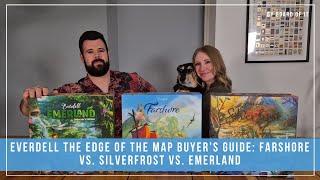
Reviewers broadly agree that Everdell Farshore is a standalone game set in the seaside land of Farshore, built on the same foundation as the original Everdell. The disagreement is over how much that shared foundation matters. 3 Minute Board Games sees Farshore as a clear step forward, describing it as a tighter, more interesting game that plays like a second edition of the original. Board Game Buzzz comes to the opposite conclusion, arguing that for anyone who already owns Everdell the new game offers little beyond a new coat of paint. The Cardboard Herald lands between those views, praising the refinements while agreeing that the changes are not large enough to feel like a brand new game for existing owners.
Most reviewers see Farshore as the stronger entry point for newcomers. The Cardboard Herald recommends it as the place to start for anyone without Everdell experience, and 3 Minute Board Games argues that new players should skip the original and go straight to Farshore. Experienced Everdell fans are more divided, with some treating Farshore as an optional purchase rather than a necessity.
Core Mechanics That Define Everdell Farshore
Worker Placement
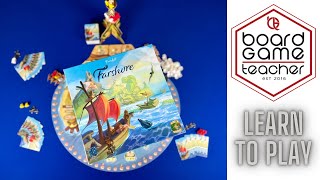
Worker placement is the engine that drives every turn in Everdell Farshore. Players begin with two workers and gain more as the seasons advance, reaching five by the end of the game. Reviewers consistently describe the spaces as the source of most of the tension. Getting Games walks through the rules and points out that a single-foot space blocks every other player, including the owner, until the season changes, while spaces with multiple feet accept any number of workers. The Docks, for example, let a player discard up to three cards for resources, and the Lookout lets a player discard cards and redraw up to the hand limit of eight. Because the spaces are limited, the action a player chooses is also a decision about which action to deny opponents.
Farshore's placement system also includes a few twists that reviewers single out. Islands along the bottom of the board are more rewarding but disappear as high tide sinks them later in the game, which forces players to decide early which spaces to rely on. Worker placement in Everdell Farshore is less a puzzle of finding an open space and more a question of timing and denial, since a space taken by one player can cost the others a key action for the rest of the season.
Tableau Building
Tableau building is the other side of the game. Each card played goes into a personal city, which can hold up to 15 cards, and the arrangement of that city determines what a player can do later. Production cards reactivate at the start of Spring and Autumn, governance cards change the rules in a player's favor, and destination cards add new worker spaces that only their owner can use. Getting Games highlights how a single destination can ripple through a city by reactivating several production cards at once.
The anchor tokens are the feature reviewers talk about most when describing how the tableau works. Each player gets three anchors, and each one can be placed on a construction to let the player add a matching critter for free. Board Game Buzzz was initially skeptical of the idea, since matching critters to buildings is a favorite puzzle in the original, but came away convinced that the anchors help players build an engine earlier in the game. The result is a tableau that grows with more flexibility than its predecessor while still rewarding planning.
The Everdell Farshore Experience
Nautical Atmosphere
The nautical theme is what most reviewers remember after a session. The board is built around a ship track that circles the outside of the map, and the cards, critters, and resources all lean into the sea. Our Family Plays Games featured a reviewer who said the theme gave them a strong sense of home, and their enthusiasm centered on the components, from the sea glass style tokens to the seaweed and lobster pieces. Board Game Buzzz offers a more mixed view, observing that many of the critters on the cards are the same squirrels, birds, and hedgehogs found in the original, and wishing the artists had leaned harder into ocean life. Even so, the reviewers who enjoy the theme describe the experience as pleasantly seaside, with boats, islands, and tides shaping the rhythm of each season.
Gateway Accessibility
Farshore is widely described as more approachable than the original. The Cardboard Herald credits the designers with smoothing out the rough edges that players complained about in Everdell, and with making the game welcoming to newcomers. Board Game Buzzz agrees that the abundance of resources and the many ways to gain them make the game easier to enter, although it argues that the trade-off is a looser, less puzzle-like economy. Reviewers tend to describe the difficulty as moderate: the rules are simple enough for a new player to grasp, but the choices still reward careful planning once the engine starts running.
What Makes Everdell Farshore Stand Out
The Windrose Ship Track
The ship track is the feature reviewers praise most often. Each season two Windrose tokens set conditions for moving a boat along the outside of the board, and playing a card that matches a condition advances the ship and can earn points and treasure. Getting Games explains that treasure tokens picked up along the track can serve as wild resources or be kept for two points each at the end of the game. Board Game Buzzz calls the track an insane source of points, noting that reaching the end can be worth 60 points alone, and says it adds a second puzzle on top of the tableau, since a player must weigh which card to play against where the ship will travel.
Quality of Life Refinements
Reviewers also single out the small changes that make the game feel tidier. Duplicate cards in the bay are stacked on top of one another, so the display always holds eight different types of cards and a card a player wants is less likely to vanish entirely. Board Game Buzzz names this stacking as one of its favorite mechanisms. 3 Minute Board Games argues that the anchors are a substantial improvement over the original matching rule and that the game as a whole feels sleek. The Cardboard Herald calls the game a strong contender for anyone who does not already own Everdell, while noting that the duplicate stacking could be added back into the original through house rules.
Potential Drawbacks
Overlap With the Original Everdell
The most common criticism is that Farshore is too close to Everdell for owners of the original to need it. Board Game Buzzz describes the game as a simple re-skin that makes you do basically the same thing as before, and concludes that experienced players do not need to add it to their shelf. The Cardboard Herald agrees that the improvements are real but not large enough to feel like a new game. 3 Minute Board Games notes that a player who went all in on Everdell could find the new game frustrating, because the core gameplay experience is vastly improved and the older system is no longer the reference point. The consensus is that the decision depends on how much a player already invested in the original line.
Loose Economy, Components, and Rulebook
A second group of concerns focuses on the game's rough spots. Board Game Buzzz finds that Farshore offers too many resources, with the eight ocean and land spaces and the treasure tokens combining to make the economy feel given rather than earned. The same review also points to the Lighthouse component, which is hard to set up and often knocked over, and to the small boards that hold the critters and make some of them hard to see from the other side of the table. 3 Minute Board Games adds that a comparatively simple game has a confusing rulebook, so new players may need a patient guide through the first few turns.
If You Enjoy Everdell Farshore
Players who enjoy Everdell Farshore's tableau and worker placement systems will find the original Everdell the most natural companion, since it shares the same card engine and resource economy. Players who want the most content should look at the original, since Farshore has no expansions of its own. A buyers guide by Tally and Farrell describes Farshore's relationship to the original as similar to that of Dune Uprising and Dune Imperium, a rebalanced take on the same core system that serves as a cleaner starting point. Players who want the same welcoming cute-critter feel with a different theme should look at Critter Kitchen, which 3 Minute Board Games recommends as a different take on the same appeal.
What Reviewers Are Saying
"Straight up Farshore is a tighter better balanced and more interesting game than the original Everdell. It really feels like a second edition where so many loose ends have been tidied up."
— 3 Minute Board Games
"I'm gonna be brutally honest here. I don't think you do. I don't think that this game is giving you anything else that Everdell doesn't already give you."
— Board Game Buzzz
"What really won me over, mostly following my trip back home, was the nautical theme of this game. First of all, the artwork is just beautiful."
— Melanie, Our Family Plays Games