/pic4956399.jpg)
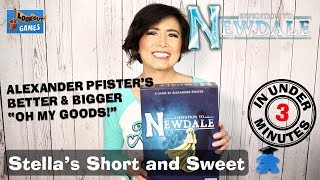
Expedition to Newdale is the new Oh My Goods! (2015) card game from renowned designer Alexander Pfister. In this board game adaption of the successful card game, 1 to 4 players from 12 and up compete in different chapters to experience the world of the Longsdale kingdom once again. The story of Expedition to Newdale starts about five years after the events from Oh my Goods! Escape to Canyon Brook, but you don’t need to know the prequels at all. Each chapter of the game lasts about 90 minutes which adds up to around 12 hours of exciting campaign gameplay. And when you found your favorite chapter while playing the campaign, you can always come back and play it again to have even more fun!
At the beginning of the game you have your personal board, a coal mine as your start building and 5 hand cards. Depending on which chapter you are playing, the appropriate game board sits in the middle of the table. Each round is divided into 5 phases which are played in order (or partially parallel, once you become more familiar with the game). In phase 1, a new event is revealed which usually alters the course of play in this round slightly (e. g., by introducing new buildings). Additionally the event card shows a fixed amount of workers which are available this round. An information which is much appreciated, as you have to place your action markers in phase 2. The latter are numbered 1 — 4 which is important for phase 4 and means that you need to plan ahead. But first phase 3: in this phase, more workers are drawn from a bag and get added to the others. This means that productions which would have been impossible before (because workers were missing) are now easily done. Pushing your luck might be beneficial! Phase 4 is the opposite to phase 2. Instead of placing your workers, you resolve their chosen action in order of their numbers. We hope you had a backup plan in place if your desired workers were not drawn in phase 3, because this can trigger an unpleasant chain of events! Not enough workers could mean that a production does not happen, which then means that you might not have enough money to build the building with your second action marker. Oh, and your third marker was planned to directly produce in the newly built building? Well, where there is no building, there’s no place to produce in, right? Clearly: planning ahead, a little luck and good alternatives are the way to success. In Phase 5, all players can either use a free building action or draw new hand cards. The last phase is used to resolve all buildings which do not need workers, e. g., an automatic coal production or a building which offers the conversion of a certain good to victory points. Afterwards the next round starts, of which you play a total of seven. A final scoring at the end of round seven will then show if you win or lose.


- Efficient production chains
- Goods as currency
- Tight gameplay
- Campaign-like structure
- Tarrant has not played it yet
- Exploration
- Universe of Oh My Goods
- Campaign-like, repeatable
- Oh My Goods
Mechanics (from transcript analysis)
- Engine Building — Focuses on building efficient production chains.
- legacy — Features campaign-like elements with evolving gameplay.
- Push Your Luck — At the start, players can produce if they drew certain tiles from the bag, affecting everyone.
- Resource Management — Uses goods as currency.
Video topics + discussion points
Quotes (from this video)
- it's fairly thematic I think so you work together you try to get like their different scenarios and different boxes top boxes that you can open like once you finish this next move the next one
- I really like that game like we play that true in a row and that's usually pretty rare for games that lets play two in a row
- I would put it as the best crunchy heavy type game of the year
- one of my favorite mechanics is a little bit like Concordia where your action is car driven so that's makes the game the whole games more streamlined
- I really like how how much market speculation and manipulation oh yeah you can make that whole game almost if you want to
- I always get suspected that's the thing I always get suspect because I'll draw this like scribble that actually silhouettes something that's oblique ley related to it and that's how I like to plan I'm always in trouble for it
- the tricky bit is that each people personality has got different things that they do for example the Jack pushes what to me pulls away or something like that
- that's why I preferred this than that one is because this is cooperative
References (from this video)

- Features a branching story campaign across eight chapters.
- Includes multiple unique player boards.
- Uses familiar iconography from Oh My Goods.
- Comes with a drawstring bag and stickers.
- The game boards have a distinctive and potentially humorous aesthetic.
- The story elements are sparse, relying heavily on player imagination.
- Some board elements (banners) are blank, adding to confusion.
- The artwork, especially for people, is considered mediocre by some.
- The rulebook is described as 'challenging' and potentially 'verbose'.
- Thematic board game version of Oh My Goods.
- Oh My Goods Universe
- Campaign with branching story elements.
- Oh My Goods
- Above and Below
- Near and Far
- Cartographers
- Maracaibo
Mechanics (from transcript analysis)
- board game — Translates the Oh My Goods card game experience into a board game format.
- Campaign — Consists of eight chapters with branching story paths.
- Card-based gameplay — Utilizes cards similar in format and icons to Oh My Goods.
Video topics + discussion points
Quotes (from this video)
- Possibly the worst board game I've ever made.
- It's famous for being horribly hauntingly bad.
- The issue with this one is that he has a section on the board this little TP section where you go and you trade with as the book says Indians.
- It's a complete thematic reskin of Mombasa.
- Little maple cowboys with interchangeable hats.
- Blackout Hong Kong is algebra first semester and then Great Western Trail is the second half of the semester.
- You bid on the tiles you want instead of randomly drawing.
- This is an expansion that narrates a story over five chapters.
- The cards look straight out of other game with extras.
- It sounds like The Purge.
References (from this video)
- Features cool monster illustrations.
- Includes stickers.
- Has a drawstring baggie.
- The game is described as having a 'light touch with the story'.
- The board art is confusing with blank banners and 'exploded heads'.
- The story elements on the cards are sparse.
- The rulebook might be challenging to learn.
- The artwork for people is not a strong point.
- Monsters
- Story-driven campaign
- Carnival of Monsters
- Oh My Goods
- Maracaibo
Mechanics (from transcript analysis)
- Campaign play — An advanced level game in eight chapters with branching stories.
- Card Drafting — Features decks of cards that appear similar to Oh My Goods.
- Resource Management — Involves processing goods into more complex objects.
- Tile Placement — The game involves placing tiles, though the specific mechanic is not detailed.
Video topics + discussion points
Quotes (from this video)
- Possibly the worst board game I've ever made.
- It's famous for being horribly hauntingly bad.
- The issue with this one is that he has a section on the board this little TP section where you go and you trade with as the book says Indians.
- It's a complete thematic reskin of Mombasa.
- Little maple cowboys with interchangeable hats.
- Blackout Hong Kong is algebra first semester and then Great Western Trail is the second half of the semester.
- You bid on the tiles you want instead of randomly drawing.
- This is an expansion that narrates a story over five chapters.
- The cards look straight out of other game with extras.
- It sounds like The Purge.
References (from this video)
Mechanics (from transcript analysis)
- tableau-building linkage — Referenced as having a mechanic related to tableau-building cards.
Video topics + discussion points
Quotes (from this video)
- This is probably the most complex game that I've mentioned so far because I'm omniamer.
- It's just planning ahead and trying to see what other people are doing as well and then pivot your strategy is very tactical.
- Ticket to Ride is more popular because it's more gateway.
- Dixit is a really fun party game. It’s a ice breaker.
References (from this video)
Mechanics (from transcript analysis)
Video topics + discussion points
Quotes (from this video)
- I really like how the game makes me feel producing resources building buildings
- the unique thing is the chaining of the resources
- familiarity from the previous game on the same universe all my goods which has the similar feeling to expedition to noodle
References (from this video)
- Feel of producing resources and building is satisfying
- Chaining of resources provides more reliable production
- Chapters with backstory and different roles add variety
- Familiar universe creates a sense of familiarity
- diplomacy and building
- heart of diplomacy
- chapters with backstory and slightly different roles
Mechanics (from transcript analysis)
- building cards / tableau building — Drawing building cards and building buildings to gain resources or bonuses.
- building production and upgrading — Buildings produce resources and can be upgraded to increase production.
- End Game Bonuses — Endgame objectives awarding points and potentially differing per player.
- endgame scoring / objectives — Endgame objectives awarding points and potentially differing per player.
- Hand Management — Hand management is listed as a mechanic in the discussion.
- push your life — A push-your-life element where certain number of workers are drawn each turn and affect all players.
- Push Your Luck — A push-your-life element where certain number of workers are drawn each turn and affect all players.
- Resource Management — Resource management is listed as a mechanic.
- Worker Placement — Starting with assigning workers in a non-competitive space to perform actions.
Video topics + discussion points
Quotes (from this video)
- I really like how the game makes me feel producing resources building buildings
- the unique thing is the chaining of the resources
- familiarity from the previous game on the same universe all my goods which has the similar feeling to expedition to noodle
References (from this video)
- Streamlines and expands on the Oh My Goods/ Royal Goods concept into a full board game
- Scenario variety and evolving maps add depth
- Hidden goals and regional bonuses create multiple viable paths to scoring
- Can be daunting to new players; requires familiarity to dive in smoothly
- Occasionally overshadowed by other games at conventions
- production chain / factory activation
- Oh My Goods
- Royal Goods
- Maracaibo
- Marco Polo - Maracaibo
- The Magnificent
Mechanics (from transcript analysis)
- Activate factories using workers and cards — Choose which factories to activate each round, using neutral workers and front-of-hand cards.
- Card-row purchases and map-based bonuses — Discard cards to buy new buildings; a map with regions provides bonuses and points.
- Hand management with activation costs — Each card dictates how it can be activated and what is needed to do so; some cards discard to activate others.
- Resource and money economy — Brown cubes track resources; money is spent to activate/build cards.
- Resource Management — Brown cubes track resources; money is spent to activate/build cards.
- Scenario / Mission / Campaign Game — There are multiple scenarios with different event cards and maps, enabling emergent storytelling.
- Scenario-based progression — There are multiple scenarios with different event cards and maps, enabling emergent storytelling.
- Worker Placement — Choose which factories to activate each round, using neutral workers and front-of-hand cards.
Video topics + discussion points
Quotes (from this video)
- it's the slowest azul' game by far
- I liked New Dale quite a bit
- I think there were some cool streamlining things that happened overall by having the amount of stuff that you have to make stuff be less streaky
- this is a deck-building style game
- I might have a chance to try it again at some point in the future
- I don't think I'm super excited to keep playing
References (from this video)
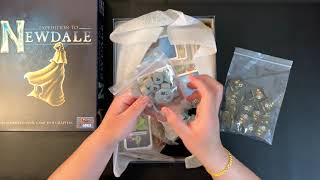
- High-quality components (wooden pieces, well-segregated components)
- Well-packed and organized shipping with protective foam
- Separation by player colors (four colors) and clear color choice
- Solo mode with labeled solo deck and prep for play
- Card edges described as white-edged, which can look dirty over time
- Some card/card-pile distinctions are not immediately clear from the packaging
- Array
- New Dale (fictional)
- Choose-your-own-adventure style
Mechanics (from transcript analysis)
Video topics + discussion points
Quotes (from this video)
- Expedition to New Dale
- this is expedition to new dale uh this might be a long game to make a video out of
- I traded Newton for this one so I definitely wanted to give this a try
- I love when there's wooden components
- shout out to phil for packing this so nicely for me to show this in such a organized fashion
- this game looks like it's got that aspect to it
References (from this video)
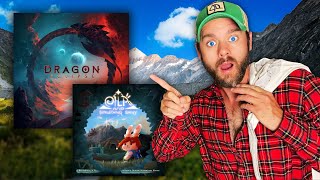
- presents a campaign within a classic euro frame
- includes exploration as a core mechanic beyond pure resource management
- some players may seek heavier narrative than euro-lite
- requires linear progression through chapters
- classic euro campaign with exploration and resource management
- migration/expansion arc across boards
- structured campaign with eight chapters
- Oh My Goods (as a predecessor to Newale's setting)
Mechanics (from transcript analysis)
- multi-board campaign progression — eight double-sided boards guiding chapters
- resource gathering and tableau building — standard euro engine with hand management and exploration
- scenario-based chapters in order — complete each chapter to unlock the next
Video topics + discussion points
Quotes (from this video)
- it's basically like Star Trek Voyager in a way where you are on a spaceship.
- Don't treat this as a wandering exploration go, you know, like if you're playing an RPG video game where you might roam around to level up.
- Stay on mission. Stay on task.
- Adorable.
- I absolutely adore it for that.
- Dragon Eclipse. This is the darling of the bunch. This is currently my favorite campaign game.
References (from this video)
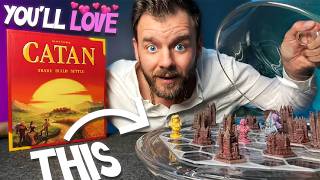
- campaign-driven with a strong euro flavor
- deep production and chaining systems
- interesting progression through chapters
- solo play is not as complete as multiplayer
- rules can be dense for new players
- economic engine, production chains, exploration
- expansion into new lands with campaigns and layered economies
- campaign/story-driven with scenario-based goals
- Catan
- Carcassonne
- Castles of Burgundy
Mechanics (from transcript analysis)
- production_chains — chain together resources and goods to create efficiencies and bonuses
- scenarios_and_campaigns — play through chapter-based missions with escalating difficulty and objectives
- tile_and_collection_system — draw and place tiles to build and upgrade your empire
- Worker Placement — place workers to activate actions across the board and on a chateau-like board
- worker_placement — place workers to activate actions across the board and on a chateau-like board
Video topics + discussion points
Quotes (from this video)
- tagline says it all what do we got here collect and trade resources to build up the island of Katan it's all you do
- you can trade with another player it can be even uneven doesn't matter or you can trade with the bank at quite a loss or you can trade with a port if you've got a settlement on a port for a better deal
- the goal of the game is to have the most points you gain points by having the most built City
References (from this video)

- art direction may not be to everyone's taste, but it is strong for him
- tutorial helps learn and scale
- family of Pfister games feel accessible with a nice learning curve
- some may find the theme distant
- box/content may be heavy for casual players
- economic engine building with multiple boards
- new world exploration and building
- historical/settlement-focused
- Lost Ruins of Arnak
Mechanics (from transcript analysis)
- learn_and_play_tutorial — Structured guidance to ease entry and scaling.
- multi_board_engines — Eight different boards provide varied resource tracks.
- Player Board | Main Board — Eight different boards provide varied resource tracks.
- progression_tracks — Tracks replace earlier versions and drive score/timing.
- Resource Management — Gather and convert goods to advance goals.
- resource_management — Gather and convert goods to advance goals.
- Tutorial — Structured guidance to ease entry and scaling.
Video topics + discussion points
Quotes (from this video)
- it's not a gateway game but if you're already like midcore or something like that it's phenomenal
- this is easily one of my top three games of the year
- art is important to me and this is not it
- it's a really fun game especially solo mode, setup is not onerous
- I'm going to put a survey in the chat and if you're watching this later it will be in the description for the viewers choice award
References (from this video)

- thematic exploration feels thematic
- fits into the heavy-game focus
- not deeply described in the clip
- resource gathering and exploration with a campaign vibe
- settlement exploration in a new land
- n/a
Mechanics (from transcript analysis)
- exploration and resource allocation — players explore new areas and allocate resources to build up their settlement
Video topics + discussion points
Quotes (from this video)
- representation is really really important you know like this is speaking from experience growing up as a people of color
- we are curious to know what your experience was like with spiel digital and online conventions
- calico, i really enjoyed learning and playing calico
- we would like to know what your thoughts are on Patreon and what you would like to see
- this month you'll probably see beyond the sun and at least on two Fridays we're going to be live streaming
References (from this video)
- thematic exploration feel
- compact footprint
- less widely known, potential learning curve
- exploratory logistics and resource management
- exploration and frontier expedition
- adventure-driven
Mechanics (from transcript analysis)
- tile/route exploration — expeditions expand through tiles and route choices.
Video topics + discussion points
Quotes (from this video)
- i don't like blue haven
- you can play that game like for a long time because there's so much content in it
- it's a really quick filler that maybe i mean we'll let me showcase one day
- we are starting the alexander fister series
- i think it's a great game
- tequeno obelisk of the sun
- it's a dice selection game that's drafting dice drafting
- we currently do not have a patreon we probably won't open one
- please go ahead and do so if you would like to do a more private intro feel free to email us
- thank you so much for following along and supporting our channel