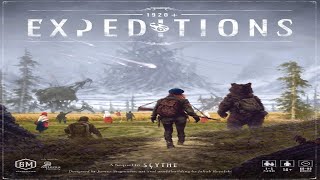
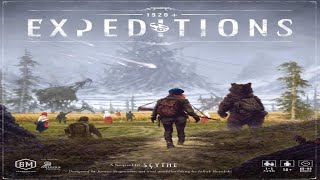
The sequel to Scythe sends players on a new adventure into Siberia, where a massive meteorite crashed near the Tunguska River, awakening ancient corruption. An expedition led by Dr. Tarkovsky ventures into the taiga to learn about the meteorite and its impact on the land. Itching for adventure, heroes from the war privately fund their own expeditions to Siberia, hoping to find artifacts, overcome challenges, and ultimately achieve glory. Expeditions has completely different mechanisms than Scythe, though the goal was to capture some of the same feelings that Scythe evokes, with a slightly darker, more supernatural theme.
Expeditions is a competitive, card-driven, engine-building game of exploration. Play cards to gain power, guile, and unique worker abilities; move your mech to mysterious locations and gain cards found among the tiles; use workers, items, meteorites, and quests to enhance your mech; and use power and guile to vanquish corruption.
—description from the publisher
- Tapestry
Mechanics (from transcript analysis)
Video topics + discussion points
Quotes (from this video)
References (from this video)
Mechanics (from transcript analysis)
Video topics + discussion points
Quotes (from this video)
- but that sounded really cool
- Expeditions definitely is making progress and sounds like it's on gonna be on the way hopefully this summer
- what's a game that makes you smile or makes your family smile or your friends smile
- my non-stowmeyer game that always brings us joy in my family and makes us smile has to be dice thrown
- the expansion dies Throne Adventures
References (from this video)
- Massive expeditions playmat with gorgeous art
- New Expeditions content this year
- Expeditions
Mechanics (from transcript analysis)
Video topics + discussion points
Quotes (from this video)
- my favorite Ston Meer game is vulture
- I absolutely love the metal lra
- Wingspan Vision friendly cards these are for all the expansions released so far
- rolling Realms I love rolling Realms
References (from this video)
Mechanics (from transcript analysis)
Video topics + discussion points
Quotes (from this video)
References (from this video)
- Interesting, focused engine-building with card play
- Solo mode with basic AI (Ottoa) adds replayability
- Varied card deck provides multiple paths
- Some rule interactions can be confusing without a proper guide
- Solo mode lacks direct player interaction
- Scythe
Mechanics (from transcript analysis)
- Action limitation β On a turn you can perform two of three actions: play a card, gather on the current tile, or move, with a refresh granting access to all three on the next turn.
- engine building β A large deck of unique cards fuels engines; discarding vs playing triggers different card abilities.
- engine-building with card interactions β A large deck of unique cards fuels engines; discarding vs playing triggers different card abilities.
- tableau building β Your hand sits to the left of your board and your tableau sits to the right; played or discarded cards both move to the right; you refresh to the left to regroup.
Video topics + discussion points
Quotes (from this video)
- two players, not enough time
- steal someone's donkey
- bang for your buck
- eight maps in the base box
- you can draw from the deck. Each card has its own way of like yes, you can use it as an item, but it's also one of the endgame conditions
References (from this video)
- takes the world of Scythe and makes it more approachable
- faster pacing relative to Scythe
- strong thematic integration and exploration flavor
- long play at higher player counts
- requires balancing multiple victory conditions to climb the ladder
- exploration and development with multiple victory paths
- World of Scythe universe with exploration and expansion
- strategic, multi-objective progression
- Scythe
Mechanics (from transcript analysis)
- engine building β players develop their economies and capabilities across a shared world
- engine-building β players develop their economies and capabilities across a shared world
- exploration β map exploration and uncovering new opportunities as play progresses
- multi-condition victory β victory is achieved by meeting several different, balanced conditions
Video topics + discussion points
Quotes (from this video)
- this is my number one game of all time right now.
- And the art is beautiful. The world building is so interesting.
- Expeditions, however, from what I've heard, is one that you only want to play at lower player counts cuz it gets long.
- the tableau isn't set in stone. It's constantly moving.
- We love a co-op.
References (from this video)
- Beautiful, asymmetrical miniatures and distinct mech designs
- Deep, engine-building potential with rich combo interactions
- Strong exploration feel with a modular, evolving board
- Tight pacing and meaningful space-blocking interaction
- Clear theme integration; not a direct clone of Scythe
- Steep initial learning curve and some feel-it-in-time-cumbersomeness
- Large footprint and pronounced table-hug factor requiring ample space
- Iconography can be dense; some rule details live in the rulebook rather than on cards
- Not identical to Scythe; fan expectations may differ depending on the desired feel
- Exploration, resource management, and corruption vanquishing within a mechanically dense, post-science-fantasy setting.
- A sprawling hex-based exploration world with mechs, corruption tokens, guardians, and a central base camp that dictates win conditions.
- Story-driven exploration with asymmetrical character abilities and animal companions guiding progress.
- Scythe
- Lost Ruins of Arnak
Mechanics (from transcript analysis)
- Asymmetric meeples and abilities β Each mech and companion animal has unique abilities affecting movement, vanquishing corruption, and storage.
- Card-driven action selection β Actions are enhanced by playing cards; players refresh to perform move, play, and gather actions, unlocking ongoing combos.
- Deck building β Not a pure deck-builder; card acquisition and play shape a personal engine tied to the board and actions.
- End-game engine and scoring tension β Players aim to place stars on their base and advance abilities, racing to achieve four stars before others.
- Integrated deck-building progression β Not a pure deck-builder; card acquisition and play shape a personal engine tied to the board and actions.
- Modular board β Players reveal tiles, encounter guardians, and uncover resources as mechs move across a large board.
- Modular hex map exploration β Players reveal tiles, encounter guardians, and uncover resources as mechs move across a large board.
- Resource/Power economy and corruption vanquishing β Power and GU energy are spent to vanquish corruption on tiles, driving progression and ability use.
- Space blocking and non-violent competition β No direct combat; players interact primarily through blocking spaces and racing to explore first.
- Table presence and card-tuck mechanics β Cards are tucked under the mech boards using raised tabs to manage the hand and actions without clutter.
- Worker tokens as resources β Colored workers function both as workforce and a resource pool used to pay costs and activate abilities.
Video topics + discussion points
Quotes (from this video)
- Expeditions is the spiritual sequel to Scythe.
- it's a race to explore the most as quickly as possible before anyone else can.
- it's a solid game.
- go in with the mind of Expeditions this isn't Scythe.
- this is Expeditions.
References (from this video)
- Engaging card-driven engine-building that scales with player count
- Strong replayability driven by companions, mechs, and a large card pool with varied powers
- Beautiful, thematic artwork and components that evoke the world well
- Solid solo mode with approachable yet competitive AI bots
- Pacing that shifts noticeably from the first half to the second half of the game
- Two-player sessions are quick and tight, offering a fast, satisfying experience
- Tone and weight are lighter than some players may expect from Scythe-era titles, which can disappoint heavier-game fans
- Tile real estate on the board is substantial; some players may feel space-heavy components dominate the table
- Four-player games can feel longer and slightly more chaotic, potentially reducing pacing benefits for some groups
- Interaction is more about space competition and card acquisition than direct combat, which may disappoint players seeking heavy interaction
- Deck-driven exploration where players assemble and manipulate a personal engine while racing to complete Glory-based objectives.
- A modular board exploration experience set on a distant world with a focus on uncovering locations, managing resources, and racing to fulfill goals.
- Procedural, mechanically driven exploration with a light thematic overlay rather than a strong, scripted narrative.
- Scythe
- Rise of Fenris
Mechanics (from transcript analysis)
- Boasting / Glory tokens and goals β Glory tokens are earned by meeting goals and can trigger an additional endgame phase when players reach the required thresholds, creating a national race to finish.
- Card-driven resource generation and worker placement on cards β Cards provide the primary actions, including gaining coins, workers, or triggering power-based effects; workers placed on cards enable additional bonuses and synergies.
- Companion and mech variety β Different character companions and mechs introduce stable variety in each game, affecting starting powers, secondary actions, and movement possibilities.
- Deck management / hand optimization β Players start with a small hand and progressively add cards to their deck; many cards are tucked under the player's mat to gain power or points, creating a dynamic tension between short-term actions and long-term engine shaping.
- end game bonuses β The game ends after a player places their fourth Glory token; then all players finalize scoring for coins, corruption, items, and Glory tokens.
- Endgame timing / four-Glory trigger β The game ends after a player places their fourth Glory token; then all players finalize scoring for coins, corruption, items, and Glory tokens.
- Location exploration and map token collection β Moving around the board reveals spaces, flips tiles, and earns map tokens that are needed for certain goals and to unlock later abilities.
- Melding / tucking under mat β Meteorite, quest, and item cards can be tucked under the mat to grant coins, powers, or points, forming a core endgame trigger and engine-tuning layer.
- Solo mode with ATOMA bots β A modular solo system using bots to simulate opponents, with multiple difficulty levels and scalable timing that preserves the race feel.
- Solving / quest stacking β Quest cards tucked under the mat increase victory points, creating a targeted path to score while balancing immediate actions.
- Three-action engine with forced refresh β On most turns, a player moves their cube to cover one of three main actions, then performs the other two actions; a refresh action redraws all cards and prepares the next turn, enabling a rapid tempo and shifting options.
- Upgrading / tucking under mat β Tucking items under the mat grants ongoing powers and point potential, influencing long-term planning and power pacing.
- Vanquishing corruption β A mechanism that removes corruption tokens to open up more powerful actions and progression paths, contributing to endgame acceleration.
Video topics + discussion points
Quotes (from this video)
- this is a sequel to sithe but it is quite a bit different
- it's a race for exploration
- this is a much much lighter gaming
- the art in particular I think the art inspired the original game
- the components... they knock it out of the park
- the art across the board is stunning
- two players it's super fast and we play a whole game in 40 45 minutes
- it's a midweight card game
- being able to explore and see a lot of that map as you play is very satisfying
References (from this video)
- Strong integration of deck-building with worker placement
- Accessible solo play through automa mechanics
- Clear end-game path via boasting and quests
- Cooperative-leaning mechanics where helping others aids you
- Upgrading items and melding meteorites adds strategy
- Large physical footprint and bulky components; tiles could be smaller
- Learning curve for new players and first-time play
- Overhead camera can make details hard to see in recordings
- Cooperative-leaning exploration with competition via glory tokens and AI objectives
- Modular map exploration with base camp, map tokens, corruption tokens, and automa AI
- Rule-driven, with player narration and strategic decision-making
Mechanics (from transcript analysis)
- Automa AI deck β An AI decision deck and glory card drive automa actions, progress, and tile effects.
- Boast actions and glory tokens β Placing glory tokens on base camp via boast actions; drives end-game scoring.
- end game bonuses β Score via glory tokens, map/corruption tokens, and upgraded items; mastery of quests increases value.
- End-game scoring and upgrades β Score via glory tokens, map/corruption tokens, and upgraded items; mastery of quests increases value.
- Quests and solvability β Solving quests grants rewards; some require discarding or spending resources.
- Tile-based exploration and map tokens β Map tokens reveal objectives and locations; tiles spawn corruption tokens.
- Tile/Map Shifting β Map tokens reveal objectives and locations; tiles spawn corruption tokens.
- Vanquish and corruption management β Spend guile/power to remove corruption and unlock item upgrades.
- worker placement β Gaining green/blue workers to activate abilities and perform tasks.
Video topics + discussion points
Quotes (from this video)
- I love this game so far
- the AI was very easy to manage
- I like how there's kind of like a deck building aspect worker placement for sure
- the tiles were a little smaller so it could take up less space
- the overhead camera to show as much as I could
- I really need to make my way to a boast area
- I love this game
References (from this video)
- Beautiful art on minis and cards
- Nice insert and packaging
- Eco-friendly bags
- Five-player support with organized storage
- Solo mode support via Automa Factory
- Large box that takes up table space
- Repacking the insert cover can be fiddly
- Array
- Siberian Expedition
- journal-entry
- Scythe
Mechanics (from transcript analysis)
- automa / solo mode β Solo mode provided by Automa Factory to enable single-player play
- Card-driven actions β Companion and Atoma cards grant abilities and actions; players gain and activate these cards
- Hex-grid / modular board β Uses a hex-based map with multiple boards that can be arranged; hexes are present on the board structures
- Miniatures with color bases β Five miniatures with color-coded bases to indicate ownership and tracking; storage solutions for components
- Resource tracking & scoring tokens β Various tokens and markers used for tracking and scoring, including tracking cubes and stars
Video topics + discussion points
Quotes (from this video)
- Captain's Journal it's a Siberian Expedition over here
- the new game smell is very strong
- these bags are eco-friendly or biodegradable of some kind
- I should be able to do at least a partial playthrough or tutorial
- I think my experience with Scythe ... it was a little less than ideal for a solo gamer
References (from this video)
- family-friendly],
- educational text on cards adds flavor
- simple to teach
- may feel lightweight for some players
- educational exploration and travel
- world exploration with global routes and points of interest
- route building with shared expedition cards and text references
- Ticket to Ride
Mechanics (from transcript analysis)
- set collection β players contribute cards to expeditions that are shared and contested by all players.
- set-collection / route building β players contribute cards to expeditions that are shared and contested by all players.
- Simultaneous Actions β all players influence routes and destinations through card play.
- simultaneous interaction β all players influence routes and destinations through card play.
Video topics + discussion points
Quotes (from this video)
- it's the magic of editing
- this is the game of the month that we love the most, the most that we play
- Harmony is an easy buy, for yeah it's a good place price point and an excellent production
- Patchwork with bees, or Flower Fields, is absolutely lovely
- we love all of the reward stuff, we love all of that
- we're building together with you guys
- Different Strokes for Different Folks
- Ironwood was our November 2024 game of the month
References (from this video)
- Strong action selection with a clean, card-driven engine
- Solid base solo mode included in the core game (no expansion required to play solo)
- Clear thematic tension between exploration and corruption management
- Visually appealing components and modular map tokens that add variety
- Engaging end-game tension with four-star and boast mechanics
- Setup and ongoing component tracking can feel fiddly in a solo run
- End-game tracking and AI behavior can be nuanced and potentially confusing for new players
- Can require significant table space and organization to manage cards, tokens, and swaps
- Exploration, resource management, and tactical card-driven engine building
- Modular map exploration with a boss-like automaton AI and quest-driven objectives
- Array
- Scythe
- Tapestry
- Rolling Realms
Mechanics (from transcript analysis)
Video topics + discussion points
Quotes (from this video)
- Expeditions is a wonderful game I am so excited to play this solo.
- Expeditions is a wonderful game and I absolutely love Expeditions.
- Expeditions is very fun solo.
- Expeditions does feature multi-use cards, which I really enjoy.
- The solo mode is included in the base game.
- I prefer Expeditions over Scythe.
References (from this video)
- Adds new play options for fans
- Keeps core game balance
- Consolidation into one box increases packaging
- Mech combat and exploration
- Dueling game expansions within the Scythe universe
- Compact expansion with miniatures
- Scythe
Mechanics (from transcript analysis)
- mini-games β Adds plastic mechs and optional new components.
- Miniatures / expansion box β Adds plastic mechs and optional new components.
Video topics + discussion points
Quotes (from this video)
- This is not my house. This is a vacation property here.
- We're here on a little mini retreat to all work together in the same place for a few days.
- I am in Phoenix, Arizona with all seven of my co-workers.
References (from this video)
- engaging, asymmetric map exploration
- varied player actions and strategic depth
- replayability with different goal sets
- not as widely owned; sometimes hard to obtain accessories
- learnability can be steep for new players
- exploration and quest completion
- mechs exploring a hex map with goal-oriented play
- goal-driven progression with action selection
- Scythe
Mechanics (from transcript analysis)
- goal_based_scoring β complete end goals to gain victory points
- hand_to_board_card_mechanics β cards in hand can be played/placed via worker/mech actions
- hex_map_exploration β discover hex locations that unlock actions and rewards
Video topics + discussion points
Quotes (from this video)
- Darwin's Journey is my number one game of 2023
- Raising Robots is wonderful
- this is such a good game
- Barcelona is absolutely stunning and the chaining is satisfying
- Expeditions is not like Scythe
- the art project is absolutely fantastic
References (from this video)
- Fast, simple turns that keep the experience flowing.
- Engaging solo experience with a quick AI opponent.
- Strong card-play system with synergy and tactical depth.
- Dialable difficulty for solo play via five AI levels.
- High production values and strong artwork.
- Clear tension from a race to achieve objectives.
- Overproduced box size and production not matching a smaller footprint.
- Marketing framed as a Scythe sequel leading to misaligned expectations.
- Unbalanced mech-like powers in solo mode (some are clearly more useful).
- Less appealing for higher player counts; shines best solo or at low player counts.
- Can feel generic or overproduced relative to its streamlined gameplay.
- Meteoric corruption, exploration, resource management within a streamlined design.
- A world where meteorites fall from the sky and corrupt the land; exploration and settlement themes drive the action.
- Abstract, thematic with a sci-fi/fantasy flavor; emphasizes engine efficiency and solo play.
- Scythe
- Tapestry
Mechanics (from transcript analysis)
- AI Opponent β A streamlined AI that acts quickly, often just moving and obstructing spaces; can be dialed in with difficulty levels.
- Card-driven actions and multi-use cards β Cards have multiple uses, enabling different actions; you may tuck cards for resources or ongoing abilities.
- End-run and scoring via achievements β Players race to achieve objectives; scoring is driven by achievements and card-driven resources.
- Map and tile activation β Players activate map tiles for actions and resources, driving map-flow and spatial decisions.
- Multi-use cards β Cards have multiple uses, enabling different actions; you may tuck cards for resources or ongoing abilities.
- Simultaneous Actions β On a turn you perform two of three options: move, play a card (with possible bottom-ability), resolve it and activate a tile; sometimes all three.
- Tile/Map Shifting β Players activate map tiles for actions and resources, driving map-flow and spatial decisions.
- Turn actions β On a turn you perform two of three options: move, play a card (with possible bottom-ability), resolve it and activate a tile; sometimes all three.
- worker placement β Certain worker pieces enable bottom-of-card special abilities and interact with tile actions.
- Worker-based card activation β Certain worker pieces enable bottom-of-card special abilities and interact with tile actions.
Video topics + discussion points
Quotes (from this video)
- Expeditions is being marketed as a sequel to Scythe.
- This is a much more streamlined simple AI system.
- It's a game about meteorites falling from the sky and corrupting the land.
- I don't find it boring at all, I think it's a really interesting game, especially as a solo game.
- The turns are fast and simple.
- Overproduction in the big box doesn't match the actual scale of the game.
- The marketing and the box size create misaligned expectations.
- Some of the mech powers feel unbalanced in solo play.
References (from this video)
- Clear onboarding through live teaching while playing; the host walks through decisions in real time.
- Strong thematic cohesion with a dramatic corruption mechanic and a mission-oriented arc.
- High degree of player agency and multiple viable paths for scoring (quests, upgrades, boasting).
- Card-driven interactions provide ongoing loops of gain, spend, and refill that feel satisfying and tactile.
- The tiger companion (Changa) adds flavor, narrative weight, and practical synergies with blue workers.
- The gameβs complexity can be intimidating for new players; setup and tile bookkeeping are non-trivial.
- AI behavior can feel repetitive or punishing in late-game phases when corridors and tiles become locked behind glory thresholds.
- Reliance on randomized tile reveals and corruption draws introduces variance that can skew optimal strategies.
- Tracking the order of exhausted cards is important for effect references; misordering can lead to confusion during play.
- Exploration, resource management, and artifact-driven progression against a spreading corruption, with a sci-fi frontier aesthetic and a pet companion motif.
- Post-apocalyptic Siberia after a meteor strike unleashes a dormant corruption; players assume the roles of war heroes who privately fund expeditions to cleanse corruption, locate artifacts, and gain glory.
- First-person, tutorial-forward playthrough with step-by-step onboarding and live commentary; emphasis on emergent strategy through card-driven actions and tile exploration.
Mechanics (from transcript analysis)
- end game bonuses β Quests completed, corruption cleared, upgrades owned, map tokens gathered, and boasting actions contribute to end-game scoring and victory.
- hand management β Cards in hand may be played or moved to an exhausted area; certain abilities let cards enter hand directly, bypassing the exhaust track.
- hand management and exhaust β Cards in hand may be played or moved to an exhausted area; certain abilities let cards enter hand directly, bypassing the exhaust track.
- opponent AI (OToma/Ota and mechs) β OToma/mechs act via a deck with movement, glory thresholds, and actions like sweeping and map actions; their behavior shapes tile accessibility and pacing.
- quests and solving β Quests are a card type that provide long-term goals; solving quests yields resources, powers, and end-game scoring momentum, and some keep core values as rewards.
- Reclaim as Action β A core action that spends power and/or guile to remove corruption from a tile, unlocking new tile actions and shifting the board state.
- Resource management β GU (glory/utility), power, map tokens, and workers are tracked; tokens trigger actions, upgrades, and scoring opportunities.
- resources and tokens β GU (glory/utility), power, map tokens, and workers are tracked; tokens trigger actions, upgrades, and scoring opportunities.
- scoring and end-game conditions β Quests completed, corruption cleared, upgrades owned, map tokens gathered, and boasting actions contribute to end-game scoring and victory.
- setup and tile exploration β Tiles are randomized and arranged into southern, central, and northern zones; exploration reveals new map tiles and potential corruption on tiles.
- Upgrades and persistent abilities β Upgrading items via gather actions or other triggers grants permanent bonuses, reducing reliance on placing workers on tiles.
- Vanquish β A core action that spends power and/or guile to remove corruption from a tile, unlocking new tile actions and shifting the board state.
Video topics + discussion points
Quotes (from this video)
- Expeditions this is being built as the sequel to the mega hit side really
- gameplay-wise they don't share much in common (with the previous title)
- we're playing as war heroes who have privately funded our own Expeditions hoping to clear the corruption
- the Highlander Mech this Mech has a special ability that's going to let us gain cards directly into our hand
- Olga and her awesome tiger companion changa
- we're going to be using the Vanquish action in order to remove that corruption
- Vanquish and you can Vanquish as much as you want on the tile that you're on
- the blue Mech is sweeping, wow, sweeping a lot of cards here adjacent to these three
- we gain a blue worker here and chonga is going to let me gain one exposed benefit from an adjacent location
- Quest cards require placement and activation; solving quests yields rewards
- we end the game after gathering enough stars, claims and boasts occur, and we total up points
- upgrades provide persistent bonuses and reduce reliance on workers
- we hoard power and GU to execute Vanquish combos on the board
- the corruption tokens on tiles are a constant pressureβclearing them unlocks new options
- we rescue cards from the exhausted pile and reuse them to fuel future actions
- boasting becomes a pivotal end-game mechanism that can swing final scores
- the map tokens act as victory points at the end and steer end-game decisions
- the Sasquatch-like tiger companion is a narrative device that ties to the artifact quest line
- the synergy of items on the board creates ongoing effects that chain through turns
- this is a deliberate slow burn of engine-building and tile mastery, not a quick tactical burst
- the game rewards long-term planning through four completed quests for end-game stars
- the sense of exploration is reinforced by the process of revealing new tiles and discovering corruption patterns
- you feel the tension of marching the mechs while managing your own resource engine
- end-game scoring hinges on a mixture of quest count, corruption cleared, upgrades, and boast bonuses
References (from this video)
- evokes engine-building feel of Scythe while being distinct
- beginning of game boost may speed early progress, which some players wanted
- engine-building, optimization, with first-person art and encounters
- engine-building and exploration on tiles with mechs
- episodic exploration
- Scythe
Mechanics (from transcript analysis)
- engine building β build and optimize a personal engine to advance on the map.
- engine-building β build and optimize a personal engine to advance on the map.
- one mech per player β each player controls a single mech on the board.
- Player Board | Main Board β each player controls a single mech on the board.
- Tile-based encounters β encounters appear as tiles instead of cards.
Video topics + discussion points
Quotes (from this video)
- giving players some starting resources at the beginning of the game... we like to give players a little boost
- a tiny formatting thing that actually makes a big difference
- the back of the box content packaging decision required a separate sheet to show the component list
References (from this video)
- Strong card play and potential for interesting combos
- Beautiful art and component quality
- Meteorite-based upgrades introducing new abilities
- Solid card-driven engine-building foundation
- Lack of cohesive theme and narrative
- Repetitive, 'boring' core actions
- Unbalanced turn order dynamics and endgame timing
- Limited player interaction and heavy bookkeeping
- Balance concerns with multiple players and luck variance
- expedition and salvage of resources amid corruption
- Earth ravaged post-apocalyptic landscape with exploration routes and new locations
- procedural, minimal thematic storytelling
- Scythe
Mechanics (from transcript analysis)
- card-driven actions with worker activation β play a card to activate the card's embedded ability and possibly chain effects
- corruption tiles and hazards β explored locations can reveal corruption that imposes penalties
- engine-building on a hex map β move across hexes to collect resources, upgrade, and complete quests
- item upgrades via meteorites β upgrade items granting new abilities and expanded actions
- quest and glory system β complete objectives to earn glory points and trigger endgame
- token-based economy and endgame scoring β blight tokens and stars drive scoring and endgame timing
Video topics + discussion points
Quotes (from this video)
- this game is Just devoid of theme
- it's a walk down a dirt road in a corn field and every path you choose just feels exactly the same as the path you were on
- there are too many boring actions in this game
- the art is beautiful
- don't bother playing this with one or two players
- it's mediocre
References (from this video)
- strong card play with multi-use cards and chaining combos
- beautiful components and table presence
- midweight engine-building with clear directional flow
- metal minis option and high production quality
- distinct action-tracking mechanics like Vanquish for corruption management
- player-count scaling feels imbalanced; two players feel sparse while five players are crowded
- limited direct interaction beyond blocking spaces
- unclear long-term replayability for some players
- Resource management, exploration, corruption, and technological advancement via mechs
- Tunguska, Siberia; Frozen steppe with meteorite-induced phenomena
- Procedural engine-driven progression with evolving map and missions
- Scythe
- Storm Raiders
- BattleTech
Mechanics (from transcript analysis)
- card_management β central to engine-building; players manage, activate, and chain card powers
- corruption_and_removal β corruption tokens and the Vanquish action to remove corruption from the board
- gather β draw cards and trigger card-driven actions; gain colored workers
- Meld β meld meteorite cards under your board to gain money; triggers rewards from past melds
- Move β move a mech 1-3 spaces, reveal unrevealed tiles, and activate effects
- play β play a card from hand to the right of your board to gain effects
- Reclaim as Action β refresh action to return played cards to hand and reset action cube for next turn
- refresh β refresh action to return played cards to hand and reset action cube for next turn
- set collection β collecting card/tiles sets to place victory stars
- set_collection β collecting card/tiles sets to place victory stars
- Tile/Map Shifting β move a mech 1-3 spaces, reveal unrevealed tiles, and activate effects
- upgrade_and_mission β install upgrades and complete missions to place stars and improve your engine
Video topics + discussion points
Quotes (from this video)
- The best thing about this game is the card play I love multiuse cards and chaining combos
- Expeditions it's BattleTech for pacifists
- Expeditions is its own thing and that's a fun midweight engine building and card manipulation game
- it's a solid middle complexity game with a few moving Parts suitable to most hobby Gamers
- Scythe is one of the first big breakout Kickstarter games
References (from this video)
- engine-building/mech-driven exploration
Mechanics (from transcript analysis)
Video topics + discussion points
Quotes (from this video)
- Our crossovers are like popcorn.
- I adore Revive.
- Planet Unknown. Highly enjoy it.
- Mind Management is a hidden movement puzzle that really shines.
- Bruge is a fantastic engine-builder with a huge stack of cars and cards.
- Too Many Bones remains a powerhouse for me.
- Isla and Something Shiny is something I won't forget.
- Phantom Opera is one of the clever hidden movement implementations I know.
- Feast for Odin is one I keep coming back to.
- Northwood is a logic puzzle in solo form that I love.
- Lord of the Rings trick taking game is a clever cooperative twist.
References (from this video)
- lacks the charm of Wildlife Adventure
- not particularly good as a game
- wildlife adventure
- family game
- Wildlife Adventure
Mechanics (from transcript analysis)
Video topics + discussion points
Quotes (from this video)
- it's only a game
- you're listening to the broken meeple show a podcast that speaks passionately about board games
- I am very much a cold blooded I'm a cold blooded lizard I need cold
- the top 50 has finally finished finally it's done
- there is nothing apart from it being bright and sunny there is nothing about the summer that really gets me like you know excited or interested because it's just too hot
- I look at these top 50s uh they certainly increase a bit
- there's a lot of good feedback in terms of what's up next hard to say really
- I would give it at least a seven out of 10 right now and say it's good
- the Arkham Horror games are still pretty solid and you know they're fun to play but they are definitely getting to a point where I don't think I can uh like really say that they're practical
- my tastes were new at that point you know I respected terroriser for its thiness
- I have definitely developed to want more theme in my games
References (from this video)
Mechanics (from transcript analysis)
Video topics + discussion points
Quotes (from this video)
- Stonemaier games is 10 out of 10, would definitely recommend
- I'd much rather talk about a publisher who I really like to work with
References (from this video)
Mechanics (from transcript analysis)
Video topics + discussion points
Quotes (from this video)
- El Grande is my favorite game of all time; it is the original area control game and the cream of the crop.
- Only your best round will count in Coliseum, which is a cool twist on scoring.
- El Grande and the King, with simultaneous selection and Castillo, harmonize to create a rich gameplay experience.
References (from this video)
- Good game overall
- Enjoyable gameplay
- Expected to be as good as Scythe
- Didn't live up to hype expectations
- Mediocre compared to Scythe
- Overhyped by the designer's reputation
- Didn't meet high entertainment standards expected
- Exploration and adventure
- Expedition/Adventure
- Strategic exploration
- Scythe
Mechanics (from transcript analysis)
- worker placement β Core mechanic similar to Scythe
Video topics + discussion points
Quotes (from this video)
- in this day and age mediocre isn't enough average isn't enough it's got to be fantastic
- we have over 300 games you know they're tens of tens of thousands of games available lots lots of good games to pick it's not good enough to just be average
- it's your opinion yeah if you like it if you like it if you like the game so much you want to go online and write a big defense on it that's awesome
- if the game inspires you that much do you think it's that good that you feel the urge to do that that's amazing
- we're not trying to make a name for ourselves this shooting on games like yeah drama channel
- the coolest thing is that you can trade with other people
- this one is what I call the dragon - it's the final boss
- it's rewarding because there's so much depth it's so much fun
- if you only own one deductive game deduction game try this one
References (from this video)
- Neat design with some novel mechanics for exploration and resource satisfaction.
- Large box size noted as a potential storage/space issue.
Mechanics (from transcript analysis)
- Movement / exploration with preset tasks β Move a unit or explorer around a map to gather resources and complete conditions.
Video topics + discussion points
Quotes (from this video)
- I love the card game I designed and she made the game.
- Spring cleaning is officially up for pre-order.
- Not a whole lot of views on these things obviously because they are exclusives but that doesn't matter.
- Ten years later, I designed a game and you could go out and buy it right now.
- Is this going to be a thing I continue to do for another ten years? Time will tell.
- I could have a whole lot more views if I changed things around to target getting a lot more views, but I would have stopped this channel years ago.
References (from this video)
- Fluid and flexible action economy that supports multiple viable plans
- Beautifully sculpted Mech model and unique starting powers that feel thematic
- Rich, layered card interactions and upgrade paths that enable varied strategies
- Strong component quality and map expansion that enhance immersion
- Tension and risk are notably weaker than Scythe, leading to flatter downstream stakes
- Feels like busy work at times, with incremental optimization rather than weighty decisions
- Limited direct player interaction beyond card selection and timing, reducing conflict
- Thematic grandeur can fade as the map is fully revealed and numbers drive the endgame
- renaissance of a post-war landscape through mecha-powered exploration
- 1920s+ modernist mecca-style frontier with sprawling map exploration and renown-based scoring
- mechanics-driven, with questlines and location bonuses shaping the strategic narrative
- Scythe
Mechanics (from transcript analysis)
- action selection β three actions on your character mat that can be combined in flexible sequences, including rest turns for resets
- card pool management β cards can be played for immediate or ongoing bonuses, upgraded via other cards, or removed for permanent effects on your Mech
- map revelation β revealing locations increases power and grants new options; map density grows over the game
- quest/renown system β quests grant reputation and end-game points, tying progression to Renown thresholds
- Resource management β resources and workers are gathered, spent, upgraded, and converted through card effects and location bonuses
- rest mega-turn β a special rest turn that allows taking all three actions in any order, resetting the engine with a powerful payoff
Video topics + discussion points
Quotes (from this video)
- Expeditions is a curious concoction in that it's beautifully crafted and exceptionally smooth to steer but what you end up doing smacks a busy work
- the pool of cards instantly refills you claimed the corruption token I was going for itching you closer to the seven corruption token goal
- there's a specter of flimsiness about it
- Expeditions on the other hand is bereft of tension sure
- without tangible challenge risk or cost the constant rewards feel hollow
References (from this video)
- Strong variety from random starting Mech, starting character, and companion combos.
- Engaging action system with a smooth tempo and a reduced penalty for rest turns.
- Robust solo automa with clear pacing and adjustable difficulty.
- Deep card play with multiple synergy paths and a Tableau/Deck-building blend.
- Tight integration of card placement with board position creating meaningful choices.
- Fiddly to remember the interaction of three card types.
- May feel less heavy for players seeking a giant empire-building Euro.
- Card readability can be challenging in competitive mode due to small text on board.
- Exploration, deck-building, and tableau-driven engine building in a light-to-mid-weight Euro
- Exploration and resource gathering aboard modular expeditions with randomized tech and quests
- Strategic engine-building through card-driven actions and board-position interactions
- Union City Alliance
- Scythe
Mechanics (from transcript analysis)
- action_system β Turn starts with a refresh, revealing and then performing available actions.
- automa β Solo mode with a scalable AI that affects pacing and scoring, with multiple difficulty levels.
- board-positioned card acquisition β Card acquisition and use depend on your position on the board, creating spatial decisions.
- Deck building β Players assemble a personal deck/tableau to drive actions and scoring.
- deck-building β Players assemble a personal deck/tableau to drive actions and scoring.
- tableau building β Cards laid on the board influence actions and bonuses, creating engine synergy.
- tableau-building β Cards laid on the board influence actions and bonuses, creating engine synergy.
Video topics + discussion points
Quotes (from this video)
- I think it's going to be a really cool choice of when you want to keep cards in your hand and when you want to place them under your boards
- there's some cool stuff going on there's some nice variety
- this is a better than most euros
- check it out for light to mid-weight euros with a strong card play and card combos
- the automa... five different difficulty levels
- I don't think this game is almost anything like Scythe beside the victory Stars
References (from this video)
- Great automa system for solo play
- Immersive world with narrative aspects
- Satisfying engine building
- Good sense of discovery
- Table hog with massive components
- Large tiles take excessive space
- Adventure and quest
- Exploration and discovery
- Narrative-driven solo experience
- Scythe
Mechanics (from transcript analysis)
- Automa system β Excellent solo mode system
- engine building β Building an engine through card play
- Hex Exploration β Moving around the map revealing hexes, quests, and corruption
Video topics + discussion points
Quotes (from this video)
- Oh hello my name is Paula Deming and we are seriously talking about a serious list of serious board game rankings
- This game has no right to be as fun as it is but it is so much fun
- I would like to offer an apology right now to Lookout games
- Turn it into a gift send it to people you need to apologize
- It makes my brain buzz but in a good way
- I had the most fun playing this in 2023 out of any other gaming experience I have had all year
- The twists and rules changes that happen as you go through the chapters are so interesting
- And now it's 2024 so forget all of those now they're old
References (from this video)
- Promoted as a true return to the Scythe-esque world with fresh mechanics
- Two-player capable and compatible with the Scythe ambiance
- Balancing two-player gameplay without the full player count lessons remains to be seen
- As a standalone, expectations are high for a satisfying evolution
- car-driven engine-building in a post-scarcity frontier
- Scythe-inspired world where a meteorite draws explorers
- standalone but in the Scythe universe; epic exploration
- Scythe
- Scythe: Ascension / Scythe expansion family
Mechanics (from transcript analysis)
- area control / resource management β control territories and manage resources to gain power
- engine-building β players develop mechanisms to improve production and economy
- standalone in Scythe world β not a reskin; preserves the art style and world while offering new mechanics
Video topics + discussion points
Quotes (from this video)
- this is a flip and write game
- open world style flip and write
- I'm very intrigued by the fact that it's designed by Stephen Aramini
- standalone sequel to My City
- two-player only fully Cooperative game
- pure deduction
- it's the next in the South Tigris series
- draft your actions at the very beginning of the game
- asymmetric compared to everybody else