/pic3151415.jpg)


























First Martians: Adventures on the Red Planet Deep Dive
What the Community Thinks About First Martians: Adventures on the Red Planet
First Martians: Adventures on the Red Planet holds a complex place in the board game community. While some initially considered it an inferior follow-up to Robinson Crusoe, those who invested time in learning its systems found something genuinely rewarding beneath the surface. Channels like 3 Minute Board Games, Getting Games, and Watch It Played generate passionate discussion around its app integration, with reviewers divided on whether the companion application enhances or detracts from the tabletop experience. Most agree the game's scope is ambitious, delivering both tactical depth and narrative satisfaction to players who commit to its campaign mode.
Core Mechanics That Define First Martians: Adventures on the Red Planet
Resource Management Under Pressure
At its heart, First Martians is a game about managing critical resources in a hostile environment. Players must balance oxygen, energy, and food while simultaneously maintaining their Mars colony's systems. Every facility consumes resources, and every system can malfunction. This creates constant tension between pressing forward with mission objectives and performing essential maintenance. The game forces players to make meaningful choices about which systems to repair, which facilities to shut down when resources dwindle, and when to prioritize exploration over survival. Designed by Ignacy Trzewiczek and published by Portal Games, it wears its Robinson Crusoe lineage openly.
Custom Dice and System Complexity
First Martians employs custom dice to resolve actions and events, each with symbols representing different outcomes rather than standard numeric values. This design choice reduces the need for extensive reference charts and accelerates gameplay once players learn the visual language. Players roll for exploration, gathering, research, and building actions, with each die corresponding to different system blocks on the colony. Risk is ever-present: pushing a die for a better result can backfire and introduce new malfunctions, echoing the brutal uncertainty of Robinson Crusoe while reshaping it for a science-fiction setting.
The First Martians: Adventures on the Red Planet Experience
Crisis Management as Core Fantasy
Rather than the survival-adventure fantasy of building shelter on a tropical island, First Martians places you in a control room watching systems fail. The game achieves what many cooperative experiences struggle to deliver: a sense that you are responding to cascading problems rather than executing a predetermined puzzle. Malfunctions appear, resources dwindle, and players must constantly triage what to fix and what to accept as broken. This creates a particular emotional texture where success feels like barely holding the base together rather than triumphantly overcoming obstacles.
Campaign Architecture and Long-Term Storytelling
First Martians includes standalone scenarios plus campaign modes that span multiple games. The campaign evolves through player choices and accumulating conditions, with personal stakes for your crew. Decisions made in one scenario carry forward through wounds, equipment degradation, and story consequences. This multi-game narrative arc creates dramatic tension that single scenarios cannot match, rewarding players who see the full arc through to its conclusion. The combination of branching narratives and consequence tracking makes each campaign feel genuinely unique.
What Makes First Martians: Adventures on the Red Planet Stand Out
App Integration That Personalizes the Campaign
First Martians uses its companion app to handle event management, campaign persistence, and dynamic difficulty scaling without becoming a video game. The app accounts for player count and chosen difficulty, shuffling the right subset of events and seeding consequences that build on previous sessions. Rather than replacing the board game experience, the app aims to enhance immersion by personalizing scenarios and creating narrative continuity, with players consulting it during the event phase before returning to the physical board.
Thematic Focus on Survival Rather Than Adventure
Where Robinson Crusoe emphasizes narrative freedom and storytelling about hunting and weathering storms, First Martians maintains rigorous focus on the science of survival. Problems are technical failures, not fantastical encounters. This distinction attracts a different player than Robinson Crusoe, even though both games share base mechanics. For players interested in the specific fantasy of managing a Mars colony, First Martians delivers a thematic clarity that its predecessor does not attempt.
Potential Drawbacks
The Companion App Barrier
Players who dislike board games that require technology will find the app integration inescapable. While the app involvement is minimal in play time, the game cannot be played without it, and reviewers flagged early app bugs and rough edges as a real frustration. The app also creates dependency: if the service is discontinued or experiences technical issues, the game loses functionality. This represents a meaningful risk that physical-only games do not carry, and it was the single most common criticism reviewers raised.
High Learning Curve and Setup Time
First Martians has a dense rulebook and a learning curve steeper than many cooperative games. Setup takes significant time, especially for campaign games where previous state must be restored. The custom dice are evocative but unintuitive at first, and new players need to reference the meaning of each symbol repeatedly. This makes the game difficult to teach casually, and the onboarding time is substantial. For groups seeking accessible cooperative experiences, Robinson Crusoe or lighter alternatives may be more appropriate.
If You Enjoy First Martians: Adventures on the Red Planet
If First Martians resonates with you, consider exploring Robinson Crusoe: Adventures on the Cursed Island, which pioneered many of the cooperative mechanisms First Martians builds upon and excels at narrative storytelling and character freedom. If you appreciate the technical crisis management without the Mars theme, Pandemic delivers similar cooperative tension in a more compact package, though with less campaign depth. For players who want extended narrative and consequence across many sessions, Gloomhaven provides comparable long-term engagement, while Spirit Island rewards players who love wrestling with cascading threats and tight cooperative puzzles.
What Reviewers Are Saying
"What it is is a big crisis management simulation. You start the game where the base is working, and yeah you've got some assignments to do, but the core problems you deal with are about the gremlins that start creeping into your systems, things breaking down, and it's this balancing act of do I push forward to complete the mission goals or do I deal with the problem."
— 3 Minute Board Games
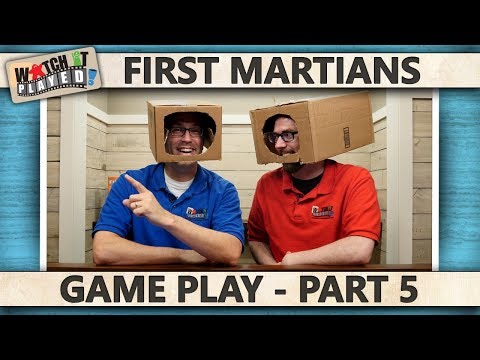
"The theme of this game is we are scientists and we are on Mars and we have to survive. That means that we have to manage resources. This game is all about managing resources: we have oxygen, we have energy, and we have food, and we have to survive."
— Watch It Played
"This game borrows several mechanics from Robinson Crusoe but definitely has its own tweak on many of these things. Much like every scenario in First Martians, we have an app that's running which will keep track of where we are within a given round as well as seeding us with events."
— Getting Games