












First Orchard Deep Dive
What the Community Thinks About First Orchard
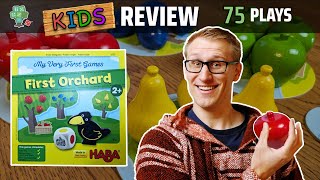
First Orchard holds a special place among reviewers as one of the rare games that genuinely bridges the gap between toddlers and structured play. Published by HABA, it is repeatedly recommended as a first game for the very youngest children. Rolls In The Family calls it one of the first games worth reaching for when introducing a toddler to board gaming, and Actualol affectionately ranks it among the most respected titles any parent has tried. The consensus centers on its remarkable accessibility paired with a genuine sense of cooperative drama.
Core Mechanics That Define First Orchard
The Color Die and Fruit Harvest
First Orchard layers learning atop simple, tactile play. On a turn, a player rolls a color die and takes a matching piece of fruit from one of the four trees, adding it to the shared basket. When the basket symbol comes up, the player may take any fruit they like. The die result directly guides the action, which removes decision paralysis and lets even a two-year-old participate. Color matching becomes second nature after a few plays, giving children repeated practice in a context where recognition leads to immediate, satisfying feedback.
Cooperative Tension Through the Raven
The raven transforms a gentle activity into a game with real stakes. Each time the raven symbol is rolled, the wooden raven advances one step along its path toward the orchard. The whole table wins if they gather all the fruit first, and loses together if the raven arrives before they finish. There is no individual winner or loser, only shared success or shared loss. Rolls In The Family highlights how this creates genuine drama, with the raven sometimes lurching forward early and prompting a scramble to grab fruit before it moves again.
The First Orchard Experience
An Introduction to Fundamental Gaming Concepts
First Orchard is explicitly built as a foundation stone in gaming literacy. It teaches turn-taking, a habit that extends well beyond the table into sharing and patience. Color recognition is practiced through functional repetition, and rolling a die introduces the idea that a random result determines your action, a building block for nearly every game that follows. Perhaps most subtly, the cooperative framing teaches winning and losing in a protected context: when the raven wins, everyone loses together, which softens the sting and makes the emotion easier for a small child to process.
A Tactile and Emotional Arc
The physical experience deserves special attention. HABA manufactures the fruit from thick, chunky wood that sits comfortably in small hands, and the raven and its path are equally substantial. Reviewers consistently praise the heft and quality of the components; there is something deeply satisfying about picking up a wooden apple and dropping it in the basket. Actualol describes the rising apprehension as the crow inches closer, a tension that mirrors a climactic moment in a film, and notes that children sometimes even feel sorry for the hungry raven at the end.
What Makes First Orchard Stand Out
Design Grounded in Child Development
First Orchard succeeds because its complexity is matched precisely to where two- and three-year-olds are developmentally: able to take turns, recognize colors, and grasp simple cause and effect. The game feels neither too simple to bore nor too complex to frustrate. Reviewers contrast it favorably with mass-market children's games that either talk down to kids or overestimate what they can follow, and they note that First Orchard respects its young players while still being genuinely playable for the adults guiding them.
Winning More Often Than Losing
First Orchard is balanced to produce victories more often than defeats, which reviewers identify as crucial at this age. Children win enough to feel successful and eager to play again, yet lose often enough that the outcome stays uncertain. Rolls In The Family notes that the randomness of the raven's movement keeps games feeling fresh across many plays, since the raven clusters its steps at different moments and creates a different dramatic arc each time rather than a predictable march to victory.
Potential Drawbacks
Repetition and Limited Depth
First Orchard is a short game, finishing in ten to fifteen minutes, and that brevity suits its target age while wearing on adults more quickly. Rolls In The Family notes that its simplicity means children will likely outgrow it fairly quickly, though kids up to around four can still enjoy it. It is designed to serve a season of a child's development rather than to sustain interest indefinitely, naturally giving way to more complex games as a child grows.
Late-Game Dead Rolls
As a game nears its end and only one or two fruit colors remain on the trees, a player can roll a color that has already been fully harvested, resulting in a turn where nothing happens. This is mathematically inevitable and brief, passing in seconds, but it can feel slightly anticlimactic. Reviewers treat it as a minor friction point rather than a real flaw, since it affects only a turn or two and signals that the end is near.
If You Enjoy First Orchard
First Orchard sits at the front of HABA's carefully curated early-childhood catalog, and reviewers who praise it typically point toward the publisher's other titles for slightly older children. Animal Upon Animal moves children toward stacking and balance, where physics and spatial reasoning take over. Rhino Hero adds a tower-building dexterity challenge with the same friendly charm. And My Very First Games: Hungry as a Bear teaches similar cooperative, die-driven concepts while adding a simple fine-motor element, an easy next step once a child has mastered the orchard.
What Reviewers Are Saying
"First Orchard is one of the first games I would recommend when introducing a toddler to board games. Its simplicity means it will likely get outgrown fairly quickly as kids get older, but I can see kids up to age four still enjoying it."
— Rolls In The Family
"First Orchard has been a great option. There's a little bit more drama; the raven might move a lot at the beginning, and it's like, oh, can we get some before he moves? Yes, it's random, we don't really have control over it, but it certainly is a little bit more interesting."
— Rolls In The Family
"First Orchard from HABA is effectively the Shawshank Redemption of toddler board games. It is liked, nay, respected, by every parent who has tried it. You play cooperatively, taking it in turns to roll the dice and take the matching colored fruit from its tree. The chunky pieces are really easy for them to pick up, and even though it says two years old, we've been playing it since she was one."
— Actualol