


























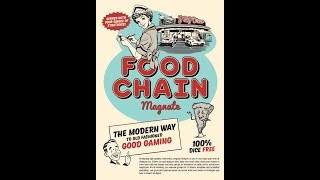
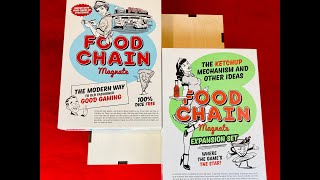

"Lemonade? They want lemonade? What is the world coming to? I want commercials for burgers on all channels, every 15 minutes. We are the Home of the Original Burger, not a hippie health haven. And place a billboard next to that new house on the corner. I want them craving beer every second they sit in their posh new garden." The new management trainee trembles in front of the CEO and tries to politely point out that... "How do you mean, we don't have enough staff? The HR director reports to you. Hire more people! Train them! But whatever you do, don't pay them any real wages. I did not go into business to become poor. And fire that discount manager, she is only costing me money. From now on, we'll sell gourmet burgers. Same crap, double the price. Get my marketing director in here!"
Food Chain Magnate is a heavy strategy game about building a fast food chain. The focus is on building your company using a card-driven (human) resource management system. Players compete on a variable city map through purchasing, marketing and sales, and on a job market for key staff members. The game can be played by 2-5 serious gamers in 2-4 hours.
German:
"Limonade? Sie wollen Limonade? Was ist mit der Welt los? Ich will Werbung für Burger auf allen Kanälen, alle 15 Minuten. Wir sind die Heimat des Original-Burgers, kein Hippie-Gesundheitsparadies. Und stellen Sie eine Werbetafel neben das neue Haus an der Ecke. Ich will, dass sie jede Sekunde, in der sie in ihrem schicken neuen Garten sitzen, nach Bier lechzen." Der neue Management-Trainee zittert vor dem CEO und versucht, höflich darauf hinzuweisen, dass... "Wie meinen Sie das, wir haben nicht genug Personal? Der Personaldirektor berichtet an Sie. Stellen Sie mehr Leute ein! Bilden Sie sie aus! Aber was auch immer Sie tun, zahlen Sie ihnen keine echten Löhne. Ich bin nicht ins Geschäft eingestiegen, um arm zu werden. Und feuere diese Discount-Managerin, sie kostet mich nur Geld. Von nun an werden wir Gourmet-Burger verkaufen. Derselbe Mist, nur doppelt so teuer. Holen Sie meinen Marketingdirektor her!"
Food Chain Magnate ist ein schweres Strategiespiel über den Aufbau einer Fast-Food-Kette. Der Schwerpunkt liegt auf dem Aufbau des eigenen Unternehmens mit Hilfe eines kartengesteuerten (Personal-)Managementsystems. Die Spieler konkurrieren auf einer variablen Stadtkarte durch Einkauf, Marketing und Verkauf sowie auf einem Stellenmarkt für wichtige Mitarbeiter.
Das Spiel kann von 2-5 ernsthaften Spielern in 2-4 Stunden gespielt werden.
- High ambition for depth and replay value
- BGG ratings reflect broad interest
- Long play sessions; potential difficulty for newer players
Mechanics (from transcript analysis)
- Economic engine with cutthroat competition — Open market dynamics and aggressive positioning against opponents.
Video topics + discussion points
Quotes (from this video)
- two players, not enough time
- steal someone's donkey
- bang for your buck
- eight maps in the base box
- you can draw from the deck. Each card has its own way of like yes, you can use it as an item, but it's also one of the endgame conditions
References (from this video)
- Deep, substantial mechanics centered on a career-path card system
- Award-winning design and strong thematic integration
- Potential for strategic depth and unforgiving challenge for experienced players
- Offers customization and practical tips from the community (e.g., printable back sheets and inserts) to improve table presence
- Unattractive art and bleak visual design; box art and back-of-box art criticized
- Very long playtime (at least three hours)
- Runaway leader mechanic makes catch-up difficult and can end games prematurely
- Endgame timing driven by bank money can feel random; house rules suggested to mitigate
- Not beginner-friendly; heavy euro not suitable for casual players
- Array
- Modern fast-food industry
- Casual, personal review
Mechanics (from transcript analysis)
- card-driven action system — CEO with attached career cards unlocks actions; expansions add more VP-level cards
- Catch-up — Big lead can be hard to catch up; bonuses can nip players if not careful
- Competitive pressure & runaway leader dynamics — Big lead can be hard to catch up; bonuses can nip players if not careful
- Economic engine / market production — Actions allow players to market and produce burgers, pizza, drinks and sell them for money
- end game bonuses — Game clock is determined by bank money; ends after the bank runs out twice
- Endgame triggered by bank depletion — Game clock is determined by bank money; ends after the bank runs out twice
- hand management — Players manage a large deck of action/upgrades via cards and inserts
- Hand management / card inventory — Players manage a large deck of action/upgrades via cards and inserts
- Market Pricing/Manipulation — Actions allow players to market and produce burgers, pizza, drinks and sell them for money
Video topics + discussion points
Quotes (from this video)
- one of the most interesting and cool mechanics about this game and it's won a lot of awards for it is the whole career path mentality
- I honestly think that you should take a copy of this back sheet print it laminate it and just X off the ones that you have because there can only ever be one per player and the game comes with like six each
- this game is incredibly unforgiving
- I felt that this game has a huge runaway leader mechanic in it where I can never catch up
- the game clock is determined by the amount in the bank
- after it runs out for the second time the game ends
- the bank's gonna run out of money
- it's gonna take you at least three hours
- it's a heavy economic game it's not really for me
- the board is bleak
- the art is not cute it doesn't have any art on the back of the box
References (from this video)
- High-quality components and art with a mid-20th century diner vibe
- Dense, flavorful cards and well-made wooden pieces
- Excellent player aids and restaurant menus that explain the game
- Milestones provide a lot of strategic variety and permanent upgrades
- Engaging marketing and hiring mechanics that encourage strategic planning
- Near-perfect information and fair interaction with opponents
- Terrible space requirements and table footprint; needs a lot of space
- Cluttered components and no dedicated insert; organization can be cumbersome
- Paper money is flimsy and unreliable; prefers chips or scoring pads
- High downtime, especially at higher player counts; game can drag
- Long learning curve and heavy calculation; potential analysis paralysis
- Theme includes misogynistic elements; may be off-putting
- Array
- 20th century America
- analytical with humor
- Agricola
Mechanics (from transcript analysis)
- Building/expansion and relocation of restaurants — Build new restaurants and teleport existing ones; upgrade houses to increase revenue.
- Campaign — Marketing tiles create demand in houses; multiple shapes and four methodologies.
- Cash flow management — Manage salaries and cash flow; payments affect strategy.
- Hiring and training — Hire employees from a guide/menu and train them to higher tiers.
- Market Pricing/Manipulation — Pricing strategy including undercutting rivals with price manipulation; discounts.
- Marketing campaigns — Marketing tiles create demand in houses; multiple shapes and four methodologies.
- Milestones (permanent technologies) — Milestones unlock permanent technologies as you reach goals; drive strategic options.
- Passive income via waitresses — Waitresses provide passive income every turn.
- Pricing and price manipulation — Pricing strategy including undercutting rivals with price manipulation; discounts.
- Variable board / unpredictable bank — Variable board and bank breaks; plans adapt to bank reserves.
- worker placement — Hire employees from a guide/menu and train them to higher tiers.
Video topics + discussion points
Quotes (from this video)
- Food Chain Magnate is going to be in eight out of ten from us
- the components are definitely not junk
- this is a punishing experience
- the game doesn't sit on a table well at all
- Hiring and training mechanic FCM is amazing
- you'll have to mod to make it enjoyable including replacing the paper money
References (from this video)
- the theme is integrated with mechanics in a satisfying way
- decisions feel weighty and impactful
- realistic, competitive economic gameplay
- heavy and lengthy; high complexity may deter some players
- competition, pricing, and strategy
- fast-food burger chain management
- economic simulation with thematic flavor
Mechanics (from transcript analysis)
- manager-structure with subordinates — Hierarchical management mechanics underlie the economic engine.
- Market Pricing/Manipulation — Pricing, staffing, and expansions respond to demand and competition; decisions feel consequential.
- opening-move significance — Opening moves strongly influence later outcomes; careful planning is essential.
- supply-demand mechanics — Pricing, staffing, and expansions respond to demand and competition; decisions feel consequential.
Video topics + discussion points
Quotes (from this video)
- the theme is so cool you don't really see a lot of games with this fast-food burger
- the decision space is really good I really like how my decisions feel like they have weight
- it's so addicting that's just so fun
- there's just something about a route where the asymmetry just works and it plays very smoothly
- the biggest complaint about this game is that there's a lot of king-making but for me honestly that's what makes it
- I've played this game 20 30 plus times at this point
References (from this video)
- economic strategy, management, and microeconomics
- modern fast-food restaurant industry with corporate competition
- satirical, business-simulation flavor
- Gaia Project
- Brass: Birmingham
- Concordia
Mechanics (from transcript analysis)
- economic engine-building — players develop a layered business engine to maximize profits
- engine building — players develop a layered business engine to maximize profits
- staffing/role optimization — managing employees and roles to unlock capabilities
- worker placement — managing employees and roles to unlock capabilities
Video topics + discussion points
Quotes (from this video)
- I'm definitely into Dragon Eclipse right now
- I just have to bribe my youngest son to play 12 games with me on that
- Primal The Awakening I actually have here on my desk I'm playing it right this second
- I've never taken money for a preview
- if you're not consistent you're never going to get seen
References (from this video)
- highly interactive and dynamic
- innovative take on supply/demand
- strong thematic engagement
- complex setup and rules
- steep learning curve for new players
- supply and demand, branding, and expansion into markets
- competitive food industry marketing and restaurant chains
- economic simulation with social dynamics
- Millennium Blades
Mechanics (from transcript analysis)
- marketing_campaigns — live market shifts driven by campaigns that affect opportunities
- organization_chart — design and manage a company organization to maximize production and campaigns
- platforming_competition — compete for market space and influence across a dynamic board
Video topics + discussion points
Quotes (from this video)
- Dead of Winter, a crossroads game.
- it's nostalgic.
- the campaign ends on the final draw.
- I think this puzzle to me is more crunchy and satisfying than something like Cascadia.
- Cascadia is pretty chill.
- What a good game.
References (from this video)
- Deck-building gains thematic meaning and strategic depth
- High freedom to pursue varied strategies
- Strong thematic integration with mechanics
- Heavy and complex to learn
- Relatively long setup and playtime
- Concordia
Mechanics (from transcript analysis)
- Deck building — Players build and manage a deck to perform actions, creating a meaningful strategic flow.
- deck-building — Players build and manage a deck to perform actions, creating a meaningful strategic flow.
- employee/manager hiring and salaries — Hiring managers and employees with salaries to unlock actions and shape company structure.
Video topics + discussion points
Quotes (from this video)
- Everything about the design of this game is obvious. It's so intuitive how it works.
- Simultaneous worker placement. Simultaneous.
- I think that's a key identifier of a truly innovative game.
References (from this video)
- Deep strategic depth with a dense web of interlocking systems that reward careful planning and adaptation.
- A sharp, purposeful critique of capitalist structures rendered through mechanics rather than didactic narration.
- High degree of player agency: almost any strategy can be pursued and adapted to counter opponents’ moves.
- Milestone system introduces meaningful, game-altering decisions that stay with players beyond a single round.
- Thematic immersion is strong: branding, advertising, labor management, and market manipulation feel authentic within the game’s satire.
- Very high replayability due to the combination of variables: player count, board state, and evolving market dynamics.
- Play time is extremely long, especially with larger player counts, which can dampen engagement over time.
- The catch-up mechanic and the scale of the game can amplify downtime and create frustrating lulls between impactful turns.
- The learning curve is steep; onboarding new players requires patience and careful rule interpretation.
- Downtime and administrative overhead during setup and round reveals can slow the pace and affect turn flow.
- The tone can feel harsh or punitive, which may be off-putting to some players or reduce accessibility for casual groups.
- Six-player play and certain expansions can exacerbate pacing issues and destabilize balance, depending on group dynamics.
- Capitalist competition, corporate ladder dynamics, marketing and branding as weapons, the labor market as a controllable resource, and the tension between long-term strategy and short-term ploys.
- A dense urban landscape where restaurants and fast food empires rise and fall through aggressive marketing, labor management, and cutthroat competition. The board represents a neighborhood of consumer domains, with homes and businesses mirroring a cityscape where appetite and advertising battle for dominance.
- Analytical yet playful, with sharp satire about capitalism and corporate power; the narration treats the game as a lens to examine market behavior, while acknowledging the brutal elegance of the design.
- Monopoly
- Monaco
Mechanics (from transcript analysis)
- advertising campaigns — Players invest in a variety of marketing actions—billboards, leaflets, planes, and even radio waves—that influence demand in different neighborhoods. Advertising creates a dynamic demand field that benefits those who can sustain campaigns, coordinate timing, and place ads to outpace rivals. The mechanics simulate branding wars in a granular way, where placement, reach, and timing determine who captures market share. The impact of ads persists, creating long tails of influence that outlive a single round.
- Catch-up — A mechanic that, in theory, helps skilled players bridge gaps but in practice can be used to intensify pressure on competitors. While intended to stabilize the game when a lead is established, it can also enable a locomotive-style surge that makes late-game comebacks possible—yet still punishing for those who fall behind early.
- Corporate structure and pyramids — Each round, players secretly arrange a hierarchy that resembles a corporate pyramid. This structure determines which employees perform which tasks and how revenue generation is organized. The reveal happens simultaneously, which heightens tension as players anticipate rivals’ moves and try to predict how different pyramids will interact with the evolving market. Managing this internal network is a core cognitive load of the game.
- Hiring and payroll — A formalized, pyramid-shaped hierarchy forms each round as players secretly draft employees and then reveal their choices. Each employee has a role (kitchen staff, trainers, managers, etc.) which determines what operations they can perform and how they contribute to production, marketing, and revenue. Salaries drain cash flow and can lead to forced terminations if the payroll becomes unsustainable, creating a persistent tension between growth ambitions and cost control.
- Ketchup (catch-up) mechanism — A mechanic that, in theory, helps skilled players bridge gaps but in practice can be used to intensify pressure on competitors. While intended to stabilize the game when a lead is established, it can also enable a locomotive-style surge that makes late-game comebacks possible—yet still punishing for those who fall behind early.
- Market Pricing/Manipulation — Players invest in a variety of marketing actions—billboards, leaflets, planes, and even radio waves—that influence demand in different neighborhoods. Advertising creates a dynamic demand field that benefits those who can sustain campaigns, coordinate timing, and place ads to outpace rivals. The mechanics simulate branding wars in a granular way, where placement, reach, and timing determine who captures market share. The impact of ads persists, creating long tails of influence that outlive a single round.
- Milestone-based revenue boost — Achieving milestones grants ongoing advantages that compound over time. This creates a tangible path to victory for players who execute a cohesive plan, while also increasing the risk of runaway leads if one player capitalizes too aggressively on early gains.
- milestones and achievements — A central engine of power in the game. Milestones are objective, round-specific goals that grant powerful, sometimes game-breaking rewards to the earliest achievers. The mechanic rewards speed, planning, and risk-taking, but it also introduces a volatile element where others can snatch the advantage by acting quickly. The milestone system drives dramatic shifts in momentum and can create dramatic swings in lead, shaping late-game decisions and forcing players to adapt their strategy on multiple fronts.
- Pricing and demand dynamics — Prices and product mixes are adjusted to outmaneuver competitors and maximize profit margins. The game emphasizes strategic pricing, bundling, and product differentiation. Consumers react to advertising and to the presence of competing products, creating a shifting landscape where even small price changes can cascade into major revenue shifts and strategic misalignments among rival firms.
- worker placement — A formalized, pyramid-shaped hierarchy forms each round as players secretly draft employees and then reveal their choices. Each employee has a role (kitchen staff, trainers, managers, etc.) which determines what operations they can perform and how they contribute to production, marketing, and revenue. Salaries drain cash flow and can lead to forced terminations if the payroll becomes unsustainable, creating a persistent tension between growth ambitions and cost control.
Video topics + discussion points
Quotes (from this video)
- Food Chain Magnate isn't monopoly because unlike monopoly it succeeds at its goal
- it's ruthless and unforgiving
- the ketchup mechanism expansion offers the titular ketchup module
- Lizzie Magie designed Monopoly as a critique of land grabbing
- I don't actually enjoy playing Food Chain Magnate
- Food Chain Magnate is a pastiche of capitalist structures
- Monopoly is a boundlessly repetitive symbol of a system that can be gamified similarly to FCM
- I think board games achieve this in two different ways, either emulating an activity or presenting an abstract idea, but FCM blends both in a way that can feel personal and dangerous
References (from this video)
- Highly interactive; every action affects all players
- Infinite replayability due to changing board setup and expansions
- Excellent production quality and deluxe components
- Strong blend of long-term and short-term strategy
- Expansion modules provide substantial variability and depth
- Unforgiving; runaway leaders can punish new players
- Steep learning curve for beginners without good onboarding
- Base game opening strategies can feel limited; expansions broaden them
- Lots of upkeep and fiddly math can increase downtime
- marketing, supply chain, and expansion to maximize profits
- Urban restaurant market with competing chains across changing neighborhoods
- economic strategy with interactive market dynamics
Mechanics (from transcript analysis)
- delivery_logic — Deliver foods/drinks to houses; failing to deliver can waste marketing.
- employee_hiring — Hire chefs, trainees, and managers to drive operations.
- expansion_modules — Expansion modules add new mechanics and variability to play.
- Market Pricing/Manipulation — Discounts and monopolistic pricing via managers to control demand.
- marketing_actions — Billboards, mailboxes, airplanes advertising to households.
- milestones — Racing to goals like CFO status and milestone rewards.
- Pick-up and deliver — Deliver foods/drinks to houses; failing to deliver can waste marketing.
- pricing_strategy — Discounts and monopolistic pricing via managers to control demand.
- random_setup — Tile orientation and initial board setup create variety with limited luck beyond setup.
- restaurant_placement — Randomized map tiles create dynamic neighborhoods and placement choices.
- turn_order — Turn order advantage/disadvantage affects planning and timing.
- upkeep_and_math — Heavy upkeep, calculations, and resource tracking per turn.
- worker placement — Hire chefs, trainees, and managers to drive operations.
Video topics + discussion points
Quotes (from this video)
- This game is one of the best economic games that I've ever played.
- Infinite replayability.
- There's zero luck in the game.
- It's a strategic game where you are thinking strategy long term most of the time.
- This game is amazing; highly interactive; every move everyone takes is being dissected.
- Turn order is can be huge in this game.
- I like that you're doing both short term and long term strategies.
- Expansion modules changes the strategies in the game.
- The production is amazing.
- If you get someone in there, the game is absolutely fantastic and I'm blown away by the amount of replayability.
- Downtime. Sure, there's things going on, but you're always thinking, and so it doesn't feel like a long game.
- The number of houses, the number on the houses changes everything because they eat in order of houses.
- There’s lots of upkeep in this game. There's lots of math.
- The expansion itself is amazing.
- I will always play with the new milestones, which really changes the strategies in the games.
- Overall, I love the game.
- It's been the Game Boy Geek.
References (from this video)
- Deep strategic depth
- Very high complexity for casual players
- Economic simulation of a fast-food chain
- Twilight Struggle
Mechanics (from transcript analysis)
- economic_engine_building — Players build a business strategy to maximize profits.
- engine building — Players build a business strategy to maximize profits.
Video topics + discussion points
Quotes (from this video)
- theres no good or bad games objectively
- every game has its own unique profile
- the five attributes: theme mechanics components strategy and complexity
- the perfect board game formula
- identify the strengths of a game even if those strengths are outside of their own perfect board game formula
References (from this video)
- Deep, satisfying economic strategy
- High replayability and interaction
- Rich thematic flavor with robust components
- Very long playtime and heavy rule set
- Steep learning curve for new players
- Capitalism, competition, and corporate ladder dynamics
- 1960s fast-food restaurant business
- Economic simulation with sharp, dry humor
- Terraforming Mars
- Patchwork
Mechanics (from transcript analysis)
- economic engine building — Layer profit-maximizing mechanisms through menu development and pricing.
- engine building — Layer profit-maximizing mechanisms through menu development and pricing.
- Market demand and price management — Dynamic market conditions require strategic pricing and timing.
- Market Pricing/Manipulation — Dynamic market conditions require strategic pricing and timing.
- Turn-based competitive economy — Players compete with others by outmaneuvering opponents on the market.
- worker placement — Direct actions to staff and upgrade your restaurant empire.
Video topics + discussion points
Quotes (from this video)
- In space, no one can hear you scream about how you didn't draw the card you need again.
- The real monsters are the other players.
- The answer here, of course, is terraforming Mars.
- This one's food chain magnet.
- Cartographers.
- The biscuit tin never has biscuits in it, does it? It's always got bubbling sewing stuff.
References (from this video)
- Excellent metaphor for a cutthroat fast-food industry
- Many nuanced roles with authentic analogies to real-life business
- Expensive and quite complex to teach and learn
- marketing, real estate, operations, and consumer demand
- competitive fast-food business in a neighborhood with corporate hierarchies
- economic simulation with real-life analogies
- Stronghold
Mechanics (from transcript analysis)
- Corporate hierarchy and market dynamics — A hierarchical structure governs actions; players market families and open restaurants to drive demand
- Role-based action execution — Players assume roles (marketing, kitchen, real estate, etc.) to execute actions through a round
Video topics + discussion points
Quotes (from this video)
- there are five different definitions for theme
- pasted on theme
- Thematic World
- figuratively thematic
- literally thematic
- I mean he's got two games clinic and small City
- these IP games that's not really my scene
- the host's specialty on Euro and family style games
- this is a Cutthroat game between all players is a neighborhood
- every bit of this game just has a very true analogy to real life
References (from this video)
- has fans
- pseudo knockout problem
- leads can't be recovered from
- 3+ hour commitment with limited winning paths
- 5-player version incredibly long
Mechanics (from transcript analysis)
Video topics + discussion points
Quotes (from this video)
- it's not even a game it's just like a story
- why is it there this is the game about inventions and this is basically telling me to make cutesy patterns with tiles
- the bane of my freaking life this horrible game
- I just want to feel like right I can do this I can do this
- just design one good game one good game one good mode
- why can't I tell you
- they just made them a lot worse
- it's a red flag to the game is going to suck
References (from this video)
- Sharp, deep economy and strategy depth
- Very replayable with different counts and module setups
- Humorous theme and strong production/art style
- Clear player agency and meaningful choices each turn
- Long play time, especially with expansions
- steep learning curve; can be opaque for newcomers
- balance and optimal strategies vary significantly with player counts
- Corporate expansion, staffing, and marketing to dominate the food industry
- Indeterminate town with a grid of roads/houses; players run competing fast-food empires
- Sarcastic, humorous documentary-style analysis of a cutthroat industry
- Greed Inc.
- Antiquity
- Great Zimbabwe
- Roads and Boats
Mechanics (from transcript analysis)
- abstracted market interactions — Households’ demands and competition over goods create indirect competition and strategic positioning.
- advertising and campaigns — Turn-based marketing campaigns that influence demand across households, with spatial/distance considerations.
- asset/ownership economy — Bank and milestone chips drive end-game conditions; money counts to determine winner when the bank breaks.
- dinner-time resolution — Resolve demand from households, collect money, and trigger paydays; multiple goods satisfy various needs.
- milestones and modules — Milestones grant rewards; base game vs. expansions introduce new modules that modify play (ketchup, sushi, noodles, fry chefs, etc.).
- staffing and hierarchy — Recruit, train, promote, and manage a multi-tier staff hierarchy to deliver products and profits.
Video topics + discussion points
Quotes (from this video)
- the game not that complex like most Splatter games. It's not super complex rules wise, but it's deep. Every decision you make matters.
- This is a deck builder. Just kidding.
- the ketchup mechanism. And the ketchup, this we are going to touch on.
- the core idea is sushi is a dish only eaten by fancy folk, I'm paraphrasing, by people in houses with gardens.
- the milestones provide rewards; expansion modules change the feel dramatically.
References (from this video)
- Deep strategic depth
- Strong thematic flavor
- Long playtime
- Steep learning curve
- capitalist competition and restaurant management
- Global fast-food marketplace in a modern city
- economic engine-building
- Alchemists
- Quacks of Quedlinburg
- Potion Explosion
- Broom Service
Mechanics (from transcript analysis)
- engine-building — Develop an internal engine to accumulate money and upgrade facilities.
- resource/market management — Balance salaries, prices, and budgets to outperform rivals.
- worker placement — Assign workers to actions to hire staff, train employees, expand restaurants, and run campaigns.
Video topics + discussion points
Quotes (from this video)
References (from this video)
- Tense, strategic gameplay with high interaction
- Clear economic focus and deep decision space
- Can feel overly cutthroat and punishing
- Rulebook/learning curve can be steep
- Pricing strategy, market competition, and operational tactics
- Restaurant/food-chain business simulation
- Business strategy with cutthroat competition
- Other heavy economic/market games
Mechanics (from transcript analysis)
- market pricing and resource management — Players control restaurant pricing and supply chains to maximize profits over multiple rounds.
Video topics + discussion points
Quotes (from this video)
- I’m cautiously excited if that makes sense.
- Stone Age is a great recommendation because it really helps explore worker placement without an overload of rules.
- Cheez-its are the number one around here.
- Rivet Heads is being published by New Mill Games, which is a publisher with a small team.
- Tiny Epic Galaxies is my favorite Tiny Epic game after trying most of them.
- I ended up stopping formal reviews because they were taking the joy out of the hobby for me.
- Dominant Species Marine tweaks the worker placement, making it a bit lighter on overhead but still chaotic.
References (from this video)
- Iconic and popular game
- Good to have summary video
- Good value on second-hand purchase
- Business competition
- Economic simulation
Mechanics (from transcript analysis)
Video topics + discussion points
Quotes (from this video)
- I used to call this a shelf of shame that was a pretty common thing to call it back in the day and I don't never really liked that term because I don't feel shame that I haven't got to these games
- this is mostly work like this is just a backload of things I probably should get to
- people will still be looking for it
- it doesn't matter if the game is like 20 years old people will still be looking for it
- I've painted this one and I spent a lot of time doing it
- there's no point putting them on the channel I think both of them have been out of print for like a decade
- one of the worst kickstarters by one of the worst studios in board gaming history
- Golden Bell Studios did everything wrong you could possibly think of
- purely toxic company run by incredibly terrible people
- it would be kind of a joke that I'd be able to do a three minute video of feudum
- this game has a tutorial video online that's like 40 minutes long
- The Rose explanation video feels like a parody but it's actually how the game is played
- nothing personally to me puts me off playing a game that then sitting down unboxing it and having a craft assignment
- stop making me spend hours assembling your damn games
- this is an uncontrollable mess right now
- I'm a full-time dad and I'm really doing this in the evenings
- I have a finite space and also it just puts pressure and stress on me having a whole bunch of crap there that I know I'm not going to get to
- I'm going to do a big cull
- I will be published by this company but that doesn't mean I'm going to be slavishly devoted to every single game they put out
- I am a sucker for cute animal games like I really am
References (from this video)
- Strong thematic integration between theme and mechanics
- Low reliance on luck compared to other games
- Deep strategic economic engine
- Modular board and advertising/expansion mechanics
- High complexity and steep learning curve
- Long playtime and potential analysis paralysis
- Can be harsh and unforgiving for new players
- corporate empire building in a cutthroat food service industry
- urban neighborhood fast-food market with competition among chains
- economic simulation with satirical tone
Mechanics (from transcript analysis)
- competition via market advantage — location quality and pricing beat competitors to attract customers
- economic engine / cash flow — players earn income from selling food and pay salaries, driving game progress
- end-condition bankruptcy — play ends when the bank runs out of cash
- Market Pricing/Manipulation — pricing and meeting demand affects customer visits
- Modular board — board is modular and used to place ads and locate restaurants
- modular board / location placement — board is modular and used to place ads and locate restaurants
- pricing and demand management — pricing and meeting demand affects customer visits
- role hierarchy / action selection — player actions are determined by an internal organizational hierarchy
Video topics + discussion points
Quotes (from this video)
- food chain magnate is one of the strongest thematic games i know
- this game has a solid 10 for mechanics
- for luck a 1
- play continues until the bank runs out
References (from this video)
- Rich integration of engine-building with direct, game-wide competition that creates meaningful tension and dramatic swings in fortunes.
- Strong thematic cohesion: the hierarchical, org-chart style engine provides a clear, intuitive metaphor for how decisions propagate through the business.
- High replayability due to variable strategic paths, multiple avenues to profitability, and the way interactions with opponents continually reshape the optimal plan.
- Very heavy rules and a long setup/playtime; new players may require substantial onboarding to reach fluency.
- Steep learning curve and dense decision space can be intimidating for casual gamers or those seeking lighter experiences.
- Corporate empire-building and workforce management in a highly competitive restaurant landscape, explored through an explicit hierarchical organization chart as the engine of play.
- An urban, cutthroat market for quick-service food, where competing restaurants jockey for position across a city or region through expansion, staffing, pricing, and marketing.
- Analytical and strategic with satirical undertones; the game's mechanics tell a story of scaling a business through disciplined decision-making, counterplay, and resource allocation.
- Agricola
Mechanics (from transcript analysis)
- economic_management — Money flow, pricing, wages, and investments dictate profitability; players must balance short-term cash needs with long-term strategic investments.
- engine building — Players construct a scalable internal engine by layering actions that unlock revenue, growth, and competitive advantages; the engine evolves as restaurants expand and capabilities are added.
- engine_building — Players construct a scalable internal engine by layering actions that unlock revenue, growth, and competitive advantages; the engine evolves as restaurants expand and capabilities are added.
- hiring_and_staffing — Recruitment, training, and deployment of staff influence efficiency and capacity; staffing decisions ripple through operations and profitability.
- menu_pricing_and_marketing — Dynamic adjustments to menus and marketing efforts shift demand, customer behavior, and competitiveness across the market.
- organizational_structure — Thematic and mechanical emphasis on an organized, hierarchical chart; the game visualizes and leverages corporate structure as a functioning engine.
- player_interaction — High degree of direct competition and interaction through market moves, pricing wars, and strategic undercutting, creating a tense and reactive play environment.
- Positive player interaction — High degree of direct competition and interaction through market moves, pricing wars, and strategic undercutting, creating a tense and reactive play environment.
- worker placement — Recruitment, training, and deployment of staff influence efficiency and capacity; staffing decisions ripple through operations and profitability.
Video topics + discussion points
Quotes (from this video)
- it's literally just like an orga chart
- that anxious feeling when you're playing
- one decision can swing things drastically
- I think about the tension of an agricola
References (from this video)
- Generates undying love and devotion from players
- Players consider it their lifetime favorite
- Deep economic simulation
- business simulation
- corporate competition
- economic system
Mechanics (from transcript analysis)
- closed economy
- commodity trading
- economic simulation
- negotiation
- Stock holding
- Stock management
- Trading
Video topics + discussion points
Quotes (from this video)
- We are coming up at the end of a decade and that's an important thing
- There have been monumental shifts, an absolute monster releases this decade
- The game that has most inspired my imagination and stretched my strategic muscles in the most satisfying way of the 2010s
- It changed the way that gamers thought about games as experiences
- No more was it about a game that I could replay eight bajillion times but one in done experiences or disposable experiences that convey a specific story
- When gaming historians are looking at the most important games that have come out amongst the last 100 years I honestly think that pandemic legacy is going to be one of those milestone games
- Gloomhaven has brought so many new people to the Hobby because the mainstream success of it
- As far as a game that is this in depth and this meticulously put together could appeal to as many as possible gloomhaven has succeeded like no other game has
References (from this video)
- Tightly designed economic engine
- High interaction due to competition for customers
- Can feel punishing when opponents undercut
- Steep learning curve for new players
- pricing, advertising, staff management
- fast-food empire management
- mathy, unforgiving business simulation
- Puerto Rico
- Concordia
- Brass Birmingham
Mechanics (from transcript analysis)
- engine-building — build a restaurant empire by hiring staff and expanding menus
- pricing/advertising — set prices and market the menu to attract customers
- set collection / inventory — manage burgers and ingredients as the market shifts
- worker placement — train and deploy staff to execute restaurant tasks
Video topics + discussion points
Quotes (from this video)
- they're easily the most dominant form of proper board games in the hobby
- we've covered some fantastic heavier euros and past lists like Alchemists Wingspan and Robertson Crusoe so just for the sake of an all-new list we're putting those as honorable mentions
- this is a collection starter and here are the 10 best euro games for experienced gamers
References (from this video)
- Host prefers this over similar games
- Smartphone Inc.
Mechanics (from transcript analysis)
Video topics + discussion points
Quotes (from this video)
- I know the games I play. I know the games I love to play. And I know the games that I theoretically want to play but don't actually play.
- I need at least one of those two things in play - either high personal interest or good reputation
- Designers, reviewers, other people mentioned
- I'm going to be trying to be more mindful about reality as opposed to the desires that I have
- These tend to be less of a priority. Like occasionally I dive into an unplayed game that isn't a review copy, but more often than not if I'm diving into an unplayed game, review copies do take precedence
- I have so many euros I love and so many that I'm behind on
References (from this video)
- unique theme with deep economic tension
- strong variability in play through asymmetric decisions
- very long play sessions
- steep learning curve
- economic interaction with intense player impact on others
- restaurant chain management and corporate competition
- dry-business/policy-driven
- Gloomhaven
- Terraforming Mars
- Great Western Trail
Mechanics (from transcript analysis)
- economic interaction — decisions by others directly impact your profits and options
- engine/area control via restaurants — players build a hierarchy of restaurants to maximize profits
- high downtime risk — campaign pacing can be long and heavy
Video topics + discussion points
Quotes (from this video)
- two-player Cooperative game dice game about trying to land planes this is Sky Team
- reviews were great and glowing
- it's such a unique game
- the modular map... explores with base players
- cooperative campaigns
- this is the Nemesis experience that I'm going to want to have and play for years to come
References (from this video)
- Deep, highly interactive engine-building with high variability
- Long-term engagement for dedicated players
- Campaign-like weight may limit casual play
- Competitive global restaurant empire with corporate structure
- Restaurant industry in a mid-20th-century economy
- Mechanics-driven with strong thematic flavour
- Ark Nova
- Ark Nova (economic engine comparison)
Mechanics (from transcript analysis)
- Hierarchical decision making — Strategic choices ripple through the organization and market
- Resource/market engine with organizational chart — Players build an organizational structure to drive revenue and actions
Video topics + discussion points
Quotes (from this video)
- There's nothing even close really, I think, to what this game is doing with this.
- It's not a campaign. It's a campaign game, but it can be played in one-offs as well.
- This one has the potential to be the best game we try this year.
References (from this video)
- Completely deterministic (zero luck)
- Interesting Milestone mechanic (first to do something gets permanent ability)
- Thematic advertising mechanics are well done
- Objectively good game design
- Extremely cutthroat and punishing
- Pseudo player elimination possible round one
- Experienced players will dominate new players completely
- Way too long
- Rich get richer dynamic from Milestones
- Capitalism
- Business Simulation
- Market Competition
- Advertising
Mechanics (from transcript analysis)
- Combat: Deterministic
- Cutthroat competition
- Deterministic (No Luck)
- economic simulation
- milestones
Video topics + discussion points
Quotes (from this video)
- it delivers what it promises and it does have that true epic feel to it
- bless you you've got you've got a game that's tailor-made for you
- you can be set for life playing Magic with your group but yeah it's not for me
- this is a game where if you are playing with somebody who knows the game they are going to absolutely trounce you
- I think you'd cut 30% from this game and it wouldn't be a worse game for it
- taking myself out of the equation this is like 10 but with my own enjoyment into it it's definitely significantly lower
References (from this video)
- Deep economic simulation and long-term planning
- High interaction can dominate conversation and disrupt gameplay
- Complex setup and rules
- Economic strategy and staffing optimization
- Restaurant management and fast-food empire
- Highly interactive with heavy economic planning
- Wavelength
- Wingspan
Mechanics (from transcript analysis)
- Engine-building / economic engine — Players manage staff, menus, and pricing to optimize profits
Video topics + discussion points
Quotes (from this video)
- We love that magic circle. We know that there's a social container that's created, and it's made through the cardboard and ink of the board game itself.
- If you're not playing to win, you're disrespecting the game and everyone at the table.
- Go is a haiku. Minimal words, maximum impact, endlessly interpretable.
- The healthiest approach is probably having three or four anchor games that your group can love and dive deep into supplemented by regular new experiences.