/pic1513085.jpg)











































For Sale Deep Dive
What the Community Thinks About For Sale
For Sale stands as a timeless classic that resonates across the board gaming community. Stefan Dorra's 1997 design has earned a permanent place in the BoardGameGeek Hall of Fame, a testament to its enduring appeal and elegant design. Reviewers consistently praise it as a masterclass in small-box game design that punches well above its weight class. Adam Porter places it firmly in his top three filler games of all time, noting its status as an absolute classic that belongs in any collection. The game succeeds where many auction games falter because it distills the economic concept into something simple, engaging, and immediately replayable.
Core Mechanics That Define For Sale
Bidding as the Gateway to Strategy
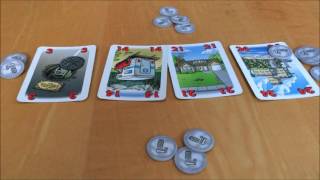
The game's first phase revolves around a deceptively straightforward auction mechanism where players bid for properties without seeing their values. What makes this brilliant is how bidding decisions carry weight and consequence. Rather than simply bidding money, each player must decide whether to stay in the auction or drop out, taking the lowest-valued property currently available while paying half their bid. This creates a constant tension between ambition and caution. Players quickly learn that not every high-value property card warrants the highest bids; mid-range properties often hide remarkable value that can be leveraged in the second phase, rewarding careful observation and restraint.
Simultaneous Revealing and Economic Timing
The second phase shifts entirely into a blind card game where properties become currency. Players simultaneously reveal a property from their hand face-down, and the player with the highest-value property claims the first money card offered. This two-part structure creates a completely different decision space from the auction phase. Now the real estate acquired in phase one determines earning potential. A player holding lower-value properties cannot compete for the highest payouts; they must identify opportunities where available payment amounts align with property values. This timing element forces constant recalculation as rounds progress, transforming every decision into a layered puzzle where nothing is guaranteed.
The For Sale Experience
Quick and Snappy Gameplay
For Sale delivers gaming satisfaction in approximately 30 minutes, making it ideal for opening a game night, closing one, or filling the gap between heavier experiences. Turns move rapidly because the rules are straightforward and decision windows narrow naturally through the bidding structure. The game never overstays its welcome or loses momentum. Players remain engaged from start to finish because the simultaneous reveal phase in round two keeps everyone participating actively rather than creating downtime.
Rewarding Mastery with Accessible Entry
The accessibility of For Sale is genuinely impressive for a game containing such clever economic interplay. New players grasp the auction format immediately and can begin playing within minutes of learning rules. Yet the game reveals depth through repeated plays. Experienced players recognize patterns in property distributions, read bidding intentions, and make calculated gambles that novices cannot anticipate. BoardGameGeek reviewers note that players often request an immediate rematch after their first game, sensing they could perform better with another attempt. The game successfully balances the joy of surprise for newcomers with the satisfaction of accumulated knowledge for veterans.
What Makes For Sale Stand Out
Elegant Design Through Constraint and Variation
For Sale exemplifies how restricting variables creates surprising richness. The auction mechanism remains identical every round, yet the combination of properties that emerge creates a distinct texture for each auction. When a huge gap exists between the lowest and highest available properties, bidding tension peaks. When all properties cluster in similar value ranges, an entirely different strategic calculus emerges. This property of self-generating variation without added rules represents masterful game design. The game accomplishes what many auction games fail to achieve: avoiding repetition while maintaining simplicity.
Perfect Calibration of Luck and Skill
The game balances fortunate property draws against player decision-making beautifully. Drawing low-value properties can feel punishing, yet savvy players recognize that securing free or cheap low-value cards preserves spending power for phases when all available money is attractive. This nuance separates casual play from optimized play without requiring complex rules or overwhelming new players. The economy remains closed and elegant; players circulate a fixed pool of money between buying and selling, and no card draw or random element can destroy a carefully constructed strategy outright. Skill and luck dance together rather than overshadowing one another.
Potential Drawbacks
Auction Mechanics as Acquired Taste
For some players, auction games carry an inherent tension that borders on stressful rather than engaging. The constant bidding decisions and the threat of overpaying can feel uncomfortable for those preferring collaborative or contemplative gameplay. While For Sale remains simpler and lighter than complex auction games like High Society, the core mechanic of "bid or concede" does not suit every gaming preference. Players seeking games without any auction element may not click with this design regardless of its accessibility.
Limited Interaction Between Players
While the game remains highly interactive in the bidding phase, the reveal phase operates largely as a solitaire exercise where players simply play their highest card or strategically hold back. Beyond the bidding itself, direct player interaction remains limited compared to games featuring negotiation, blocking, or attacking mechanics. Players manage their own property portfolios rather than directly challenging opponents, which may feel less combative or socially engaging than certain gaming groups prefer.
If You Enjoy For Sale
Fans of For Sale gravitate naturally toward High Society, which shares the auction mechanism but adds an elimination threat that ramps tension higher. No Thanks offers a lighter auction experience with even fewer rules, requiring players to pass or pay to take numbered cards. For those seeking the rapid-fire pacing and accessibility without auctions, Sushi Go delivers similar elegance through simultaneous card selection instead of bidding. Modern Art provides a more complex auction game for players wanting deeper economic strategy. Lost Cities captures the quick gameplay and decision-making tightness in a different mechanical context.
What Reviewers Are Saying
"It's one of those perfect light games that you can play with anyone. The gameplay is fast and it has very few rules to get into. For Sale is a great game to introduce to people, and everyone has loved it."
— BoardGameGeek
"It's such a brilliant little head scratcher. You've got this interesting two-part game structure where the way the auction is structured makes every single auction feel different and has a wrinkle."
— No Rolls Barred
"For Sale is an absolute masterclass in design, taking very simple ideas and turning them into a really intriguing experience that is very easy for new players to get into and very rewarding for the person that plays it over and over again."
— Adam in Wales