































Forestry Deep Dive
What the Community Thinks About Forestry
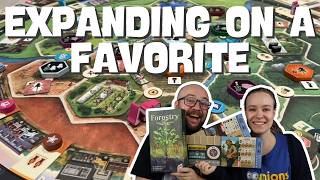
Forestry has earned a warm reception from reviewers who gravitate toward dense, well-constructed Euro games. The consensus that keeps emerging is that this is a game doing everything competently and doing it in a way that rewards focused, efficient play. Tabletop Turtle put it bluntly: Forestry is "the most euro of Euro board games," a game "euroing all over the place," but one they ultimately chose to keep. Rahdo Runs Through placed it at number 16 on a list of top anticipated Essen Spiel games he had already played, praising its thematic coherence around sustainable logging and its surprisingly smooth teachability despite the breadth of its systems. Board Gaming Ramblings listed it twice in their October top three, once for their two-player experience and once for a four-player session, calling it "a really, really solid game" and "just plain fun."
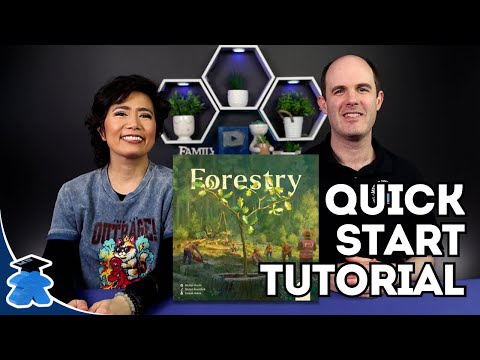
The game is not for everyone. Tabletop Turtle noted clearly that if you are not already a Euro fan, Forestry is unlikely to convert you. But for the audience it targets, reviewers consistently describe a satisfying, cerebral experience where smart play feels genuinely rewarding. Before You Play's two-player playthrough shows that even early rounds establish meaningful tension around action economy, positioning, and resource flow.
Core Mechanics That Define Forestry
Action Points and the Dual-Worker System
At its heart, Forestry is an action point game. Players begin each round with three action points and spend them across a menu of roughly ten different action types, split between a harvester who moves around the main board and a sawmill manager stationed at one of three processing complexes. The harvester handles logging, reforestation, building placement, and collecting forester tokens. The sawmill manager unlocks building abilities, processes wood into the specific types contracts require, and can upgrade sawmill buildings to generate passive income when others use them.
Rahdo highlighted the puzzle at the center of every turn: how to extract maximum value from three, four, or eventually five or six action points when the list of things you want to accomplish always exceeds what you can actually do. Movement costs an action point, which Tabletop Turtle identified as one of the game's genuinely frustrating design choices. You feel the loss every time you spend an action simply repositioning rather than producing. But Before You Play demonstrated how players adapt, anchoring their harvester near a productive hex and alternating harvest and reforest actions to keep the same space cycling efficiently.
Action points can be expanded through the development track, which players advance by collecting stars from harvesting, reforesting, and filling their reward track. This creates a pleasing long arc: early rounds are tight and deliberate, while later rounds open up with more options and more powerful combo chains.
Contracts, Wood Processing, and the Water Track Multiplier
The main scoring loop runs through contracts. Each contract requires a specific type of wood, processed in a specific way (dried, pickled, or planed), and fulfilling one earns points, coins, stars, and icons that feed into end-game scoring multipliers. The five wood types and three processing methods create a web of requirements that forces players to plan several actions ahead: harvest the right tree, get it to the right sawmill, process it, then spend an action to fulfill the contract.
The water track multiplier is the game's most distinctive scoring system. Players build water structures onto the board, and each structure introduces a scoring token tied to a category: forester tokens collected, contract icons earned, or other tracked quantities. The multiplier starts at one times but can be pushed higher by fulfilling certain board conditions, turning an already meaningful scoring category into a potentially massive end-game swing. Before You Play spent considerable time during their playthrough evaluating which water structure best aligned with their emerging strategy, illustrating how this system forces long-term commitment over short-term optimization.
The Forestry Experience
Tight, Clock-Driven Tension
Forestry plays over ten rounds, and reviewers consistently describe a feeling of pressure that builds as the round track counts down. Tabletop Turtle compared it to White Castle, noting that the visible countdown creates a constant awareness that every action matters and no turn can be wasted. Rahdo described the experience of looking at your player aid and seeing all the possible actions you could take, then realizing you will accomplish only a fraction of them before the game ends.
This is not a chaotic tension but a cerebral one. Tabletop Turtle noted that Forestry makes players feel smart, crediting the game with creating moments where you look at your setup and think through a chain of actions that all connect. The feeling of executing a clean, efficient turn generates genuine satisfaction precisely because the opportunity cost of every choice is so visible.
Ecological Rhythm and Thematic Coherence
One of Forestry's most praised qualities is how cleanly its theme and mechanics interlock. The harvest-and-reforest cycle is not just flavor: you physically cannot harvest a depleted space until someone spends actions to replant it. Before You Play captured this rhythm in the opening rounds, with both players alternating between extracting resources and flipping tokens back to their productive side. The game's rulebook, they noted, is filled with real-world information about different tree species and processing methods, and the thematic grounding gives even abstract decisions a tangible logic.
Rahdo singled out the contracts specifically for this quality. The products players are building from lumber are often surprising: wooden satellite components, bicycle helmets, transparent wood panels. These details make the game's story of ecologically responsible industry feel genuinely told rather than pasted on. Tabletop Turtle noted with amusement that players are building "weird things that should probably never be made out of wood, like bicycle helmets," which adds a lighthearted texture to an otherwise cerebral game.
What Makes Forestry Stand Out
Engine Building Within a Fixed Structure
Forestry is built around the satisfying arc of an engine that grows over a fixed number of rounds rather than expanding indefinitely. The technology track on each player's board offers ongoing bonuses that compound: gaining a star whenever you move your harvester, earning a coin and star each time you fulfill a contract, or triggering additional rewards when you build water structures. These technologies are not available all at once. Players must advance their development track, choose which ongoing bonus to unlock, and then build actions around that bonus for the rest of the game.
Tabletop Turtle described this as "a lot of comboing" emerging from the track system, and identified the player board's grid of unlockable spaces (which they likened to "euro bingo") as something that feels very satisfying to fill out even if it looks unusual at first glance. The game rewards players who commit to a direction and reinforce it rather than spreading thinly across every available system.
Meaningful Interaction Without Aggression
Forestry sits in the pleasant range of player interaction that most Euro fans prefer. There is no direct conflict, but there are genuine reasons to pay attention to opponents. Harvesters compete for the same board spaces; only one player can occupy a given location at a time. Sawmill buildings can be upgraded by any player, and whoever upgrades earns a coin each time others use that building in a two-player game. Forester tokens trigger an end-game competition where the player with the most earns ten points, second earns six, and third earns two, creating a meaningful secondary contest that runs parallel to contract fulfillment.
Tabletop Turtle acknowledged they wanted more conflict (they self-identified as competitive players who enjoy blocking), then admitted the interaction that does exist is well-designed. Board Gaming Ramblings described the game with affection at multiple player counts, finding the experience enjoyable both at two and four players.
Potential Drawbacks
The Cost of Moving
The most consistently cited frustration is that moving your harvester costs a full action point. In a game where you begin with only three actions per round, spending one simply to reposition feels punishing. Tabletop Turtle called this out directly: the game showers you with rewards for productive actions, making the neutral act of movement feel disproportionately expensive by comparison. Before You Play responded to this constraint by staying anchored in one area of the board early in the game, cycling the same hex repeatedly, which works but can feel limiting when good opportunities appear elsewhere.
Rahdo also acknowledged the initial complexity of the player aid, noting that the first time you look at every possible action and its point cost, it can feel overwhelming. He concluded that the game plays smoother than it looks once you have a session under your belt, but the first play carries a real cognitive load.
Audience Specificity
Forestry makes no concessions to casual or gateway players. Tabletop Turtle's assessment was plain: if you are on the fence about Euros, this game will not help, and if you actively dislike them, Forestry will not change your mind. The game's density of systems, the range of action types, the interconnected scoring categories, and the fixed-round clock all serve players who already enjoy this style of game. This is not a criticism of the design so much as a clear description of its intended audience. For players who love tight, optimization-focused Euro games, Forestry delivers exactly what they are looking for.
If You Enjoy Forestry
Tabletop Turtle directly compared Forestry to White Castle, citing the shared sense of ticking-clock pressure and the feeling that no action can be wasted. If Forestry's combination of action-point management, contract fulfillment, and visible round countdown resonated with you, White Castle occupies the same emotional and mechanical space. Rahdo's countdown placed Forestry in a group of games built around optimizing a fixed resource under time pressure, a category that also includes economic Euros where every turn is an opportunity cost calculation.
Reviewers also referenced Epidora and King Domino in adjacent discussions about games in the set-collection and tile-building space, though these are lighter experiences than Forestry. For players interested in the ecological and nature theme specifically, Forestry's dual focus on harvesting and sustainability is relatively rare in the board game landscape. Its closest spiritual relatives are dense Euro games where the theme is structurally embedded rather than decorative, and where engine-building rewards emerge from careful planning across many interconnected systems.
What Reviewers Are Saying
"Forestry is the most euro of Euro board games. It is euroing all over the place, but it is a good Euro game. It is a solid game and it has a decent amount of interaction. All of which is, begrudgingly as I have to admit it, I enjoy. There's no mean. Well, that's not true. You can be a little mean in this game. There are ways in which you can sort of get in people's way here and there and sort of block people's spaces off, but more often than not you're just kind of doing your own thing."
— Tabletop Turtle
"I am really a huge fan because of the theme. This is a game about running logging operations in an ecologically friendly way, focusing just as much on the reforestation as we do on the chopping down and transport of lumber. Every round it's going to be a puzzle of how do I use my three or four or five action points to get the most out of this. It's a sharp game. It plays smooth. While it is a big game with a lot of moving pieces, it's really elegant and easy to teach."
— Rahdo Runs Through
"Forestry is a really, really solid game about forestry. It gets even better. I really enjoyed it with two, but I really enjoyed it with four as well. It's just plain fun."
— Board Gaming Ramblings