/pic2296858.jpg)
In Forge War, players will take on the role of blacksmiths in a kingdom rife with marauding harpies, cursed dungeons and fire-breathing dragons. They are charged with gathering ore from the mines, purchasing weapon designs from the market and then using these resources to forge weapons for adventurers who will go on quests to fight back the ever-deepening darkness. If the adventurers are successful, they will return with more ore, money and other rewards with which players can invest back into their burgeoning weaponsmithing empire.
At its core, Forge War is a rewarding game of aggressive investment, which occurs through the acquisition of quests. Quest management becomes challenging for the player, however, because quests undertaken aren't completed immediately, but instead progress each turn and become more difficult. At specific time intervals, players will need to add more resources to their quests or face failure.
Gameplay cycles through three different phases in each round. The first phase consists of moving pieces around a hex grid to maximize resource production. The second phase is a market phase that features an action blocking mechanic to gain access to new weapon plans and other advantages. The final phase is the acquisition and management of quests, which are selected from a pool of available cards.

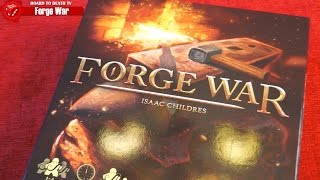
- Lots of immediate tactics to long-term strategy.
- Nice subtle player interaction.
- It holds player interest until the end.
- Well balanced with many avenues for victory.
- Rule book and player mat make learning curve easier.
- Components are good and numerous.
- Replay value.
- Can pose serious analysis paralysis moments.
- Timing feels off: too short in standard game, too long in epic game.
- Artwork could be more vibrant and less muted.
- Adventuring Guild
Mechanics (from transcript analysis)
- Endgame bonuses — Players can buy endgame bonuses by playing action discs in specific spaces.
- Marketplace — Players buy unique weapons, bonus cards, single-use cards, or claim public designs.
- questing — Players acquire quests, send adventurers with weapons to complete them, and gain rewards.
- Resource Management — Players manage copper, iron, and emerald resources to craft weapons and buy cards.
- Set Collection — Collecting unique weapons, completed quests, and adventuring levels contribute to scoring.
- turn order track — Turn order is rearranged based on who has the fewest miners, and can be influenced by a player choosing to move an overseer a second time.
- Worker Placement — Players place their overseers on the board to take actions.
Video topics + discussion points
Quotes (from this video)
- The mechanics from worker placement blocking in the market phase, turn order importance from being first for market and Quest choice and the original mind movement system offers nice subtle player interaction.
- The planning aspects through the game can pose some serious analysis paralysis moments in the game and in the Epic version this does make the game long.
- In the standard game it was too short and in the epic game it felt just a little too long.
- It is a very good game and it still did very much hold every player's interest right up until the end.
- It is very well balanced with many avenues for victory.
- The rule book is written well enough and turn order even include page reference on the player mat that makes the learning curve a lot easier.
- The components are really good and numerous but I just wish the artwork would have popped more it seemed to me that I kind of got lost and was blended too much with the choice of colors kind of felt muted for me but definitely at no detriment to the game.
- All in all Forge war is a game that remain in my collection.
- It gets an 8.5 out of 10
References (from this video)
- one of my favorite games right now
Mechanics (from transcript analysis)
Video topics + discussion points
Quotes (from this video)
- Uh, Forge War. Uh, and he just told me he was that was his first time designing a game. That was really impressive, man.
- Obviously, this is a prototype. I should mention that. Uh, but the artwork still looks amazing.
- So, there's sort of two levels to the game. You know, you've got your tactical combat game, uh, where you're going to run through and fight monsters in a dungeon, and then that's sort of stitched together over multiple scenarios with a larger campaign setting where you've got character progression, people leveling up, and, you know, getting cool items and abilities and stuff like that.
- So, you're going to play the top ability of one card and the bottom ability of the other card.
- And even if you don't want to do an ability that's listed on here, any card can be used as an attack two on the top and a move two on the bottom.
- So, the whole point of each scenario is to complete the objective the same before that happens.
- Uh I I think your style of gaming appeals more to us. More of a Euro style, I believe you have. Uh and and we always love the theme of ameritra game theming.
References (from this video)

- wildly successful Kickstarter
- many people thought it was fantastic
- host initially judged Kickstarter games harshly
- host regrets not trying the prototype earlier
- Love Letter
Mechanics (from transcript analysis)
Video topics + discussion points
Quotes (from this video)
- Love letter she loves love letter
- The first game doesn't mean anything don't worry about it you might mess up a couple of rules worse comes to worse next time you play the game you fix it
- I think the most complex game I've ever played is Empires and Arms
- but munchkin is a game that I've played where it's it's going on on like and on and on and it's because of the luck factor and it's also because of the beat up on the leader
- I think the most played app would be suer Wars I've played like over 300 games of that
- cheaters or jerks that's what we always say
- I don't underestimate the number of people who might be interested in attending don't underestimate the amount of work it's going to be
- I want to win too believe me like I want to win the game that that's fun but um I don't get wanting to win that much that to me seems dangerous or scary
References (from this video)
- Strong thematic integration with lawn care and neighborly interaction
- Short playtime (about 20 minutes) makes it accessible
- Compact two-player design with meaningful choices
- Diverse card effects lead to multiple viable strategies
- Clear visual and tactile cues for stacking and scoring
- Some top-heavy stacking can crowd space on the board (oak/beanstock interactions)
- Take-that mechanics can be punishing and slow momentum if opponents counter frequently
- Limited one-on-one planning might feel repetitive after several plays
- Lawn care, gardening, neighborly rivalry, and social interaction
- Residential lawn and neighborhood backyard scenario focused on lawn care and social competition
- Competitive tableau-building with take-that elements
Mechanics (from transcript analysis)
- barbecue_and_neighbor_sway — Grill and other social cards can sway neighbors for points, at a cost of coins.
- Card/Chit Market — A marketplace with five cards; players buy cards that improve their tableau; market replenishes after each purchase.
- End Game Bonuses — The game ends when the fifth neighbor is claimed (or removed) from the board, triggering final scoring.
- end_game_condition — The game ends when the fifth neighbor is claimed (or removed) from the board, triggering final scoring.
- marketplace_and_purchasing — A marketplace with five cards; players buy cards that improve their tableau; market replenishes after each purchase.
- Resource Management — Coins and the piggy bank track monetization; grass vs dirt, and the number of cards stacked affects points.
- resource_management_and_scoring — Coins and the piggy bank track monetization; grass vs dirt, and the number of cards stacked affects points.
- Stacking and Balancing — Plus signs on cards determine how many cards can be stacked and what bonuses are earned.
- stacking_and_bonuses — Plus signs on cards determine how many cards can be stacked and what bonuses are earned.
- start_of_turn_abilities — Any start-of-turn abilities may be played in any order before taking other actions.
- Tableau Building — Players stack and arrange cards to form a personal yard tableau, with bonuses for stacked cards.
- tableau_building — Players stack and arrange cards to form a personal yard tableau, with bonuses for stacked cards.
- take_that_cards — Pest-like cards can be played to affect the opponent's yard, sending cards back to the garage.
- trash_and_yard_management — Rake and other cards let you trash cards from your yard or the store; pests and moles can regress progress.
Video topics + discussion points
Quotes (from this video)
- it's a super thematic game
- easy to understand and relate to
- it's coming to kickstarter very soon
- you can invite people over for a barbecue
- you've got a grill in your yard that all makes sense
References (from this video)
- Strong thematic appeal with a playful Halloween motif
- Clever Home/Away mechanic adds depth and tension
- Accessible two-player design with quick play time (~20 mins)
- Two-player only
- Take-that elements can be frustrating for some players
- Market replenishment can introduce additional luck/risk dynamics
- Halloween-themed turf warfare with decorations, trick-or-treaters, and Halloween-adjacent characters.
- Suburban neighborhood with yards and neighborly competition.
- Light, thematic, family-friendly
Mechanics (from transcript analysis)
- Deck Building — Drafting cards into your deck from the market and then playing them into a yard tableau.
- deck-building — Drafting cards into your deck from the market and then playing them into a yard tableau.
- home-away mechanic — You are either at home (defend and build) or away (sabotage and market actions); interruptions depend on where you are.
- market risk and drafting — Drafting from the market and replenishing it can open you to counterplays and risk from pests.
- Risk Management — Drafting from the market and replenishing it can open you to counterplays and risk from pests.
- Tableau Building — Playing cards into a yard tableau to earn points based on layout and synergy.
- tableau-building — Playing cards into a yard tableau to earn points based on layout and synergy.
- Take That — Pests and sabotaging cards can disrupt an opponent's plans by acting on their yard.
- take-that — Pests and sabotaging cards can disrupt an opponent's plans by acting on their yard.
Video topics + discussion points
Quotes (from this video)
- Trick-or-treaters come to your door you give them candy or they play a trick on you
- the candy is really important because there are some new cards in the deck
- they kept that clever Home and Away mechanism
References (from this video)

- Interesting theme and mechanics
- Uncertainty about current print status
- crafting
Mechanics (from transcript analysis)
- crafting — Players are forging items, weapons, and armor.
- Memory — Has a memory element.
Video topics + discussion points
Quotes (from this video)
- this is absolutely my number one for games you could play forever because I have played many games of this this game.
- This is basically Scrabble meets Dominion.
- It is brutal, it is harrowing, it beats you up, and it requires near-perfect precision play.
- It is maybe the greatest board game of all time.
- the puzzle here never gets old.
- Wonderland's War is so good.
- Forge War is the game Isaac Childres put out before Gloomhaven.
- Billy says it's a crafting game. That makes sense as you are forging Are you forging wars or are you forging swords or are you forging dwarves? Are you dwarves who forge the swords in a war? Maybe maybe all of them. Maybe all of it. Oh, cool. That sounds cool. I'll have to keep Is it still in print, Billy? Do you know? I don't know if if it's still in print or not.
- Unfortunately, Richard, the masses have spoken and it is Everdell that is better than Wondrous Creatures in a 58% of the vote win.
- If I had a top 12 people list of who I would want to play games with forever, Ruel would be my numbers 1 to 11. The 12th spot is still open, so I am taking applications, but you better get in quick because Ruel's very charming and he's very handsome, too. And I like not looking at the board game, but looking into his beautiful, beautiful eyes.
References (from this video)
- Considered very good by the host
- Player recognized it as a game where 'Hey, That's My Fish!' is played within it
- Player initially had no clue and guessed incorrectly
- Player received zero points for guessing
- Adventurous guild tasked with gathering resources, slaying monsters, and earning riches and prestige.
- Wild lands
- Tainted Grail
- Hey, That's My Fish!
Mechanics (from transcript analysis)
- crafting — Getting weapon designs to forge implements of victory.
- economic management — A competitive game of economic management.
- player interaction — A complex game full of player interaction.
- questing — Undertaking quests set forth by the king to slay monsters.
- Resource gathering — Navigating a kingdom's mine to gather metals and precious gems.
- spatial reasoning — A competitive game of spatial reasoning.
- variable game length — Can be played in about an hour or a longer three-stage game.
Video topics + discussion points
Quotes (from this video)
- hello young adventurers you have found the treasure hidden in the jungle
- this is the most important and most fun thing to watch so guessing the last number
- the designer root and John company
- the second word starts with the same twool letter as the first word
- Venice the city of bridges and and gondales
- the overcrowded Metropolis spread across the Earth Humanity has realized it's time to establish a new home on the ocean floor
- hey that's my fish
References (from this video)

- Big heavy strategic game
- Awesome
- Very very game
- One of the most game game
- Happy to play
- Hard to get
- Will likely never get a reprint
- Short game is boring
- Full game takes forever
- Building an army of Rodo
- Gloomhaven
Mechanics (from transcript analysis)
- action selection — Players can perform one action per round after placing workers.
- contract fulfillment — Completing contracts with specific timing requirements.
- Resource Management — Gathering necessary resources to fulfill contracts.
- Worker Placement — Players place workers to mine resources and take actions.
Video topics + discussion points
Quotes (from this video)
- So, the fewer things you're saying you're going to do this turn, the earlier you will be in the turn order and that it seems so crucial.
- But it is one of those where it's it's as you said like it's it's pretty simple. It's a lightish game but with a lot of great decisions and a lot of fun.
- So it's a very I would say um tactical game. We're trying to see opportunities like oh now you opened up that opportunity. I should probably capitalize on that but that was not my plan to stop there.
- It has frustrating moments.
- And the mayor is always there. If you're a first player, you're going to get that mayor plunk down your city and he's not going to move. He's just going to be looking at your buildings and standing in the way of your building plans because all the other people decide where the mayor goes.
- I recommend if you are into heavy games. If you're not into heavy games, go away. I mean, stay away from the game.
References (from this video)
- deep, heavy, and strategic
- engaging for experienced gamers
- steep learning curve
- long playtime can be daunting
- meaty tactical conflict with quests
- fantasy world of forging and warfare
- puzzle-like strategic planning
Mechanics (from transcript analysis)
- grid/resource management — manage a grid-like map to gather resources
- quest-based progression — fulfill weapon/quest requirements to advance stages
- Resource Management — manage a grid-like map to gather resources
- Track Advancement — fulfill weapon/quest requirements to advance stages
- Worker Placement — one worker per turn, limiting actions and driving planning
Video topics + discussion points
Quotes (from this video)
- I don't like this game I think there are way better gateways out there
- it's a classic to keep this game in the collection
- we play this so much when it came out
- I strongly recommend it I really enjoyed my time with this
- it's a really cool game because it's me and explaining you know hidden movement
- this is a really city-building game and its really a somatic
- this is a really cool gateway game
- it's best with more people
- the factions change the game completely
- this is a heavy game I think this was in my top 10 heavy games