/pic6699425.png)
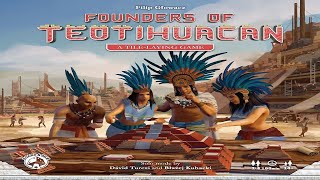
Travel back in time to the founding of one of the greatest cities of Mesoamerica and become a part of its history once again. Design the foundations of a great pre-Columbian civilization, with its buildings, temples, and a grand pyramid in the center. Find perfect locations for production buildings and great temples, and build the might of the great pyramid overlooking your city. Establish yourself as the very best among competing architects, and your project will secure you a spot among the great Founders of Teotihuacan!
Founders of Teotihuacan is a strategy game where you compete against your friends to create the best design of the city of Teotihuacan. Over the course of three to four rounds you will place your action disks to the main board, forming towers of varying strength, strategically use the bonuses they offer, and construct temples, resource buildings and the pyramid central to your project of Teotihuacan. You will balance generating resources and using them, as finding good locations on your city board becomes increasingly more difficult, and you will try to outwit your opponents, making use of an innovative and interactive action system. Finally, once the eclipse comes, all designs will be assessed and the player with the most points will win and become the architect to join the ranks of Founders of Teotihuacan!
Founders of Teotihuacan is a stand-alone game, related to Teotihuacan: City of Gods only by the shared setting of the ancient city of Teotihuacan. Thematically, the events in Founders takes place at an earlier time in history, while what was to become a magnificent city was yet in its infancy and only few inhabited the area.
On your turn, you must either perform an Action or pass. To perform an Action, place between 1 and 3 of your Action disks on an Action space on the Main board that already contains at least one disk (minimum a Bonus disk and possibly also opponent disk(s)), and carry out a corresponding Action. The Action disk(s) should be placed on top of the disk(s) already on that space, forming a stack. Each Action space can hold a maximum of 4 Action disks—including Bonus disks!
Your personal player board is divided into four Districts or quadrants. Buildings and Temples can only be placed within the two Districts closest to your Architect. Pyramid tiles can only be placed within the six Pyramid squares closest to your Architect. Your Action Strength is equal to the total number of disks (whether yours, an opponent’s disks, or Bonus disks) on an Action space.
After performing an Action (not when passing), move your Architect clockwise to the next side of your Player board, signifying
the end of your turn. This changes your Architect's Reach for your next turn. After all players have passed, the current round ends.
After the game has ended, players score additional Victory Points for how well their Districts complement their Pyramid.
—description from the publisher

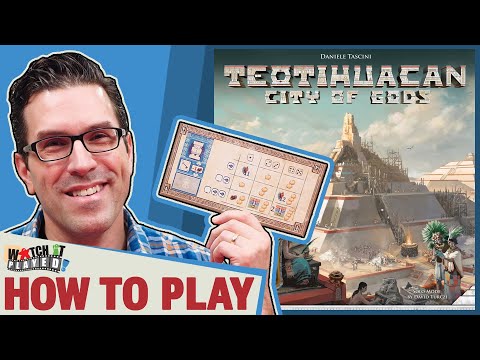
Teotihuacan - How To Play

- Deep and rewarding strategic gameplay.
- Satisfying engine-building elements.
- The connection to Teotihuacan makes it thematically interesting.
- Can be overwhelming for new players due to its complexity.
- The learning curve is steep.
- building and developing the city of Teotihuacan.
- ancient Mesoamerica, specifically the city of Teotihuacan.
Mechanics (from transcript analysis)
- Action Point Allowance — players have a set number of action points to spend each turn.
- Area development — players contribute to the development of different areas of the city.
- Resource Management — managing different types of resources is crucial for progress.
- Worker Placement — players place workers on action spaces to gain resources or perform actions.
Video topics + discussion points
Quotes (from this video)
- The people who run RageCon are just a dang delight.
- The Rage Bucks thing going on, and let me tell you what a great program.
- It's fantastically simple to do. It's really easy to figure out where the game is going to be, how many players you want.
- The space worked great. There was plenty of space. You didn't feel crowded.
References (from this video)
- Lots of playability based off the setup
- Workers level up and retire giving bonuses
- Rondel action selection system
- Lots of thinkiness and crunchiness
- High replayability
- Lots of different ways to score points
- Tracks to climb
- Sets to collect
- Tiles to move and set
- Complex
- Not for beginners
- Potential for significant downtime with more players
- Expansion box used, not the full game
Mechanics (from transcript analysis)
- Rondel — the on the board, you've got these different areas on the board that you can move your worker to and you can move up to like three spaces. But you have to go in around. So it's kind of like a rondel action selection system.
- Worker Placement (Dice) — the action selection is you moving your workers which are represented as dice. And the level of the worker is represented by the number on the die. And every time you use that worker, it levels up. And once it gets to a certain level, it retires and you have to get new worker. But when you retire workers, that also gives bonuses.
Video topics + discussion points
Quotes (from this video)
- But, um, at the end of February, or more like kind of like three three-fourths of the way through it, my youngest daughter had a stroke. She's 18.
- But, uh, we are counting blessings all over the place.
- So, uh, that is part of the reason why I haven't got this done sooner.
- Sentinels of the Multiverse has a got a really interesting worker placement system.
- This is probably the most if not one of the most complicated games in my collection. It's complex.
- And it is diplomacy.
- So, it can get personal. But it shouldn't.
- It's a game that that has that and you you go into it. It's conniving, it's backstabbing, it's coordinating.
- It is just a really good classic game
- This is a very interesting hand management game.
- It is the at probably the prototypical train robbery game because it's an the board is an actual train where you can be in the train cars or on the roof.
- no board games were harmed in the filming of this episode.
References (from this video)

- Player crates hold all player pieces and look premium.
- Alternate markers and tents replace triangles, fitting the theme.
- Volcanoes add a crucial 3D element to the board.
- Terrain tile holder is well-printed and matches the game's look.
- Treasure trove and rings add a premium feel and a nice place for tokens.
- Temple tile holders match the temple tiles and add to the aesthetic.
- Action counter as an abacus fits the theme and is functional.
- All upgrades fit back into the box with little to no lid lift.
- Temple tile holders can make the numbers on the tiles more difficult to see.
- Ancient Mesoamerica, pyramid building
Mechanics (from transcript analysis)
- Set Collection — Implied by the discussion of building temples and volcanoes.
- Worker Placement — Implied by the discussion of action points and managing them with an abacus.
Video topics + discussion points
Quotes (from this video)
- So we spend a lot of time, by we I mean a lot of time it's Tom, spending a lot of time trying to find some of the best upgrades and storage solutions that we have in our library and our personal collections.
- Anything I can put on the board that gives that 3D feel, I'm all for it.
- This just adds that 3D element to this.
- These are all just really quality of life upgrade, especially the tokens.
- Makes man, Clank! Catacombs just leap off the table.
- These kind of get that wow factor.
- This adds that 3D element to this.
- It condensed all those boxes down to this.
- It's easier to bring out Villainous this, open it up, pick your character.
- If it's one of your favorite games, getting it to look really good, that's what it's all about, man.
- It really immerses me in the theme.
References (from this video)
- Perfect blend of strategy, tile placement, and diminishing action selections.
- Clean and balanced game with close scoring spreads.
- Meaty yet fairly fast-paced gameplay.
- Lots of choices without being overwhelming.
- Tight action economy with diminishing actions.
- Strategic interplay and consideration of opponent's moves.
- Meaningful choices where every bonus tile is valuable.
- Engaging puzzle that encourages replayability with different strategies.
- Simple to learn with straightforward mechanics.
- Variable starting layouts offer replayability.
- Solid at two players.
- No insert included in the game, making storage frustrating.
- Mask scoring diminishes quickly in a two-player game.
- The name 'Founders of Teotihuacan' is not a fan favorite, but it is what it is.
- Victory point tracking goes up to 80, which is considered a weird victory point thing and requires players to constantly track their own scores.
- No stated cap on hoarding worship tiles in the rulebook, which could be a potential issue for gameplay balance.
- Founders of Gloomhaven
- Teotihuacan
- Isle of Cats
Mechanics (from transcript analysis)
- action selection — Players select actions using discs, with the number of available actions diminishing each round.
- Resource Management — Players gather and spend various resources to build buildings and temples.
- Set Collection — Collecting sets of masks provides immediate victory points.
- Tile Placement — The game involves strategic tile placement on a player board, influenced by an architect's position.
- Variable Player Powers (Implied) — The different starting player boards offer unique starting conditions and resource distributions.
- Worker placement (implied) — The movement of the architect on the board dictates where buildings can be placed, similar to a worker placement mechanism.
Video topics + discussion points
Quotes (from this video)
- nope nope uh i think this game is really really good
- that's super fascinating yes it's such a clean balanced game right
- i really enjoy it
- it's really three columns with an a or b side to it
- yeah so we have played this uh game multiple times both vying for well the first one was a little bit more we did the same strategy yeah kind of this one we totally started on opposite ends right um and and the spread was about the same yeah yeah eight points to ten points right
- the main one is the fact there is no insert in this [ __ ] game they didn't even come with bags
- i don't like the masks like i i think yeah they're immediate victory points but at least in a two-player game the points diminish very quickly right
- it feels like the game that it's kind of played off of where it's lots of choices yeah and it's familiar right if people are like why would they get this instead of t well they're radically different games yeah they're like completely different dice replacement rondelle versus right a polyamino game
- philip glow wax um i hope that's how it's pronounced uh he killed it this is a a shock because this came out this year obviously for 2022
- on scale of one to ten what would you give founders of teotihuacan a thailand game probably nine nine
- it's so good it's good uh board and dice is just one of those companies to keep an eye out for because they just they just make great games
- oh another thing that this game is very simple to learn
- the architect denotes where you can place right and final scoring right
- i don't like the fact that it goes up to 80 because that's such a weird victory point thing
- it's so solid yes
References (from this video)

- Solid polyomino game
- Clean gameplay
- Stayed in collection
- Decent solo mode
- Building a city/pyramid
- Founders of Gloomhaven
- Teotihuacan: City of Gods
Mechanics (from transcript analysis)
- Objective Fulfillment — Players complete objectives that score points.
- Polyamino — The game is described as a polyamino style game where players place tiles on top of other tiles.
- Resource Management — Collecting resources by building on top of placed tiles.
- Tile Placement — Players place tiles to build the pyramid.
Video topics + discussion points
Quotes (from this video)
- Brad and I will be doing our top five surprise games of the year
- none of our surprise games are in our top ten of the year
- This one just took me by surprise because of just how clean it was
- it's just very clean in what it does
- the effect of your card will depend on the back of the cards of the other players
- how surprised I am of how good it got as I played more of the expansions
- this game is fantastic
- it just blew me away with the way that this is how kind of a Kickstarter I almost feel should be done
- it's really neat because it's it's got a ton of tiles out in the center
- it looks super cute
- this is a smaller box game with unlimited possibilities that should not have worked but does really well
- either you're gonna really like it or you're going to really hate it
- it's its complexity is lower than a lot of the other games that these guys have made
- purely for its art
- it's just a Pleasant game
- this is a no-brainer
- this is exactly this I would never have even entertain the idea of playing something like this
- the weird suspense of the Alfred Hitchcock theme where was it was there actually a murder or was there not
- I was blown away honestly
- it's pretty damn good
- this one's super solid
References (from this video)
- Pretty damn good
- Works well at two players
- Enjoyable puzzle aspect
- Solid gameplay
- Good solo mode
- Looks kind of blah
- Some perceived it as a cash grab using the Teotihuacan name
- Building a city/pyramid
- Founders of Gloomhaven
- Teotihuacan: City of Gods
Mechanics (from transcript analysis)
- Polyamino — Uses tetromino-shaped tiles for placement.
- Resource Management — Collecting resources associated with placed tiles.
- Tile Placement — Placing tiles to build up the pyramid.
- Worker Placement — Using disks to go to locations, costing more to access certain spots.
Video topics + discussion points
Quotes (from this video)
- Brad and I will be doing our top five surprise games of the year
- none of our surprise games are in our top ten of the year
- This one just took me by surprise because of just how clean it was
- it's just very clean in what it does
- the effect of your card will depend on the back of the cards of the other players
- how surprised I am of how good it got as I played more of the expansions
- this game is fantastic
- it just blew me away with the way that this is how kind of a Kickstarter I almost feel should be done
- it's really neat because it's it's got a ton of tiles out in the center
- it looks super cute
- this is a smaller box game with unlimited possibilities that should not have worked but does really well
- either you're gonna really like it or you're going to really hate it
- it's its complexity is lower than a lot of the other games that these guys have made
- purely for its art
- it's just a Pleasant game
- this is a no-brainer
- this is exactly this I would never have even entertain the idea of playing something like this
- the weird suspense of the Alfred Hitchcock theme where was it was there actually a murder or was there not
- I was blown away honestly
- it's pretty damn good
- this one's super solid
References (from this video)

- Great game, fun to play again
- Expansion was a nice addition though not strictly necessary
- Expansion not deemed essential by one player
Mechanics (from transcript analysis)
Video topics + discussion points
Quotes (from this video)
- It's been a lot of good games we played this month. I could make like a top 10 team.
- The most important thing other than having fun is winning. You know, winning is like it's not really, but it's a thing.
- We're in it to win it.
- Because we cry a lot while playing this game and with our friends.
- It is really group dependent.
- I really like spatial puzzles, but I like spatial puzzles which doesn't just feel like randomness.
- It's just boring.
- It is interesting when you get let down with games you already played because you are sometimes you're very hyped about a new game, but then you're like you have these feelings and experiences of the game and it kind of feels different.
- It has a few things in it that I shouldn't like that cooperate cooperation.
- This is a word game and I think it worked very very well because it is a language independent.
- It was easier than I thought it would be and also more fun.
- Drillers just gave me that oh, I want to go again feeling and it's been some time since I played a deck builder that gave me like this amount of joy.
- It's really fun uh resource management puzzle all to do the best and score points which I have been kind of good at but then you are getting more and more efficient and winning.
- I liked the expansion but I didn't like the expansion.
- It has like like cog system that revolves like
- It's this and of course it's it's cool with the gimmick of it's actually moving around in the adding to the board.
- It is a action selection game with a Mancala style energy revolvement.
- It is really nice, especially the four-player version has so much interaction in like a positive and if you don't like interaction in the four-player game there is quite a lot of it, but not not negative take that the like great positive I'm saying positive interaction.
- It's been a blast to play it again.
References (from this video)

- civilization-building
- Teotihuacan
Mechanics (from transcript analysis)
Video topics + discussion points
Quotes (from this video)
- it's a sleuthing and cooperative game where everybody tries to figure out what actually happened and you can use the internet and Wikipedia
- Isle of Skye it's one of my favorite games ever well my favorite game so far definitely a top-10 game at this point
- the full released copy of Teotihuacan
- I'm writing these large documents with just all of these different thoughts that I have for ways that these games can be tweaked
References (from this video)
- There is wonderful stuff going on in the game
- Too many tracks and too much extra stuff; not streamlined
- pyramid-building with multiple tracks and complex flow
- Teotihuacan (ancient city)
Mechanics (from transcript analysis)
- multi-track progression with penalties — described as a 90-minute medium-weight euro with extra stuff
Video topics + discussion points
Quotes (from this video)
- "Wing span won by like three votes over Crusaders"
- "I'll give this one a try for sure"
- "there is a wonderful stuff going on in this game but I feel like there is a great 90 ish minute medium-weight euro game in here that is just being suffocated by extra stuff"
- "I pretty much never care about games that Fantasy Flight puts out there"
References (from this video)

- difficulty pronouncing the name
Mechanics (from transcript analysis)
Video topics + discussion points
Quotes (from this video)
- people sometimes ask me to do a top ten and if i ever did one twilight struggle would certainly be on it
- this is a two player brain burning tension filled cold war themed masterpiece that has been on bgg's top 10 for over a decade
- i'm very happy to see this released
- if you know what it is if you believe you know what it is and you can prove maybe you can find someone local pronouncing it pronouncing it oh lord pronouncing it see i got problems right from the start
- i really like how they match the color of the plastic to the artwork on the token so this way they just fit right into the game
- i've never played but i've heard lots of good things about newton
- maybe you should even it's just for yourself brighten it up a little bit
- it really is kind of their fresh interpretation
- i really like the way these turned out
- i'm a fan of these holders
- i think i accidentally did order a second copy of this
- allows you to immerse yourself further into the case
References (from this video)
- Has a 'pretty flat looking board' with no vertical table presence compared to games like Everdell.
- a pyramid / ziggurat
- Underwater Cities
- Everdell
Mechanics (from transcript analysis)
Video topics + discussion points
Quotes (from this video)
- i look kind of concerned, right? Look: my eyebrows are down.
- i'm a sick individual. But uh... i buy games for the dumbest reasons.
- As good as game as i've heard Terraforming Mars is, i'm going to wait until recessed boards are available before i make a purchase, because that seems like a pretty, uh... decent complaint about the game.
- Da da da da DA!
- Call me "Shorlock."
- Oh, just forget about it.
- Box Fart-O-Meter: zero. Are we surprised? i don't think so.
- Really, really bad! i'm not... at ALL impressed with the component quality on those!
- i think that's probably what he turned out to be in life.
- i'm such a jerk... i'm a jerk to Personal Assistant for no reason!
- i guess it's the future? i THINK that's what's happening? It's the future, and everybody's got wacky hair.
- The board is kind of not... lying flat, i've noticed. It's not really... it's kind of bubbling up. Have you ever ever had that problem?
- i'm going to save you... my casual racism.
- The people on these cards look like... kind of nerdy!
References (from this video)
- stacking action discs; thematic city-building
- rules depth unknown; may be heavier
- ancient Teotihuacan city-building; towers of action discs
Mechanics (from transcript analysis)
- action disc towers — place action discs to form towers and bonuses; balance resources and goods
Video topics + discussion points
Quotes (from this video)
- i'll be discussing 32 games that i have learned about over the last eight weeks
- gen con is happening
- arc nova it says you design a modern zoo and you run a successful park and you support conservation projects
References (from this video)

- Looks pretty fun
- Medium weight is liked
- Founders establishing a city
- Teotihuacan
- Teotihuacan: City of Gods
Mechanics (from transcript analysis)
- Action Points
- Tile Placement
- Worker Placement
Video topics + discussion points
Quotes (from this video)
- I'm Grant with Grant's gamerex back with my monthly video on the best games coming to retail uh this is the month of March 20122
- I guarantee I pronounce that wrong but I did my best okay founders of taakan
- You know so you can play you can play how our Health Care system is flawed here in America hey we want to treat patients but we want to make money doing it we don't care if you're healed if we don't make money so do you want to be frustrated by America's Health Care System then play Clinic
- if you've never played flux it is a small card game that is wacky and wild and always changing and that is the point of the game
- so if you're looking for a sort of Stone Age theme uh that involves a bunch of luck but is very accessible to all family members then check out fire and Stone from Pegasus
- it's sort of a murder mystery mixed with an escape room Style game
- this is actually a revised version of a game that came out in 2012 and a lot has changed here it is not the same game that came out in 2012
- they are educational publisher they publish educational games but they don't feel like educational games the whole you know the point of the game is to be a good game and to have a fun game and to have interesting gameplay all while educating you on a particular theme
- I love the community of board games and we help each other find good games
References (from this video)
- Plans to make a sponsored video; discussion of polyamino production and scoring.
Mechanics (from transcript analysis)
Video topics + discussion points
Quotes (from this video)
- I think I might be kind of done with it
- the best solution for us right now is my iphone
- we filmed two more playthroughs and those realistically should be the first ones that go public
- I really can't wait to hear what people think
- we're hoping to put out the gallerist later this month
References (from this video)
- Clever scoring mechanism based on pyramid size
- Strategic depth in planning and resource management
- Declining number of discs per round accelerates the game
- Good player interaction
- Easy to teach after the first round
- Excellent box insert for setup and reset
- Scoring track can be easily knocked off
- Some setup and reset time required
- Building a city and scoring victory points.
- Teotihuacan
Mechanics (from transcript analysis)
- Area Control — Controlling quadrants of the board to build temples and pyramids.
- disc placement — Placing discs on a track to select buildings or actions, with strength determined by accumulated discs.
- Engine Building — Building resource buildings to generate necessary resources over time.
- Resource Management — Gathering and spending gold, wood, and stone to build structures.
- Set Collection — Collecting scoring tiles and building temples of specific colors.
- Worker Placement — Placing workers (discs) to take actions and gain resources.
Video topics + discussion points
Quotes (from this video)
- The questions were so hilarious in the d i mean it was it was just i don't know i don't want to give any spoilers away but some of them were laugh out loud funny because of the of the answers that guy would give
- I absolutely love this game
- My body is made for something different
- It's an amazing game
- The battles i think are absolute genius i love the battle mechanic
- Decorum is a cooperative hidden information game where you and your housemate share the same objective decorate your home in a way that makes you all happy The problem is different things make each of you happy and nobody says exactly what they need Can you find a happy compromise or is it time to move out
- A game of passive aggressive cohabitation
- The insert of this is really really nicely done
- it's a very light game it's a very light area control game but i really love games with tech trees and i enjoyed rolling the dice and re-rolling and trying to take over what's nice
- you're a winner because you purchased this game and you bought it and you played it together
- it's not very heavy by any means sometimes the dice can mess you up
References (from this video)

- Cool mix of mechanisms.
- Doesn't get as much attention as it deserves.
- A step up from standard or gateway tile-laying games.
- Not overly heavy, plays in 45-60 minutes.
- Snappy turns with not much downtime.
- Building the city of Teotihuacan.
- The city of Teotihuacan
Mechanics (from transcript analysis)
- Polyomino — Using different polyominoes to build the city.
- Resource Management — Generating resources.
- Set Collection — Collecting sets for points.
- Tile Placement — Building the city with polyominoes.
Video topics + discussion points
Quotes (from this video)
- There's something so satisfying about fitting the pieces in together and filling in this space
- It feels like Tetris but a board game but it's Unique
- that's half the fun of you know castles of mading lug is I think it'll fit there does it oh it doesn't oh you know that kind of thing
- it is a dry dark black Euro
- easy to learn and hard to master
- It just has the basic Tetris like pie love
- I just love the Wild West theme in general
- there's just so many things to do here
- Patchwork can be a really Cutthroat game of trying to deny the other player the pieces they need while also trying to get the pieces that you need
- it is actually kind of fun to debate where things in your vacation took place
- it's a rare polyomino game that has a theme and the theme actually works
- that game is going to be miabi it is a polyomino game where you are drafting polyomino tiles and creating your own zen garden
References (from this video)
- Rich spatial interaction and placement constraints
- High replayability with varied templeBuild strategies
- Requires multiple plays to master synergies
- Very heavy in decision space
- Temple-building and pyramid construction with resource management
- Ancient Mesoamerican civilization building
- Spatial/engine-building with heavy planning and blocking
Mechanics (from transcript analysis)
- Action placement with discs — Place discs to perform builds and upgrade pyramids; placement affects discounts and opponent responses.
- Pyramid/temple scoring — Temples align with pyramid quadrants for scoring multipliers.
Video topics + discussion points
Quotes (from this video)
- The art style combined with the mechanics I think just really pops.
- It's also taken us to packs unplugged and beyond—polyomino month is growing.
- There is a tug and pull between when to take advantage of more turns, and when to wait for better discounts.
- Not only are you drafting tiles, you're drafting the future of your park.
References (from this video)
- With the prospect for silver expansion
- Haven't tried yet
Mechanics (from transcript analysis)
Video topics + discussion points
Quotes (from this video)
References (from this video)

- tight game; every decision matters
- offers a distinct pacing and strategic depth
- Teotihuacan
Mechanics (from transcript analysis)
- Tile Placement — tile placement into four districts; limited placement to two districts per turn; market mechanics; temple scoring
- tile placement / district building — tile placement into four districts; limited placement to two districts per turn; market mechanics; temple scoring
Video topics + discussion points
Quotes (from this video)
- Sleeping Gods is great i'm so excited to explore more of this
- Enchanted Plumes is my play of the month
- it's a great introduction to the engine building and it's just always a lot of fun to play
References (from this video)

- elegant core loop
- interesting action rondelle
- too many tracks / many systems for some players
Mechanics (from transcript analysis)
- action rondelle — the action rondelle is different each time you play
- upgradeable workers — workers can be upgraded as part of the system
Video topics + discussion points
Quotes (from this video)
- I've been really impressed with it
- the museum board is a big thing
- I would probably prefer to play Merv over a T-series game
- the Crew is easily my favorite trick taking game
- Through the Ages is a solid game
References (from this video)
Mechanics (from transcript analysis)
Video topics + discussion points
Quotes (from this video)
- the show must go on
- password working yay
- we are going to play founders of youtube
- this is a prototype
- this is a great game
- very thinky
References (from this video)

Mechanics (from transcript analysis)
Video topics + discussion points
Quotes (from this video)
References (from this video)

Mechanics (from transcript analysis)
Video topics + discussion points
Quotes (from this video)
- the only constant is change
- jungkus games is my full-time career
- i want to make this digest of all games i've talked about on the site
References (from this video)
- End-game scoring emphasizes pyramids and temples in quadrants, which adds strategic depth.
- Rules are explained in a way that ties actions to scoring and tile placement.
- The approach to balancing infrastructure and points is highlighted as a core design feature.
- The game has many interlocking rules and components, which may be challenging for new players.
- urban planning, temples and pyramids
- city of Tamtiwa Khan
- instructional tutorial
Mechanics (from transcript analysis)
- Action Points — Players place action tokens on spots; the number of tokens on a spot determines the action's strength; more tokens increase strength but reduce the number of actions available in the round.
- action tokens and action spots — Players place action tokens on spots; the number of tokens on a spot determines the action's strength; more tokens increase strength but reduce the number of actions available in the round.
- building placement and reach — Buildings are placed on a grid around the player's architect; placement must be within the architect's reach and cannot overlap existing tiles.
- end-game scoring by quadrants — End-game scoring multiplies the value of pyramid tiles by the number of matching temples in the same quadrant of the board.
- favor track and worship activation — Influence actions include moving along a favor track and activating worship tiles for various bonuses.
- Resource Management — Resources (wood, stone, gold) are spent to construct tiles; gold can substitute for wood or stone in certain situations.
- resource management and currency — Resources (wood, stone, gold) are spent to construct tiles; gold can substitute for wood or stone in certain situations.
- round setup and scaling with player count — The number of action spots, tokens, and available tiles adjusts by player count; rounds proceed until all players pass.
- temples, pyramids, and worship tiles — Three tile types exist: temples, pyramids, and worship tiles. Pyramids and temples affect end-game scoring; worship tiles grant ongoing benefits when activated.
- tiled resources and mask bonuses — Covering mask icons within a cluster yields a mask bonus token; completing a cluster grants points based on the token value.
- top/bottom action options — Action spots have a top 'build' option and a bottom 'influence' option, with six different action types total.
- Track Advancement — Influence actions include moving along a favor track and activating worship tiles for various bonuses.
- Variable Set-Up: Player — The number of action spots, tokens, and available tiles adjusts by player count; rounds proceed until all players pass.
Video topics + discussion points
Quotes (from this video)
- this game is really about balancing making infrastructure and also squeezing out victory points where you can
- the strength of this action is depicted by the number of tokens there including this cardboard and that means if i went here and my opponent went there they would be using my token to add to their overall strength
- this has finished up a pretty huge turn
- final scoring works is we just score every single pyramid that is in the center of our board now
References (from this video)
- High level of thinking and strategy for a tile placement game
- Every action feels meaningful; no wasted turns
- Strong three-player experience
- Unique use of action discs with varied strength
- Can be stressful and demanding
- One influence action spot may feel underutilized
- Staying power at 4 or 2 players may be less compelling for some players
- Lost Cities
- Wingspan
- Katan
- Terraforming Mars
- Biblios
- Biblios Quill & Parchment
- My City
- My Island
Mechanics (from transcript analysis)
- Action discs with strength and interaction — Discs placed on action spots determine action strength, and existing discs can be overridden to boost strength.
- Resource acquisition via buildings and tiles — Building actions generate resources to enable tile placement and scoring.
- Temple tiles scoring by quadrant color — Temple tiles in the middle score points based on the colors in their quadrant.
- Tight turn economy with limited rounds — A limited number of turns, requiring efficient use of actions and planning.
- Tile Placement — Players place tiles on their own board, limited by an architect meeple's facing direction.
- Tile placement into four quadrants on personal boards — Players place tiles on their own board, limited by an architect meeple's facing direction.
Video topics + discussion points
Quotes (from this video)
- Founders of Teotihuacan is a tile placement game for one to four players.
- every action you take is meaningful
- it's a very tight game
- three-player game specifically you get one less round
- there's so much to think about and so many things to consider
References (from this video)

- Unique dice-placement system with a clock-like progression
- Deep decision space and resource management
- Complexity can be intimidating for casual players
Mechanics (from transcript analysis)
Video topics + discussion points
Quotes (from this video)
- it's legitimately pretty cool
- it's a really cool game
- it's a starter worker placement game
- it's surprisingly thinky for a game that's one page of rules
- it's asymmetric and the factions play very differently
- the theme is absurd
- it's thinky because of planning ahead
- it's a flicking game, it's a dexterity game
- the artwork is beautiful
- it's purposely mean
- it's a great space game
- it's a big epic adventure
- every time you put a tile in and it affects everything else in your area
References (from this video)

- clever use of dice as workers
- satisfying ascendancy progression
- some players may find the pacing slow
- learning curve can be steep
- dice workers with temple track ascendancy
- ancient city of Teotihuacan
- clever, thematic progression
- Lords of Waterdeep
- Vinhos
Mechanics (from transcript analysis)
- ascendancy track and feeding mechanics — demand to manage workers and tokens while advancing in power
- dice-driven worker movement — workers move around a temple, gain resources and advance on tracks
- Track Advancement — demand to manage workers and tokens while advancing in power
Video topics + discussion points
Quotes (from this video)
- it's a race to points when someone breaks through that point barrier they win the game so it's really fast it's really tight
- it's a game about magic that feels a little bit like magic
- the tension of when do I take a dice to actually move a camel thus giving other people information
- one of the smartest ways dice are used in any game at all
- it's so mean but it's still so lovely
References (from this video)

- Innovative dice rondell mechanic
- Thematic integration feels strong
- Learning curve; not ideal to learn on BGA without rules
- city management with dice-driven actions
- Ancient city-building with mythic gods
- epic, temple-centered
Mechanics (from transcript analysis)
- Dice Placement — dice act as workers moving across a rondell-style board
- dice rondell / dice placement — dice act as workers moving across a rondell-style board
- multi-track optimization — players balance tracks and card-driven actions to optimize scoring
- resource/track progression — players advance on multiple tracks to gain resources and VP
- Track Advancement — players advance on multiple tracks to gain resources and VP
Video topics + discussion points
Quotes (from this video)
- it's a space themed game and I'm just not the biggest fan of that theme but really enjoyed my play of it
- two-player only game
- I love tile placement games
- the look of the game is not my favorite it is very beige
- I am so happy that I have a physical copy of this one
- I love the theme I love the art
- multi-use cards
- this is a tableau building engine building card game
- I think this one has a solo mode
- this game is so good I enjoyed it so much
References (from this video)
- Fresh integration of worker placement with architect movement that creates dynamic planning decisions
- Strong euro-style puzzle feel with clear, satisfying scoring tension between temples, pyramids, and mosque tiles
- Tight interaction for a largely strategic game without heavy direct conflict
- Solid balance between action economy, resource management, and scoring routes
- Good length for a 2-4 player game; works well at 60-90 minutes depending on player count
- The grid/mosque interaction can be mentally taxing and slightly fiddly for some players
- Expansions were not included in the base experience; variability would be welcome for ongoing play
- Theme is present but relatively subtle for players seeking strong narrative flavor
- urban redevelopment, architectural ambition, ritual monument construction
- Ancient Teotihuacan, temple and pyramid-building in a quadranted city
- puzzle-driven, solitaire-feeling planning with indirect competition
- Wingspan
Mechanics (from transcript analysis)
- Architect movement — An architect meeple circulates around the board, limiting where you can build each round and forcing forward planning.
- mosque/temple scoring tiles — Tiles confer scoring opportunities; players balance temple construction with mosque completion to optimize points.
- pattern/color matching and scoring — Pyramids and temples must align color-wise to optimize scoring; color matching informs strategic placement choices.
- Resource Management — Building actions yield resources or scoring opportunities; resources on surrounding spaces complicate planning and space economy.
- resource management and production — Building actions yield resources or scoring opportunities; resources on surrounding spaces complicate planning and space economy.
- round-based de-escalation — Each round reduces available actions via resource loss or power reduction, creating a compression dynamic and urgency.
- Tile Placement — Players place building tiles on a four-quadrant board via worker actions to create scoring opportunities and build temples/pyramids.
- Worker Placement — Small discs serve as workers; players place one or multiple to gain actions with power determined by the number placed and space availability.
Video topics + discussion points
Quotes (from this video)
- this is a new tile placement game puzzle style game from philip glowash
- it's a worker placement kind of placement game
- one thing that's very interesting about this work replacement is that it has one very interesting mechanism that is also in wingspan
- the pyramid that you build in the middle can also be built it has to be built into different sections and that means that you try to match the colors of the pyramid to the parts that you build the temples in the matching colors
- i'm going to give it an eight it's a great game
References (from this video)
- Engaging design and variability with setup.
- Rich theme and aesthetics (masks, temples, pyramids).
- Strategic depth and interesting pacing in 2-player mode.
- Fiddly components and rules for newcomers.
- End-game resource crunch may lead to paralysis.
- city-building, temple construction, religious symbolism
- Teotihuacan, ancient Mesoamerican city
- architectural design competition
Mechanics (from transcript analysis)
- Architect movement and influence — Architect moves along board influencing placements.
- Resource Management — Manage stone, wood, gold to pay costs.
- Temple and building construction — Acquire temple tiles and construct buildings and pyramids.
- Temple mask/tokens scoring — Scoring through masks, worship tiles, and temple tiles.
- Two-player setup with discs and turns — Two-player variant with turn and disc adjustments.
- Worker Placement — Action discs placed on action spaces to perform actions.
Video topics + discussion points
Quotes (from this video)
- this is a puzzle
- i hate destroying resources
- cities always look different
- it's a two-player game