/pic6573332.jpg)





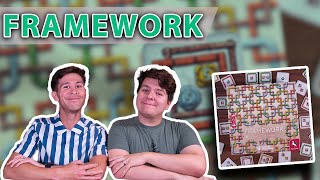






Framework Deep Dive
What the Community Thinks About Framework
Framework has earned considerable appreciation within the board gaming community, particularly among players who value puzzle-driven spatial mechanics. Reviewers consistently note that the game delivers satisfying puzzle solving with surprisingly deep decision-making despite its straightforward rule set. The design feels clean and purposeful, making it accessible for newcomers while offering enough strategic texture to engage experienced gamers looking for something approachable yet engaging.
Core Mechanics That Define Framework
Tile Placement and Follow-Through Adjacency
At Framework's heart lies a tile placement system built around what designers call "follow-through adjacency." Players place square tiles containing colored frames into a personal tableau, building interconnected patterns. The elegance of this mechanic emerges from how frames don't need to be directly adjacent to satisfy a task; instead, any continuous line of matching colored frames counts. A task might require three gold frames connected to a specific tile. If players have built a chain where one gold frame directly touches the tile and two more gold frames connect through a second tile, that continuous chain satisfies the requirement. This chain-building approach transforms simple adjacency rules into puzzles where players visualize how future tile placements cascade through their existing network.
Drafting and Racing Mechanics
Players draw tiles equal to player count plus one. In turn order, each player selects a tile, with the first player receiving the remaining tile as compensation. This streamlined drafting contrasts with predecessor Nova Luna's patchwork time-track system. The result feels punchy and fast-moving, allowing the puzzle to take center stage without prolonged downtime. Everyone races to place all 22 scoring tokens first by completing objectives, creating constant forward momentum. The tension between selecting optimal tiles and settling for what's available keeps decisions meaningful without paralyzing players.
The Framework Experience
Satisfying Puzzle Progression
What makes Framework feel particularly rewarding is how seemingly unrelated placements suddenly activate chains of completions. Early turns involve placing tiles somewhat tentatively. As the network grows, placing a single tile can unexpectedly complete multiple objectives at once because the new tile creates bridges between previously disconnected chains. Players describe this explosion of progress as genuinely clever and delightful. The game teaches you to think ahead about how colors can branch through your tableau, encouraging players to plan several moves deep without requiring perfect information.
Low Rules Overhead, High Puzzle Depth
The rules themselves are genuinely simple: draw tiles, place them adjacent to existing tiles, complete objectives whenever frame chains match task requirements, place scoring tokens. Nothing about this demands complex rule lookups or table management. Yet the puzzle complexity emerges naturally from these simple foundations. Players can teach Framework to new players in minutes, then everyone immediately engages with spatial reasoning and forward planning. This gap between approachable rules and satisfying puzzle depth appears consistently in what reviewers appreciate most.
What Makes Framework Stand Out
Refinement Over Foundation
Framework builds directly on Uwe Rosenberg's proven Nova Luna design but incorporates specific improvements that fans had requested. Some objectives now require multiple colored frames or conditional prerequisites, creating more interesting puzzle scenarios than simpler single-color requirements. Tiles feature more varied objectives, and the drafting system feels cleaner and faster. These aren't revolutionary changes; rather, they represent thoughtful iteration. Players who loved Nova Luna consistently report that Framework feels like the perfected version, while those new to Rosenberg's tile-placement family find it an excellent entry point.
Colorblind-Friendly Design
Unlike Nova Luna, which uses colors that proved difficult for colorblind players to distinguish, Framework employs distinct visual patterns for each frame type. Beyond color coding, each frame has its own visual texture and symbol, making the game genuinely playable for players with color vision deficiency. This thoughtful design choice expands accessibility without requiring special rules or accommodations.
Potential Drawbacks
Visual Presentation
Some reviewers note that Framework's aesthetic feels more functional than striking. Compared to Nova Luna's brighter, more immediately appealing visual presentation, Framework's tiles appear slightly muted and less visually distinctive at a glance. While the symbology works perfectly well and the minimalist presentation suits the abstract nature of the game, those seeking vibrant board game aesthetics might feel the package prioritizes clarity over visual drama.
Tile Luck Variance
Because players draw tiles from a bag, some draws will be more fortunate than others. A series of frame-heavy tiles might offer fewer objectives to chase, while another sequence could provide rich puzzle opportunities. While this randomness rarely feels unfair in single plays, the luck factor means outcome variance exists beyond pure strategic play. Players seeking maximum control may occasionally feel their performance is constrained by what tiles emerge during drafting.
If You Enjoy Framework
Players who appreciate Framework typically gravitate toward Uwe Rosenberg's other tile-placement designs, especially Nova Luna and Sagani, which share similar spatial puzzle mechanics. Beyond Rosenberg, games like Acropolis, Habitats, and patterns-based games like Calico appeal to the same audience. Those drawn to Framework's puzzle-building satisfaction without confrontation should explore other gateway strategy games that emphasize personal tableau development and pattern completion.
What Reviewers Are Saying
"The rules twist in this one I do actually prefer. The drafting system is much more streamlined. It's definitely my favorite Uwe Rosenberg game."
— Chairman of the Board
"Framework makes you feel very clever because of the fact that you can build out these big groups and start really cascading finishing those tasks and it's just it's very very good."
— BoardGameGeek
"I love the puzzle, I love the quickness of the draft. It's definitely a game that I play anytime anywhere. Lots of depth, very simple rule sets."
— Foster the Meeple