
This game is played in several hands. In each hand the players try to be the first to get rid of all of their cards. Their scores are based on how early in the hand they get rid of all their cards. There are two ways to play: you can play where all hands are played the same, or you can play the game with changing partners.
This is a climbing game, similar to The Great Dalmuti, Tichu, and others. The difference here is that the ranks are different kinds of colorfully illustrated animals. Each is scared away only by certain other animals. Players set out one to whatever cards of a particular variety, and someone can play onto that pile only if they have more of that animal or an equal number of some animal that can scare it away. Players get points by playing all their cards, collecting lions, and collecting a hedgehog.


Images


- Zoo
Mechanics (from transcript analysis)
Video topics + discussion points
Quotes (from this video)
- Zombie Princess is brutal. Like, it's just brutal.
- The horde is coming. You just gotta do your best to try and survive.
- It's another one of those train games where you're building routes and delivering goods.
- The economic engine in this game is really satisfying.
- Lost Ruins of Arnak is just gorgeous.
- It's a really interesting mix of worker placement and deck-building.
References (from this video)

- Zoo
Mechanics (from transcript analysis)
- Climbing Game — This is a letter-climbing game
Video topics + discussion points
Quotes (from this video)
- nobody, including us, need this many games.
- This is Divan. Mhm. I don't know anything about this game. I bought it because it looks beautiful.
- This could have easily been a Reiner Knizia game I feel like.
- And I love a reason to play Lost Ruins of Arnak Lost Ruins of Arnak because I think it's a great game.
- We have to empty our unplayed game shelf from everything that's not 2025 releases and then we'll put it in there and the rest go on the floor until we manage to play them.
- And it's based on the problem called what is called again it's based on the seven bridges of somewhere.
- I feel kind of like bad about bringing a hundred games back home.
- I I usually they go in, they go out. And that's also the thing like if I haven't played a game in a month, I will not remember the rules most of the time.
- The longest line I saw was for coffee. In the morning before the whole office.
- What's more important for you for the channel? Playing the popular ones or the less known niche ones?
- My favorite animal beside the monkey which is my favorite animal. The capybara.
- We are basically very lucky because we share a lot of hobbies.
- The building thing Ah, it was too much building. I didn't like that too much.
- It's been super fun. It's so many people. It's been so long since we did a live.
- Thank you so much for watching. Like it. We wouldn't have done this if it wasn't for you.
References (from this video)

- Team rumble mode enables cooperative play
- Keeps the original artwork intact
- Cute, approachable artwork; good entry point for families
- Mosquito rule is confusing and unclear in practice
- Situations where you must pass with no viable moves can be frustrating
- Strategy can feel unclear or underdeveloped
- Animal competition and outranking through set placement
- Zoo-based, animals in a central field with fort bonuses
- Charming, light-hearted with preserved original artwork
Mechanics (from transcript analysis)
- Card placement to center field — Players place animal cards into a shared field; players may place one or multiple cards of the same species.
- End-of-round condition — A round ends when only one player has cards left in hand.
- Lead / Pursue / Pass / Collect actions — On a turn you may Lead (if the field is empty), Pursue, Pass, or Collect. Collecting happens if all cards on the field remain at the start of your next turn.
- Outranking — To pursue, a player must outrank existing animals in the field by playing the same species with a higher value or by outranking through fort bubble animals.
- Point-deck top card scoring — When you finish a round, you take the top card from a point deck for scoring.
Video topics + discussion points
Quotes (from this video)
- I was really looking forward to playing this and I played this a lot of times with two, three, four players and I just don't understand the strategy.
- the mosquitoes adds to the confusion
- I'm glad that they have kept the original artwork cuz it is kind of cute in it.
- it's not really XXL, is it? It's more like just L. The cards are bigger.
- it's basically the same game. It's code names.
- novel use of the Tetris mechanic.
- I love Tetris.
- it's a brain teaser
- Whisperwood, yeah, I genuinely recommend this one.
References (from this video)
- Strong partnership dynamics; social play
- Requires good mutual understanding with partner
- Animal-themed partnership trick-taking with scoring by run-out order
- Partnership-focused with evolving dynamics
- David and Goliath
- Skull King
Mechanics (from transcript analysis)
- meld-like progression via cards — Players build toward endgame with card sequences and run-out order
- partnership scoring — Partners accumulate points based on how they and their partner finish
Video topics + discussion points
Quotes (from this video)
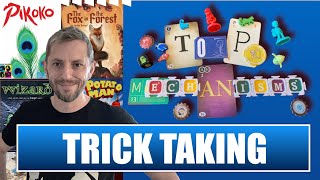
- trick-taking games are the most ancient form of card games dating back to the 10th century in China
- this is a top 10 style of trick-taking games top 10 different mechanisms used in trick-taking games and specifically in modern trick-taking games
- the first half of the game players reveal a card in an attempt to win a central revealed card
- bidding is a way to add a layer of strategy and prediction to the trick-taking format
- the most famous and popular example is the four player game teach you which is played in two teams of two