/pic8075053.jpg)
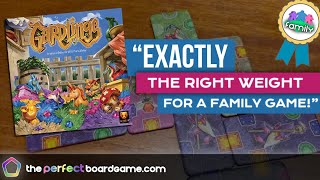
Cleverly build your garden. Harvest gems and enrich your seed bag with new, amazing creatures so your next garden can grow even more abundant. Combine the unique abilities of your creatures, and be the first to acquire the victory trophy.
Each round in Gardlings, all players simultaneously build their garden in front of themselves. You do this by drawing and placing tiles from your bag. You may stop drawing tiles at any time because if you draw too many gnomes, they will steal gems from you. At the end of the round, use any gems you matched in your garden to buy a new tile, then return all of your tiles to your bag to prepare for the next round. Each tile features potential ways to match gems, as well as a creature with a special ability. Your garden will grow larger and better each round, and the puzzle of placing tiles will become increasingly complex.
The goal of the game is to match enough gems to buy the victory tile.
—description from the designer



- Better version of Quacks of Quetlenburg
- Doing a little puzzle with these [tiles]
- New tiles have special abilities that are fun to puzzle with
- Flies under the radar
- Understand why it's fun
- I hate that [referring to Quacks of Quiddlingburg]
- Busy artwork
- I want to like quacks more than everyone else likes it. more than I like it.
- Brewing potions
- Quacks of Quiddlingburg
Mechanics (from transcript analysis)
- Bag Building — Players draw tokens from a bag to perform actions.
- Push Your Luck — Players draw tokens, risking an explosion if they draw too many of a certain type.
- Set Collection — Players collect ingredients to brew potions.
- Tile Placement — Players place tiles that form a puzzle.
Video topics + discussion points
Quotes (from this video)
- It is a fast game where you are drafting cards.
- The cool thing about this game is that you have some money that you can spend into buying upgrades for your cards.
- This is one of those games that is the experience.
- It's like a mega game. That is what makes this game stand out of anything.
- I love lying so much. It's so fun. I love it.
- But anyone else, on their turn, could choose to not put one of their cubes on a boat, but instead, sail one of those boats and not to where you wanted it to go.
- I feel like I would really enjoy this, but I just didn't enjoy my 1st play of this.
- the experience, you have to detach the experience to the game sometimes as well.
- My friend Yoshi. He just, he's way into his 60s.
- It's the stuff's going to be coming thick and fast.
References (from this video)
- Polished dice worker-placement twist that remains intuitive
- Beautiful board with biome variety and engaging components
- Tight balance between planning and competition for shared resources
- Family-friendly and approachable yet with meaningful strategy
- Bag-drawing mechanic adds tactile satisfaction
- Prototype version lacks minis, which may affect initial impression
- As a Kickstarter project, production details may evolve
- Resource management, competitive drafting, and nurturing nestlings in a family-friendly ecosystem
- Bird nesting across four biomes (grasslands, desert, alpine, freshwater, Savannah) with resources and a central nest-building theme
- Descriptive and enthusiastic overview of bird-themed strategy
- Wingspan
- Discovery
Mechanics (from transcript analysis)
- Bag Building — At the start of each round, players draw resource bags, then resolve actions by selecting stacks to place onto their boards.
- Bag Drawing — At the start of each round, players draw resource bags, then resolve actions by selecting stacks to place onto their boards.
- bird minis activations — In the finished game, bird minis can activate each round, granting special bonuses.
- dial-based bonuses — Each biome has a dial with bonuses; filling it yields end-of-round benefits and strategic options.
- Dice Placement — Each player rolls four dice and uses their symbols to place into biome spaces to gain resources and initiative.
- dice re-roll and die-side selection — Players can re-roll dice or choose sides, at a cost, to tailor their options.
- Dice Rolling — Players can re-roll dice or choose sides, at a cost, to tailor their options.
- Dice Rolling and Placement — Each player rolls four dice and uses their symbols to place into biome spaces to gain resources and initiative.
- End Game Bonuses — Each biome has a dial with bonuses; filling it yields end-of-round benefits and strategic options.
- Public and personal objectives — Public objectives require certain resource sets; personal nest goals provide end-game scoring incentives.
- Resource Management — Resources gathered are used to feed nestlings and activate bonuses across biomes.
- resource management and feeding — Resources gathered are used to feed nestlings and activate bonuses across biomes.
- wild and color-symbol dice — A wild resource and color-coded dice sides influence outcomes and allow flexible actions.
Video topics + discussion points
Quotes (from this video)
- the core mechanic here is dice rolling and placement
- this is a really Central feature it's a beautiful beautiful board
- I love dice worker placement
- it's honestly the coolest thing
- the artwork is just Dynamite
- it's a lovely light strategy game
References (from this video)
- Deluxe components provide a more tactile experience (described as prettier with plastic components for certain bits)
- Solo mode and AI integration offer a path for single-player play and learning
- Rulebook described as confusing or incomplete in places, making setup and play painful
- AI/solo rules are complex and seem poorly integrated for a smooth experience
- Game appears to be designed around 3-4 players, with awkward scaling for other player counts
- Resource gathering, nesting, and scoring through biome quadrants
- Biomes and birds nesting across a multi-biome board
- Casual, tutorial-like live-playthrough with commentary
- Dune Imperium
- Dune: Bloodlines (expansion)
- Dune (board game)
- Firefly (board game)
Mechanics (from transcript analysis)
- Biome/resource distribution — Resources are distributed into biome bags and tracked on a biome ring; duplicates can stack with limits.
- Bird energy track — A track allowing limited rerolls or face changes, with a point cost when used.
- Compound Scoring — Resources fed to nestlings determine quadrant scoring; end-of-round scoring follows feeding.
- Dice Placement — Players roll biome dice and place them into biome regions to claim resources and influence nest feeding.
- Feeding phase and nestling scoring — Resources fed to nestlings determine quadrant scoring; end-of-round scoring follows feeding.
- Gathering goals vs Nest goals — Two goal systems drive different VP opportunities: gathering resources and feeding nestlings.
- Priority order and bird actions — Resource collection and actions during feeding depend on priority order and bird placement.
- Quadrant bonuses — Completing biome quadrants grants bonuses and unlocks quadrant pieces.
- Solo/AI rules — Solitaire mode simulates AI players; setup can be intricate with multiple AI dice and placements.
Video topics + discussion points
Quotes (from this video)
- this rulebook sucks
- I hate AI's
- the deluxe version is really going to make or break the game
- this is a learning game
- it's a three and four player only game essentially
References (from this video)
- Charming and fun family weight experience.
- Nice flow to the game.
- Loved the puzzly nature of trying to keep options open.
- Streamlined compared to Quacks of Quedlinburg.
- More pick up and play with less setup than Quacks.
- Thoroughly enjoyed plays and will play more.
- Always going to be compared to Quacks of Quedlinburg.
- Quacks is well embedded and hard to knock off its podium.
- Building a map by connecting gems on tiles.
- The Quacks of Quedlinburg
Mechanics (from transcript analysis)
- Bag Building — Diving into a bag and putting out tokens.
- Map building — Connecting gems along the edges of tiles to score points.
- Push Your Luck — A push your luck bag builder game.
- Set Collection — Collecting current points to buy better tiles.
- Tile Placement — Building up a map of domino shaped tiles.
Video topics + discussion points
Quotes (from this video)
- This is why I take a look at the last five new to me board games that I played and I rank and review them in order of preference.
- I'm much more of a euro gamer and a card gamer.
- So yeah while I can say it's not for me it might be for you and it might be worth checking out and it's definitely going to be a contender for artwork of the year because everything in this game just looks spectacular.
- It's just a really charming fun family weight experience and I left the game fing really impressed by actually and I did thoroughly enjoy my plays.
- This one is exactly what I'm looking for in a deduction game because you are in charge of your own t because again you can't share your own information so you know you're in the hot seat and you actually have some autonomy you're not going to be quarterbacked by another player.
- And all in all I don't really have a single bad thing to say about this game um other than the fact I might say I'm not always in the mood to play it.
References (from this video)

- easy to learn for solo play
- advanced rules add interaction
- base rules are solo-centric and less interactive
- solo play with optional deeper rules
- solitaire puzzle game
- accessible, casual play with optional interaction
- Sorcerer City
Mechanics (from transcript analysis)
- solitaire play — Single-player puzzle experience; optional advanced rules to add interaction
Video topics + discussion points
Quotes (from this video)
- Oh shoot. Just got a chance to play Yro and it is this cool tableau builder.
- The card art's cute. It plays fast, but it feels more substantial than it is.
- Basically, you have inventions, you invent them, then you build them, you test them, and then you publish them. Also, there's boats.
- Willox Warehouse, a super bizarre abstract memory style game where you basically have a lot of storytelling.
- Surround your waterfalls. That was her downfall. She missed out a lot of points.
- It's super fun and weird.
References (from this video)
- Adds tech flavor to traits
- Increases variability
- Complexity for new players
- Array
- Technology-themed expansion
- expansion description
Mechanics (from transcript analysis)
- Trait-based deck expansion — Adds 15 tech-oriented traits with a dominant trait, an age, and a catastrophe.
Video topics + discussion points
Quotes (from this video)
- Doomlings overall. It is a um a multiplayer card game.
- I played it one time um and really enjoyed it.
- I consider this somewhat of a party game.
- This is a game for two to six players, ages 10 and up.
- Dino lings. Looks like there is a tab somewhere. So I'm guessing the theme here will be dinos or dinosaurs.
- Overlush collection contains 170 plus traits in ages to discover. Survive the jungles of Enduras with all new traits like nectar, ravenous, mimicry, metamorphosis, and the probably useful ear flaps.
- This is the Overlush. Uh it comes with four mystery packs, 56 cards, and four holo foils, holo foils.
- Doom's gold packs, seven mystery holo foil um cards.
References (from this video)

- Appealing theme and approachable rules
- Depth through habitat planning and resource diversification
- Some players may want more direct interaction
- Birds and ecosystem management
- Natural habitats with birds and nests
- Simultaneous action drafting with habitat focus
- Wingspan
Mechanics (from transcript analysis)
- Area Majority — Compete to collect a balanced set of resources for nest-building.
- area majority and set collection — Compete to collect a balanced set of resources for nest-building.
- Dice Drafting — Simultaneous dice rolls determine resource acquisition across habitats.
- dice drafting and resource collection — Simultaneous dice rolls determine resource acquisition across habitats.
Video topics + discussion points
Quotes (from this video)
- I had such a good time with it that I ended up going by the 25th Century games booth and picking this up myself.
- I'm really, really happy that I'm getting to this early because last month so the July wrap-up I filmed like mid August.
- I love deduction games and bringing in kind of this deduction element into just a quick card game I think is genius.
- Lost Ruins of Arnac with the Missing Expedition campaign was my favorite of August.
- Nestlings is a fantastic bird-themed game with a surprisingly deep engine behind a simple regimen.
References (from this video)

- Fits large groups with simultaneous play
- Strong puzzle element for varied ages
- Clear, quick-to-teach rules
- Luck of tile draw can dominate some sessions
- May require multiple copies for very large groups
- gems, dominos, and bag-ddrawing strategy
- A competitive/press-your-luck tile placement with gems and gnomes
- light, puzzle-driven with push-your-luck tension
- Quacks of Quedlinburg
- King Domino
Mechanics (from transcript analysis)
- domino-style tile placement — Tiles placed next to each other unlock gem rewards.
- risk of busting with gnomes — Gnomes on tiles can cause penalties, adding push-your-luck tension.
- simultaneous tile drawing — Players draw tiles from a bag at the same time and place them adjacent to earn gems.
- Tile Placement — Tiles placed next to each other unlock gem rewards.
Video topics + discussion points
Quotes (from this video)
- these games satisfy the same three criteria of all of my countdown family lists which is first of all they are accessible for all ages meaning none of the games on the list have very complex rules you can teach these games in less than 10 minutes and play it with anybody
- Planet Unknown is easily my favorite game on this list
References (from this video)
Mechanics (from transcript analysis)
Video topics + discussion points
Quotes (from this video)
- there's a 100 people watching us doing this right now
- it's amazing that we are here
References (from this video)
- Simultaneous gameplay creates dynamic turns
- Engaging tile-placement with helpful artwork
- Light mechanic depth for non-family players
- creatures with special abilities on each domino-like tile
- Fantasy garden/creature-themed tile-building
- family-weight fantasy
- Quacks of Quedlinburg
Mechanics (from transcript analysis)
- simultaneous tile/dominosa-like placement — Players draw and place tiles with creature symbols; matching gemstones trigger scoring.
Video topics + discussion points
Quotes (from this video)
- I absolutely want to get my hands on and try out because I love family games
- it's smart it's clever and it features simultaneous gameplay
- I read rule books and I don't watch other reviews to influence my impressions
- Nocturn is a really neat twist on a bidding game, very similar to Raw
- the core idea of bidding and adjacencies is very interesting
- I wasn't really too excited about Toll
References (from this video)
- Fast to learn and quick to teach to kids and families
- Simple setup with minimal downtime due to simultaneous actions
- Encourages light strategic thinking without overwhelming players
- Push-your-luck element adds tension and excitement without being punitive
- Gnome tile alignment can feel random and occasionally disadvantageous
- Some gardeners/bonuses require memory of what has been acquired to maximize value
- Thematic depth and artwork are not standout strengths
- Gem collection and push-your-luck tile/bag-building with unique tile actions
- Fantasy forest/gnome world with gems, dragons, and whimsical magical elements
- Light, whimsical, family-friendly
- Quacks of Quedlinburg
Mechanics (from transcript analysis)
- bag drafting / tile draw — Players draw domino-like tiles from a bag, each tile potentially carrying actions and gem values.
- Domino-like placement — Tiles are placed so touching edges align with gems on adjacent tiles to maximize value.
- gems and bust mechanics — Gnomes on tiles steal gems when busting occurs after accumulating too many gnomes.
- pity mechanic — Busts can yield a Pity Pig tile that grants a credit toward a future purchase.
- Simultaneous Actions — All players draw and place concurrently, reducing downtime.
- Simultaneous Play — All players draw and place concurrently, reducing downtime.
- wilds and tile actions — Certain tiles have special actions (Bird with Wilds, Unicorn movable, Gardener triple gems, Dragon effects).
Video topics + discussion points
Quotes (from this video)
- it's more skill than quacks of quinber
- it's a pretty simple game
- I really like this game I like this game a lot
References (from this video)
- Surprisingly good family-style game
- Easier setup and play than Quacks-inspired titles
- Slightly simpler than some modern filler games
- Cute fantasy-adjacent race to value with linked gems
- Bag-drawing, tile-placement with gem economy
- Light, family-friendly engine-building with a gentle competition
- Quacks of Quedlinburg
Mechanics (from transcript analysis)
- Bag-drawing tile placement — Draw tiles from a bag and place to create links and gain currency
- Connection-based scoring — Linking gems and tiles to score efficiently
- Resource economy — Earn tokens and advance toward victory points through placement
Video topics + discussion points
Quotes (from this video)
- "I am learning to love this game more and more as I become more familiar with it."
- "this game struck a really nice balance of making the cards important but not making it entirely card driven."
- "this is a pretty wild bidding game"
- "some really cool swings, some good kind of guer manipulation"
- "not a tug-of-war game... it's more of a traditional euro"
- "it's a really good one. very mass appeal and I'd highly recommend Push."