/pic8104136.png)



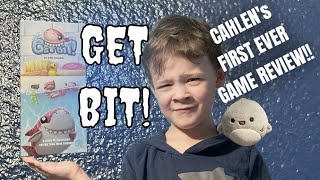




Get Bit! Deep Dive
What the Community Thinks About Get Bit!
Get Bit! has carved out a niche as one of the most delightfully absurd games around. Let's Table It walks through its mechanics with clear affection, Board Game Animal celebrates its silly charm, and Foster the Meeple sums up its appeal in a single image: you are swimming in the ocean while a shark eats you one limb at a time, and somehow it is just fun. The premise of robot swimmers racing to avoid a shark that devours them piece by piece is inherently ridiculous, and the community embraces that ridiculousness wholeheartedly. What emerges is a game prized for chaotic laughter and player interaction, even as reviewers acknowledge it is light on deep strategy.
Core Mechanics That Define Get Bit!
Simultaneous Card Play and Relative Movement
At its heart, Get Bit! is built on simultaneous card reveal. Each player secretly selects a numbered card, then everyone flips at once. Players who played a unique number advance toward the front of the line in ascending order, while any players who tied stay put. Let's Table It notes how players study one another and sometimes deliberately play the same card so neither of them moves, which creates a deceptively simple system where reading your opponents matters as much as the cards themselves. The numbers set position, not raw speed, so the puzzle is always relative to what everyone else does.
Push-Your-Luck via Limb Loss
The core tension comes from getting bitten. Whoever ends a round at the very back loses a limb of their choice, and each swimmer has four limbs before the shark finishes them off. Crucially, an eliminated swimmer who loses a limb returns to the front of the line with a full hand of cards, which inverts normal push-your-luck logic: being last is not purely a punishment but also a reset and a chance to reclaim control of your hand. Let's Table It highlights how a bad round sets you up to do well the next one, since you regain all your cards at your disposal.
The Get Bit! Experience
Embracing the Silly Theme
The physical presentation turns abstract card play into something memorable. The game features rubber swimmer figures and a grinning shark, and Board Game Animal delights in how happy the shark looks as it pursues its prey. The toy-like, tactile pieces invite handling and celebration when a figure loses a limb. Foster the Meeple captures the vibe perfectly: a game where a shark eats you one limb at a time until you are just a head, but you keep going and you really want the shark to eat someone else first. That playful absurdity, rather than any realism, is the whole point.
Dynamic Player Interaction and Bluffing
Get Bit! thrives on reading opponents. Because played cards stay visible until a player gets bitten and recovers their hand, each round offers information about what numbers remain. Let's Table It emphasizes that players try to figure out what number someone will play, then avoid it or deliberately match it to trigger a tie. The bluffing is not an explicit mechanic; it emerges from the threat of being predictable. Combined with the constant resets when swimmers get eliminated, the game generates rolling narrative tension even though the outcome leans heavily on luck.
What Makes Get Bit! Stand Out
Asymmetric Incentives and Reset Mechanics
Few games reward failure as elegantly as Get Bit!. Losing a limb sends you straight to the front of the line and refreshes your entire hand, a powerful repositioning and card advantage. Let's Table It points out that doing badly one round earns you an opportunity to do well the next, since you suddenly have all your cards back. This keeps runaway leaders in check and ensures everyone stays in contention until the very end, where the swimmer furthest back is sometimes the one best positioned to steer the next round.
Variant Flexibility
The game ships with several variants that reshape the experience: an automated opponent for three players, a two-player mode where each person controls two swimmers, a memory variant where cards flip face-down, and a mode where one player controls the shark. Let's Table It singles out the two-swimmer mode for giving players a reason to manage information between their own characters, making the game work well at smaller tables and for family play.
Potential Drawbacks
High Luck Dependency
While bluffing and reading add texture, the fundamental outcome of who ends up last each round is heavily luck-dependent. Even strong play cannot guarantee survival, since a tie or an unlucky card can leave you at the back. Let's Table It openly acknowledges there is a ton of luck in the game, framing it as the nature of the design rather than a flaw. Players seeking deterministic, deeply strategic experiences will find Get Bit! chaotic rather than carefully balanced; it trades depth for accessibility and laughs.
Component Durability
The detachable limbs add physicality but raise durability concerns. Board Game Animal wishes the body parts were easier to take apart, noting that the tiny limbs, charming as they are, can be fiddly. Over many plays, the repeated removal and reattachment of the little arms and legs could wear on the figures, particularly in groups that play the game often or roughly.
If You Enjoy Get Bit!
Reviewers point toward games that capture similar energy. Sushi Go! and Coup reward reading opponents under uncertainty in a quick, light frame. King of Tokyo delivers accessible push-your-luck with a theme that drives the narrative, while Camel Up brings the same kind of chaotic, swingy laughter to a betting race. The common thread is games that prioritize shared laughter and interaction over perfect information and optimization, exactly where Get Bit! shines.
What Reviewers Are Saying
"You really get four chances with your four limbs to stay ahead of someone else. It comes down to sudden death, and the player who swims the furthest wins the game."
— Let's Table It
"Everyone tries to play as fast as you can to get away from the shark. You play cards from your hand to simulate how fast you're swimming, and the card you play stays on the table, so players can read each other based on what cards they have left."
— Board Game Animal
"You're swimming in the ocean while a shark eats you one limb at a time. But it's fun. You just keep going until they eat your body and then you're just a head. But you want them to eat other people before they eat you."
— Foster the Meeple