/pic920285.jpg)






Giants Deep Dive
What the Community Thinks About Giants
The board game community regards Giants as a brilliantly executed abstract tactical strategy game that punches far above its weight. Reviewers consistently praise it as a masterpiece of mechanical design that delivers profound strategic depth within a compact, accessible package. This is not a game that relies on theme or production value to impress, but rather on the elegance of its core systems. Across multiple reviews, players emphasize that Giants reveals new layers of strategy with each play, rewarding careful tactical thinking and punishing hasty decisions. The consensus is clear: Giants is a game that belongs in the collection of anyone who appreciates two-player abstract strategy.
Core Mechanics That Define Giants
Rock-Paper-Scissors Tactical Interplay
At its heart, Giants operates as a sophisticated rock-paper-scissors system where every unit type has a clear counter. Tanks cannot be killed by fighters, only by bombers. Fighters eliminate infantry and other aircraft but fall to anti-aircraft guns. This elegant constraint forces players into meaningful decisions: every deployment is both an offensive move and a defensive statement. Reviewers note that the genius lies not in the complexity of individual rules, but in how these simple counterplay relationships create genuine strategic tension. One player described the experience as playing against an opponent who always has a theoretically optimal response available, which means victory comes down to pure outmaneuvering and forward thinking.
Magnetic Modular Unit System
The physical implementation of Giants deserves special mention. Players deploy trucks and tanks with magnetic attachments that change their capabilities in real time. A truck base can receive a cannon for firepower, a transport module to deploy infantry, or an anti-aircraft gun to lock down aerial routes. The magnetic pieces are satisfying to manipulate, and the permanence of loss (vehicles don't respawn like infantry) creates genuine stakes. Reviewers highlighted the toy factor as a crucial element that makes Giants feel both tactile and fun despite its abstract nature. The fact that players physically feel their mistakes, watching destroyed equipment leave the board permanently, adds weight to every decision in a way that pure point-based systems cannot.
The Giants Experience
Tense, Unforgiving Tactical Dueling
Players describe Giants as intensely tense, a game where every move must account for opponent responses multiple turns ahead. This is not a game where you can afford many mistakes. The decision space in each turn, though simple on the surface (move twice and deploy once, or move once and deploy twice), branches into countless meaningful variations. Reviewers repeatedly emphasize that Giant generates that special tension unique to two-player games: the back-and-forth where each player must think not just about their own goals, but about reading and predicting the opponent's next play. One reviewer noted playing Giants feels like a game of chess at speed, where you're constantly in a state of mutual threat assessment.
Quick-Burning Aggressive Play
Though playable in 10-30 minutes, Giants demands focus throughout. There is no downtime, no room for mental disengagement. This creates a satisfying experience where the game ends while momentum is still building, before any single dominant strategy ossifies into boredom. Players found themselves wanting to immediately play again, not out of obligation to finish a campaign, but because the experience was so engaging that one play felt like a taste rather than a full meal.
What Makes Giants Stand Out
Perfect Information Counterplay Without Randomness
Giants eschews dice, card draws, and hidden information. What you see is what you get. This creates a pure test of tactical skill where every advantage or disadvantage flows from player decisions, not luck. Reviewers praised this design choice as uncommon and refreshing in modern board games. The absence of randomness means that players cannot hide behind "bad luck." When you lose, it is because your opponent saw the board state more clearly or planned deeper than you did. This is both humbling and motivating for repeat play, as improvement is always possible through better analysis and deeper foresight.
Extreme Accessibility Wrapped Around Profound Depth
Giants teaches in under five minutes. The rules are simple. The board state is obvious. Yet reviewers discovered that this apparent simplicity masks a game of remarkable strategic richness. Unlike many abstract strategy games that are easy to learn but take dozens of plays to understand, Giants yields strategic insights to new players while continuing to reward masters. One reviewer noted they immediately bought a copy after a single play at a convention, a rare vote of confidence in a game's staying power. The Supplies expansion, while adding tactical flexibility, was noted by one reviewer as detracting from the pure rock-paper-scissors elegance of the base game, suggesting that the core design is complete as-is.
Potential Drawbacks
Games Can Overstay Their Welcome When Victory Is Decided
One consistent criticism across reviews: Giants can suffer from a pacing issue late game. When one player achieves a commanding position, the opponent may still have moves available but no realistic path to victory. The game does not automatically end when one player becomes mathematically certain to win. This can lead to situations where both players know the outcome, but play must continue through several more turns to reach the formal victory condition. Players have sometimes chosen to concede rather than play out inevitable defeats, which works mechanically but breaks the elegance of the system. Reviewers noted this happens occasionally, not frequently, but it is worth keeping in mind for groups that prefer games that cleanly end at the moment of true victory.
Not for Players Who Need Theme to Engage
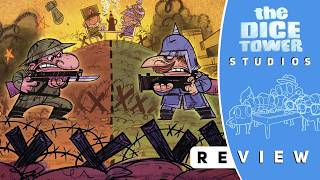
Giants leans hard into abstraction. The military setting is present but minimal, serving only as flavor for what is fundamentally a mathematical puzzle. Reviewers noted that the game's appeal is almost entirely mechanical. Players seeking narrative, atmosphere, or thematic immersion will find Giants sterile and cold. The cute art style helps somewhat, but this game is for people who love abstract strategy for its own sake, not as a vehicle for story or setting. One reviewer compared it to chess or Santorini, games where the theme is secondary to the intellectual challenge. If abstract strategy games are not your preferred genre, Giants will not convert you.
If You Enjoy Giants
Reviewers who loved Giants drew comparisons to several other acclaimed abstract strategy games. Santorini and Mythic Mischief both deliver similar experiences of tactical depth wrapped in small-box design, though with different mechanics. Tak is mentioned as another excellent pure abstract strategy game with no special abilities, just clean systems. Those who appreciate the chess-like quality of Giants and want to explore similar territory should consider these titles, each of which offers the deep strategic satisfaction that makes Giants compelling without requiring the exact same mechanical framework.
What Reviewers Are Saying
"I think it's so well done. It comes in a little box and this feels good and it's just a pleasure to play. Love the aesthetic of the cartoony on the wood is awesome. This feels like a rock, paper, scissor, what kills what. I dig it."
— Gaming with Edo & Jessica
"This entire thing is a complicated rock, paper, scissors puzzle of how to prevent whatever your opponent is trying to do through the way you can move, position, and deploy in ways that stop them from achieving their goal while helping you achieve yours. That's the base game of Giants. Everything in the game has a way that it forces your opponent to react, and everything comes down to how you're trying to approach it."
— Board Game Co
"There is just overflowing amounts of strategy in this game. It feels like a rock, paper, scissors tactical abstract strategy game disguised as a cute little war game. If you like two-player tactical abstract games, this should definitely be up your alley."
— Bowers Game Corner