/pic3596584.jpg)






Gloom of Kilforth: A Fantasy Quest Game Deep Dive
What the Community Thinks About Gloom of Kilforth: A Fantasy Quest Game
Gloom of Kilforth: A Fantasy Quest Game has earned its place as one of the most beloved solo and cooperative adventure games in the community. Players consistently praise its atmospheric design, stunning artwork, and the personal narratives that emerge from each playthrough. The game balances mechanical depth with the freedom to craft epic tales of heroic journeys across a fantastical land. However, this narrative freedom comes at a cost: the game asks players to actively engage with storytelling rather than having the story handed to them through scripted text. For those willing to invest in world-building and character development, channels like The Dungeon Dive and AzureDeath agree that Gloom of Kilforth delivers an experience that resonates deeply with adventure-game enthusiasts.
Core Mechanics That Define Gloom of Kilforth: A Fantasy Quest Game
Dice-Pool Challenges and Keyword-Driven Progression
At its heart, Gloom of Kilforth uses a dice-pool system where fives and sixes count as successes. Players build their pools by combining their character's base attributes (Fight, Knowledge, Sneak, and Influence) with bonuses from items, allies, and spells. What makes this distinctive is that challenges need not be completed in a single action. Players can spend multiple actions in a turn rolling dice, gradually accumulating the successes needed to overcome enemies, complete quests, or progress saga chapters. Progression hinges on keyword collection: each of the four saga chapters requires specific keywords found on location and encounter cards throughout the land. This creates a natural loop where players explore the grid, discover what keywords they need, then hunt for those specific cards among the regional decks. Designer Tristan Hall's system, published by Hall or Nothing Productions, rewards patience and adaptability over raw optimization.
The Night Track and Action Economy
Time pressure comes from the Night deck, a stack of cards representing days passing. Each turn, a Night card is flipped, corrupting one location to Gloom and often bringing a negative event. The number of actions available each day is tied to current health: losing health reduces both your maximum health and your daily actions simultaneously. This creates tension where reckless combat or careless movement compounds over time, forcing players to balance exploration against survival. The mechanic elegantly ties tactical decision-making to resource scarcity, ensuring that every action must be weighed against the finite time remaining before the final confrontation with an ancient evil.
The Gloom of Kilforth: A Fantasy Quest Game Experience
Sweeping Narratives and Personal Sagas
Gloom of Kilforth excels at fostering emergent storytelling. Rather than being led by a storybook, players construct their own narrative threads by connecting location discoveries, defeated enemies, and acquired items into a coherent personal adventure. Each character begins by selecting a race and class combination, then pursues a four-chapter saga against a chosen ancient evil. The game provides breadcrumbs through flavor text, location names, and quest requirements that players weave into their own epic. When a player finally learns a rumor about an item and must travel across the land to claim it, what could be a mechanical fetch quest becomes a memorable journey with real stakes. The gothic fantasy art style reinforces this atmosphere, creating visual moments that players remember long after the game ends.
Deep Replayability Through Variable Encounters
The sheer volume of content and randomization ensures that no two games feel identical. A large pool of location cards is shuffled into a fresh grid each game, and the regional encounter decks are vast and only partially drawn during play. Even after multiple playthroughs, players encounter cards they have never seen. Character progression is nonlinear: players level up by choosing from two skill options at each level, leading to wildly different power curves between games. Difficulty can be tuned through variants, allowing players to customize their experience. This variability means that even experienced players cannot memorize an optimal strategy; each game demands fresh tactical problem-solving.
What Makes Gloom of Kilforth: A Fantasy Quest Game Stand Out
Gorgeous Art and Atmospheric World-Building
The art direction is often the first thing players mention when discussing this game. Every card features intricate, detailed illustrations that evoke a gothic fantasy aesthetic. Locations are striking, allies are memorable, and even common enemies feel dangerous and atmospheric. The world of Kilforth, from its mountains and badlands to its forests and plains, comes alive through the visual language of the cards. This art serves as more than decoration; it provides the visual scaffolding that lets players anchor their narrative constructions. A beautiful card discovered at a crucial moment becomes part of the player's remembered story, cementing the connection between mechanics and meaning.
Solo and Cooperative Flexibility with Minimal Overhead
Unlike many adventure games that require managing a full party, Gloom of Kilforth focuses on developing a single hero. This singular focus eliminates much of the bookkeeping while creating personal investment in that character's journey. The game plays equally well solo or cooperatively, with players either controlling individual characters or jointly progressing a shared hero. When combining sets such as Gloom and Shadows of Kilforth, the designers solved location-specific card conflicts with token-drawing systems, allowing deck merging without breaking thematic coherence. This thoughtful design respects player time while opening the door to expanded play without a proportional increase in complexity.
Potential Drawbacks
Rules Complexity and Fiddly Mechanics
Gloom of Kilforth is undeniably fiddly. The rulebook, while well written, contains many steps, exceptions, and timing windows that new players must internalize. Learning the game often requires reading the rules more than once and making mistakes during play; even experienced players returning after a gap frequently need to reference the rulebook. There are many moving pieces to track at once: health, actions, gold, items, titles, spells, allies, saga chapters, and Night card effects. For players accustomed to streamlined, intuitive designs, the cognitive load can feel burdensome, and the game's evolving rules mean obtaining the latest official rulebook is worth the effort for clarity.
Narrative Ambiguity and Keyword Hunting
The game provides keywords and chapter descriptions but leaves narrative connections implicit. If players expect a cohesive, authored storybook experience, they may find Gloom of Kilforth dry and mechanical. The keyword-hunting aspect, while enabling exploration, can feel transactional: move to a location, flip cards until you find the keyword you need, then move on. Some players experience this as less flavorful than adventure games with fully scripted encounters and story beats. The game's strength lies in collaborative imagination, as players must actively decide why a particular enemy or quest matters to their saga. Those unwilling or unable to invest that creative energy may find the experience hollow, since the base mechanics alone do not supply narrative momentum.
If You Enjoy Gloom of Kilforth: A Fantasy Quest Game
Players who love Gloom of Kilforth often gravitate toward other games in the Kilforth family: Shadows of Kilforth and Call of Kilforth add mechanical layers while preserving the core exploration-and-leveling loop. Runebound offers a similar sense of progression and combat-driven exploration with less fiddliness. Shadows of Brimstone delivers comparable atmosphere and a dungeon-delving structure, though with more scripted scenarios. And if Kilforth's weight feels excessive, Tiny Epic Pirates provides a lighter, faster adventure in a different setting while keeping the sense of a personal journey across a map.
What Reviewers Are Saying
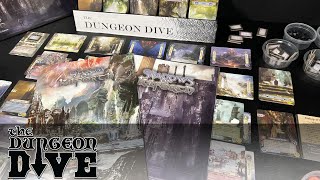
"Gloom of Kilforth is an overland adventure game where you are going to be working your way through the land of Kilforth. The land of Kilforth is represented by twenty-five cards. You have these location cards, five by five, and you will set those up."
— The Dungeon Dive
"I have these big sweeping tales, and I get to remember what happened with each of my characters and hopefully they make it to the end and get to save the world. I love the adventures along the way, that whole idea of traveling through a character's personal saga and their own chapters leading up to that big final battle."
— Gaming with Edo & Jessica
"The replayability with this is nuts. There's great replayability, and the copy I traded for included all the Gloom of Kilforth content. One other handy thing it included was these playmats, which are very nice to have, especially because it helps with the grid."
— AzureDeath