


Godzilla: Tokyo Clash Deep Dive
What the Community Thinks About Godzilla: Tokyo Clash
Godzilla: Tokyo Clash, designed by Prospero Hall and published by Funko Games, is often called the most popular Godzilla board game. Commentators tend to agree that the monster lineup is a strong foundation, with Godzilla, Mothra, King Ghidorah, and Megalon all bringing their own identity to the table. Opinions split when it comes to execution. No Rolls Barred celebrates the game as one of the first board games to truly capture the city smashing silliness of kaiju battles, while Board Game Animal calls it a mixed bag that is fun without being outstanding. The praise and the criticism point at the same thing: the theme is loud and joyful, but the rules and the visuals do not always keep pace with it.
Core Mechanics That Define Godzilla: Tokyo Clash
Throwing Vehicles and Kaiju Across the Board
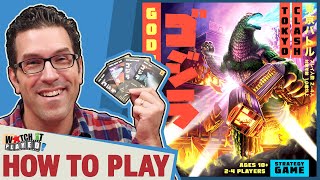
Watch It Played explains that the central combat rule is that a card's attack value never damages a building or vehicle directly. Instead, the attack value sets how far a monster can toss a tank, a building, or another kaiju in a straight line, and destruction happens through throwing. A thrown vehicle that hits a kaiju is destroyed and the opposing monster takes damage, while a thrown kaiju plows through the small buildings along its path and stops at any large building it meets. This is where the game earns its monster movie flavor, because the city becomes ammunition and obstacles rather than a static backdrop. Board Game Animal, who found the rules clunky, pointed to exactly this area of attacking monsters and throwing buildings as the place where the rule set is hardest to follow.
Trophy Draws and Hidden Dominance Values
Direct damage against a kaiju lets the attacker draw cards from the defender's deck, check the dominance symbols on them, and keep the strongest card as a trophy. A defender can play a defense card to reduce how many cards are drawn, and the rest of the drawn cards go to the discard pile. Trophy values stay hidden from opponents even though the number of trophies is public, so final scoring carries a layer of secret information. Energy runs alongside this engine. Destroyed buildings and vehicles pay out energy that fuels card play, and power plants, military bunkers, and radar dishes add extra benefits such as drawing cards or peeking at an opponent's deck. Together these systems turn every deck into a resource that gets burned down over the course of the game.
The Godzilla: Tokyo Clash Experience
Kaiju Spectacle on a Crowded Map
The feel of play is closer to a city brawler than a precise wargame. No Rolls Barred describes players stomping around the map, throwing cars at each other, and hurling opponents into buildings while charging up energy to play cards. Watch It Played's setup walkthrough reinforces the sense of chaos, with tanks placed along the edges of the board, trains dropped onto the track tiles, and events that bring more vehicles into the fight. The modular city tiles give the table a strong sense of scale. Even unpainted, the monster miniatures are described as lovely, which makes the spectacle visible from across the table.
Tension Over the King of the Monsters Token
The King of the Monsters token is the sharpest social element in the commentary. Whoever holds it draws an extra card during the refresh, takes the first turn of each round, and earns two bonus points at final scoring. The token changes hands whenever another player deals damage to the holder, which keeps attention on the current leader. It also decides ties, so the title stays worth fighting for right up to the last round. Board Game Animal notes that chasing victory points rather than knocking out rivals can pull a player out of the fight, but the token keeps conflict between the kaiju personal and immediate.
What Makes Godzilla: Tokyo Clash Stand Out
Monster Miniatures and Theme Fidelity
Board Game Animal says the choice of monsters is great and that the monster miniatures look good, and No Rolls Barred goes further by saying the whole product captures the feel of Godzilla before players even reach the figures. The roster lets the game deliver the monster on monster clashes that fans expect. Each kaiju has its own deck, its own unique ability, and its own energy-driven card play, so the roster feels distinct rather than cosmetic. For reviewers who value the license, the strongest argument in the game's favor is how completely the presentation signals that these are the monsters from the films.
Modular Tokyo Board and Building Tiles
Watch It Played shows that the city is built from modular tiles, and the building pieces press into place in the tiles and stay there for future games. Each tile is matched to building codes for radar dishes, power plants, military bunkers, towers, and small buildings, so the destruction follows a clear system. Setup is randomized, which means each session starts with a fresh layout of streets and districts. That modularity is what turns the city into a participant in the fight rather than a fixed scenery backdrop.
Potential Drawbacks
A Dark Board and Hard-to-Read Pieces
The most consistent visual complaint from Board Game Animal is that the board looks very dark and that some pieces are hard to tell apart from others. That matters in a game where the table is supposed to be a readable battlefield, because the difference between a small building, a vehicle, and a kaiju needs to be clear at a glance. The same reviewer admits to being surprised by some of the visual decisions, which suggests the production has real room to improve.
Clunky Rules for Attacks and Throws
Board Game Animal finds the rule set clunky and not straightforward when it comes to attacking other monsters, throwing buildings, or interacting with the environment. The reviewer contrasts this with Unmatched and other battling games that have an ease of play this one lacks. Watch It Played's walkthrough supports the complexity, since a single action can combine move symbols, range, direct damage, defense cards, trophy draws, and throws that stop at large buildings or other kaiju. Board Game Animal also suggests that a second edition could iron out some of the fiddly mechanisms and component issues that hold the game back.
If You Enjoy Godzilla: Tokyo Clash
Players who enjoy the brawling of Godzilla: Tokyo Clash will find Unmatched a natural companion. Board Game Animal calls it a phenomenal game system that blends a remarkable cast of characters together, and it is the benchmark the reviewer uses for ease of play in this genre. Fans who want a lighter, more direct kaiju romp that still captures the rivalry of monsters fighting over a city should look at King of Tokyo. Board Game Animal describes it as inspired by Godzilla in the same way Tokyo Clash is, while not being the real Godzilla thing, which makes it a fitting next step for players who want the same spirit with a different take on the license.
What Reviewers Are Saying
"One of the important things to understand about an attack is that you can never directly attack a building or vehicle with a card's attack strength. Instead, vehicles and buildings are only destroyed when things are thrown."
— Watch It Played
"Godzilla Tokyo Clash is a beat-em-up board game that's also one of the first ever made to truly capture the city smashing silliness of hot monster on monster action. The whole product really captures the feel of Godzilla, and that's before you get to the miniatures."
— No Rolls Barred
"Tokyo Clash is a bit of a mixed bag for me. It's fun but I don't personally find it outstanding."
— Board Game Animal