/pic4887376.jpg)
/pic5988511.jpg)
/pic6893215.png)
/pic7350809.png)
/pic4887376.jpg)









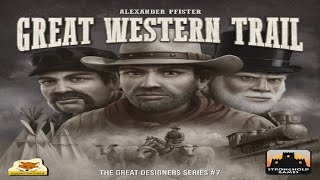
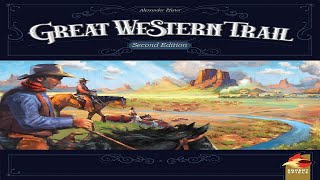
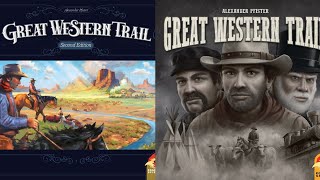













Great Western Trail Deep Dive
What the Community Thinks About Great Western Trail
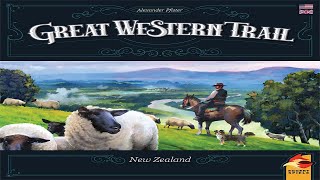
Great Western Trail, designed by Alexander Pfister and published in 2016, holds a position of genuine respect among Euro game enthusiasts, though that respect comes with some nuance. Reviewers across the board recognize the game as a well-constructed, strategically rich experience that punches above its weight in terms of accessibility. Chairman of the Board describes it as delivering "the impression of a medium to heavyweight Euro" while remaining surprisingly simple to teach. Rolls in the Family stands out as a genuine champion of the design, with Ryan and Daniel explicitly choosing the original Great Western Trail over Maracaibo after comparing the two. Luke Hector at The Broken Meeple traces a fascinating arc: once a vocal critic of the first edition, he now rates the New Zealand version an 8 out of 10, calling it "more open" with "more options." Neon Gorilla echoes that enthusiasm for New Zealand's additions, while Chairman of the Board was "slightly underwhelmed" given years of high expectations, settling on a 7 to 7.5 rating. The common thread: even critics agree the game is solid, and most who bounce off an earlier version find their way back through later editions or expansions.
Core Mechanics That Define Great Western Trail
Deck Building
Deck building in Great Western Trail works differently from most games in the genre. Players begin with a modest deck of cattle cards and, over time, acquire higher-value cow types by spending cowboys at the cattle market. The deck does not fill with purchased power cards so much as it evolves into a more refined hand of unique cattle types, because duplicates count for nothing when delivering to Kansas City. The pressure to thin duplicates, chase high-value cards, and time the deck's cycling creates a sustained tension Rolls in the Family specifically praised: "We love in Great Western Trail the deck building, like trying to get your hand right before you get to Kansas City and how that affects the pacing." Cowboys determine which cattle a player can afford and how cheaply, so investing in them early is one of the defining engine decisions of the game. Neon Gorilla noted that in the New Zealand version, dedicated deck-building cards push this system further, finally making the deck feel like something genuinely being built rather than just slowly upgraded.
Engine Building
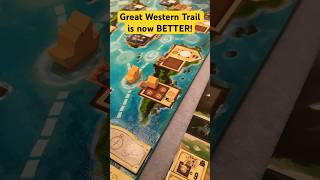
The rondel-style trail movement sits at the center of a multi-layered engine. Each time a player moves their cattleman along the trail, they stop at buildings to take actions: hiring workers from the job market, placing personal buildings on the board, upgrading train stations, and acquiring certificates. These investments compound. Cowboys reduce cattle costs. Engineers advance the train, reducing delivery fees. Builders place personal buildings that generate money for the owner and slow opponents. Chairman of the Board highlighted the satisfying result: "As you get further and further along this track, you get more and more money from turn to turn." The engine is transparent, meaning players can see exactly how their current investment translates to future advantage, creating the cerebral satisfaction reviewers repeatedly identified as the game's strongest experiential note. Before You Play described their first four-player session as producing "a lot to think about," a sentiment echoed by nearly every reviewer.
The Great Western Trail Experience
Cerebral
Playing Great Western Trail asks players to hold many variables in mind simultaneously: the quality of cards in hand, when to make the Kansas City run, which worker type to invest in next, and where to place buildings for maximum personal benefit while creating obstacles for opponents. This is not a game of reflexes or luck management; it is quiet, deliberate strategic planning. Chairman of the Board praised the way the design "blends complexity with simplicity," noting that individual actions are mechanically simple even as their collective consequences are deep. The game rewards players who project several turns ahead and read what opponents are prioritizing. That mental engagement stays consistent throughout, with no phase feeling idle or autopilot.
Satisfying Engine
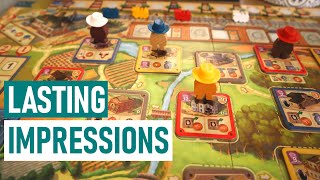
The engine-building arc in Great Western Trail produces one of the most consistently satisfying progressions in the Euro genre. Early turns can feel constrained, with limited money and a weak starting deck. But as workers accumulate on player boards and cattle quality improves, each loop around the trail becomes markedly more productive. Reviewers described the experience of watching their own engine click into gear as a highlight. Getting Games' detailed playthrough showed exactly how this arc develops: early turns spent acquiring a single cowboy or builder, mid-game turns generating meaningful income through building networks, and late-game turns delivering high-value cattle herds to distant cities. Luke Hector at The Broken Meeple captured the feeling when he described how he "went all over this little map" and "built some specific tax buildings" in his winning run, engine elements generating passive income while he pursued primary objectives simultaneously.
What Makes Great Western Trail Stand Out
Accessible Depth
The design's most praised achievement is the compression of genuine strategic weight into a turn structure any player can grasp after five minutes of explanation. Move one to three spaces. Take the action on the building you stopped at. Refill your hand. That is the entire turn, mechanically. Chairman of the Board called the result "surprisingly intuitive," noting that "the thought and decision about what you're going to do, at least mechanically, is not difficult whatsoever." This approachability does not come at the expense of strategy: the choices of where to move, which buildings to land on, and when to press for Kansas City versus stalling to build a better hand contain substantial decision weight. The absence of fiddly exceptions allows players to focus mental energy on strategy rather than rule recall, a balance many heavier Euros never achieve.
Balanced Strategic Paths
Great Western Trail supports meaningfully different approaches to victory, with cowboys, engineers, and builders each anchoring viable strategies. Chairman of the Board noted playing a two-player game where one player went "a completely engineer route" and the other went "a very cowboy-orientated route," with the final score separated by a single point. That balance is not accidental; the design ensures that heavy cattle investment, aggressive movement via train advancement, and passive income through building placement all have realistic paths to competitive scores. Luke Hector's winning game at the Icelandic retreat leaned heavily on building placement and hazard removal while others focused on cattle, yet he outscored the field. This sandbox quality, the freedom to pursue distinct strategies without a single dominant approach, keeps the game fresh across repeated plays.
Potential Drawbacks
Playtime
Playtime is the most consistent concern across reviewers. Chairman of the Board noted that even playing with "really quick players" who "don't have any analysis paralysis," the game "came in probably just over two hours," which he described as "on the longer end of that scale." Luke Hector's four-player game ran closer to three hours, leading him to observe that the game "needs to end a little bit quicker." The pacing dynamic is unusual: as more buildings fill the trail, each traversal takes longer and offers more decision points, causing playtime to expand as the game progresses rather than compress toward a decisive conclusion. At four players this can test the patience of tables that did not budget a full evening.
Limited Player Interaction
Beyond collecting tolls when opponents cross personal buildings, and competing for the same workers in the job market, Great Western Trail is largely a parallel optimization exercise. Chairman of the Board noted that "the interaction is limited," with players primarily building their own engines rather than disrupting others. Rolls in the Family identified this as one reason they ultimately preferred the base game over Maracaibo: the solo optimization loop is compelling in its own right, but players seeking direct confrontation or negotiation will find little here. The foresight mechanism at Kansas City, where players add hazards and workers to the shared board, provides some indirect tension, but the game does not punish opponents so much as shape the environment everyone navigates.
If You Enjoy Great Western Trail
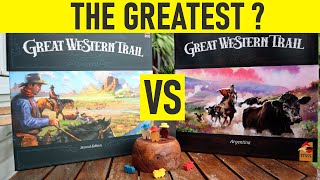
Reviewers consistently mention Maracaibo as the natural comparison for Great Western Trail, both designed by Alexander Pfister and sharing the trail-movement rondel structure, though Chairman of the Board notes Maracaibo is "much more involved" and harder to teach. For those who prefer Great Western Trail's accessibility, Grand Austria Hotel delivers comparable economic flow with similar worker-conversion satisfaction. Glen More II Chronicles offers a different take on route-building with tile drafting. Rococo, mentioned by Before You Play as producing a similar "feel," channels comparable resource-to-points conversion in a dress-making setting. Players drawn specifically to the deck-building dimension should explore Gloomhaven: Jaws of the Lion for a different genre application of hand management. And for those interested in other iterations of the Great Western Trail formula, the New Zealand and Argentina versions offer meaningfully different experiences within the same mechanical framework.
What Reviewers Are Saying
"This one is so much more intuitive, much simpler to explain. A lot of it takes place on the main board itself where that simple mechanism of going one, two, or three spots is where the decision space lies, and I think that's a bit more accessible, a bit more inviting. It still gives you that impression of a medium to heavyweight Euro, which I think is quite a nice balance."
— Chairman of the Board
"I can't stress enough how this changed the feeling of the game for me. This is a core difference that in my mind totally separates itself from the original. Each turn feels really good when you're turning through that deck, and that's why I gotta keep it. I'm giving it the Neon Gorilla stamp of approval."
— Neon Gorilla
"We love in Great Western Trail the deck building, like trying to get your hand right before you get to Kansas City and how that affects the pacing. I played it almost four times with you and then finally decided I think I got to add this to my collection."
— Rolls in the Family