El Paso at the end of the 19th century: Five railroad companies have connected the Sun City to their network and made it a major hub for the cattle trade. Ranchers from the surrounding parts of Texas and Mexico drive their cattle into the city to send them on their long journey to the north, east, and west of the United States.
In Great Western Trail: El Paso, you take on the role of the ranchers of that time and bring your best cattle to El Paso to earn money and victory points. Hire more cowboys, builders, and engineers to get closer to your goals:
Buy cattle to increase the value of your herd!
Construct buildings to unlock more actions!
Participate in the expansion of the railroad and secure the most attractive contracts!
El Paso is mechanically based on its predecessors in the Great Western Trail trilogy. It can serve as an introduction to the series and is the perfect game for game nights when there is not enough time for its big brothers!
—description from the publisher
- Tightly balanced scoring with clear endgame timing
- Deep strategic depth from hand management, deck cycling, and building choices
- Strong thematic flavor with a Western cattle economy vibe
- Clear guidance to prefer the 2B building variant over 2A (2A is too powerful)
- High complexity and a potentially steep learning curve for new players
- Iconography and component readability challenges noted in play, e.g., icons being small
- Building options are limited (only two buildings available at a time) which constrains long-term planning
- Array
- Old West cattle ranching and railway expansion
- Strategic economic simulation with theme-flavored actions
- Great Western Trail
Mechanics (from transcript analysis)
- Building / Tile Placement with Limited Buildings — Players manage a small number of buildings and can upgrade or replace them, affecting actions and endgame scoring.
- Card/Resource Thinning and Market Economy — Cards can be discarded for money or certificates; resources (money, certificates, cows) are spent to acquire better cows and capabilities.
- Deck building — Purchased workers enter a tableau and, after each turn, players draw back up to a hand size, cycling through a deck of cows and specialists.
- Deck building / hand management — Purchased workers enter a tableau and, after each turn, players draw back up to a hand size, cycling through a deck of cows and specialists.
- end game bonuses — Endgame points come from objective tiles and permanent certificates, with bonuses tied to endgame tiles.
- Endgame Timing / El Paso Timer — The end of the game is triggered by a timer mechanism (Simmon cards) and El Paso deliveries determine final scoring cadence.
- Market Actions and Auxiliary Actions — Actions can be augmented by auxiliary actions (exchange tokens, extra movements, or two distinct actions) and a market-like flow for cows.
- Objective Tiles / Endgame Bonuses — Endgame points come from objective tiles and permanent certificates, with bonuses tied to endgame tiles.
- worker placement — Players place workers on a rondelle action board to take actions, unlock resources, and progress toward El Paso.
Video topics + discussion points
Quotes (from this video)
- the game scores very tightly
- do not play with 2A. Always play with 2B.
- This is the game timer. These have points on them for some reason, but they're worth no points.
- getting any wild worker for free is holy cow.
References (from this video)
- In-depth, multi-phase gameplay with clear structure (move, action, draw)
- Rich action economy with multiple ways to develop your strategy (auxiliary actions, hired workers, train cards)
- El Paso mechanic provides a distinctive scoring moment and adds tension to the late game
- Appendix referenced for extra clarity helps with complex iconography
- High complexity and dense rule set may be intimidating for new players
- Iconography and board terms can require consulting the appendix or reference sheets
- Cattle herding, route optimization, and trading posts within a western expansion context
- American West, El Paso region during the 19th-century cattle trade
- mechanics-driven strategy with thematic flavor via cattle types and trading posts
Mechanics (from transcript analysis)
- Certificate and helper (worker) economy — Earn certificates to boost breeding value and use workers to gain extra steps or actions.
- Deck building — Build a herd deck from cattle cards and manage hand to optimize breeding value and earnings.
- deck-building / hand management — Build a herd deck from cattle cards and manage hand to optimize breeding value and earnings.
- Endgame scoring across multiple tracks — Score from coins, buildings, discs on trading posts, and tiles via a final tally.
- set collection — Reveal your hand at El Paso to total breeding value, counting each cattle type once (with certain bonuses).
- Set collection / breeding value calculation — Reveal your hand at El Paso to total breeding value, counting each cattle type once (with certain bonuses).
- Tile-based location actions — Activate multiple actions from location tiles, with special rules for El Paso tiles and common buildings.
- Trading post scoring / delivery — Deliver cattle cards to the El Paso trading post for scoring and progression.
- worker placement — Place workers to activate actions on the board, hire workers, and move along the board's spaces.
Video topics + discussion points
Quotes (from this video)
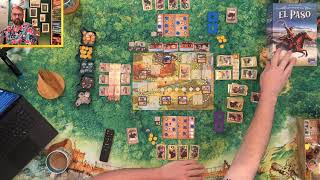
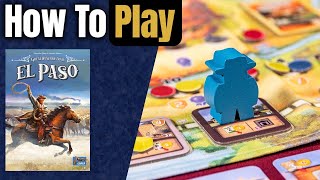
- El Paso is played over multiple turns while you move your herder to a new location, activate a variety of abilities corresponding to that location, and deliver your cattle card to the trading post in El Paso, all in hopes of scoring the most victory points by the end of the game.
- On your turn, you'll complete three phases: move, action, and draw.
- El Paso, your herder must stop their movement and carry out the depicted actions on the tile.
- You'll reveal your entire hand to determine your total breeding value.
- If any spaces have a negative coin value next to them, you'll need to pay that back to the supply.
References (from this video)
- Adds new tension and variability to the base game
- Keeps core systems familiar while offering fresh choices
- Additional rules can compound complexity for new players
- May extend playtime compared to the base game
- extended railroad-based cattle logistics and scoring
- El Paso region frontier expansion
- variant/scenario-like extension of core game
- Great Western Trail
- Glen More II Chronicles
Mechanics (from transcript analysis)
- Deck building — Continued reliance on action cards to perform strategic plays.
- deck-building — Continued reliance on action cards to perform strategic plays.
- set collection — Additional opportunities to collect and deliver resources for points.
- set-collection — Additional opportunities to collect and deliver resources for points.
- worker placement — Utilize spaces to optimize movement and actions on the trail.
- worker-placement — Utilize spaces to optimize movement and actions on the trail.
Video topics + discussion points
Quotes (from this video)
- We got all the Great Western Trails and Great Western Trail El Paso.
- Grand Austria Hotel alltime banger right there.
- For my money, I think this might be the best shelf that we
- bite-sized version of Gloomhaven with like 25 scenarios.
- Awesome tile lane game.
- That's awesome.
- I don't know.
References (from this video)
- Streamlined version of Great Western Trail with a quicker pace
- Easy to learn and teach, good for new players
- Maintains core ideas of GWT while removing some complexity
- High variability due to building options and objective tiles
- Supports solo play and online play on Board Game Arena
- Nice option to introduce GWT concepts without full depth
- Lacks some depth and nuance of the bigger GWT experience
- Fewer path choices and roadblocks, which may reduce strategic feel
- Some players may prefer the original game's thematic weight
- Rail-based route-building with cattle economy and city-building
- Western United States frontier towns around El Paso, rail-building era
- Euro-style, abstracted theme with deck-building and objective-driven scoring
- Great Western Trail
- Pirates of Maracaibo
- Terra Mystica
- Terra Nova
- Glass Road
- Black Road
- Black Forest
Mechanics (from transcript analysis)
- building track progression — buildings on tracks grant actions and bonuses as you advance
- card market / train card deck — train cards act as a market replacing a traditional rail track mechanic
- Deck building — build and optimize a hand of cards (cattle, workers, engineers) to perform actions and gain points
- deck-building — build and optimize a hand of cards (cattle, workers, engineers) to perform actions and gain points
- end game bonuses — score is driven by secret/objective tiles and bonuses that vary game-to-game
- end-game trigger (depletion of key cards) — the game ends when a specific pool of cards is exhausted
- Resource management — manage money, resources, and cards across turns to optimize engine
- set collection — collect cattle cards to improve your deck and increase scoring options
- set collection / cattle cards — collect cattle cards to improve your deck and increase scoring options
- solo mode — a solitaire variant exists for solo play
- Track advancement — buildings on tracks grant actions and bonuses as you advance
- variable end-game objectives — score is driven by secret/objective tiles and bonuses that vary game-to-game
- worker placement — visit buildings on a compact map to take actions and collect resources
- Worker placement / action selection — visit buildings on a compact map to take actions and collect resources
Video topics + discussion points
Quotes (from this video)
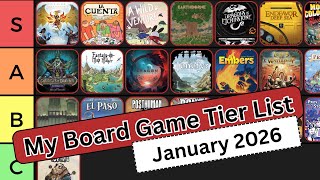
- I give this game a 7.3 out of 10.
- This is a quick review of El Paso, a streamlined version of Great Western Trail.
- It's easy to learn and retain the rules.
- El Paso has legs because of the variability in buildings and objectives.
- It's a good option to introduce to other folks who are used to Great Western Trail.
- I would prefer to come back to El Paso more often because it's easier to bring to the table and to play online.
- The solo mode is a nice addition for solo players.
- If you want a shorter, accessible euro with deck-building and route-building, El Paso fits the bill.
- The game ends when the key cards are exhausted, which creates a clear, if variable, ending condition.
References (from this video)
- Snappy, streamlined gameplay for a euro with fewer fiddly bits
- Auxiliary actions provide meaningful late-game choices and customization
- Smooth solo mode with its own deck and character
- Strong entry point into the Great Western Trail series
- Cloth board can make visibility and iconography hard to read; small tiles and oversized workers
- Iconography is small; spatial layout can slow down turn flow especially for new players
- Deck-building aspect can feel slow; limited multi-sell actions constrain speed
- Learning curve remains presence despite being a lighter entry in the series
- railway expansion and cattle logistics; efficiency and resource management
- El Paso, Texas, in a stylized American Southwest during the cattle-trading era
- Eurogame-focused, with a straightforward path from start to El Paso and back
- Great Western Trail
- Great Western Trail: New Zealand
- Great Western Trail: Argentina
Mechanics (from transcript analysis)
- Auxiliary actions and token economy — Remove a disc from your player board at El Paso to unlock powerful auxiliary actions later in the game.
- Combat: Deck/Hand — Play against a solo AI-like Sue with its own movement and deck; the rulebook explains the solo mode well.
- Deck building — Acquire cattle cards and actions to improve your deck; at El Paso you discard your hand and draw a new one.
- Deck-building and hand management — Acquire cattle cards and actions to improve your deck; at El Paso you discard your hand and draw a new one.
- resource and income management — Earn money and victory points by purchasing cattle, hiring workers, and developing your engine.
- Resource management — Earn money and victory points by purchasing cattle, hiring workers, and developing your engine.
- Solo mode with a dedicated character deck — Play against a solo AI-like Sue with its own movement and deck; the rulebook explains the solo mode well.
- tile placement — Place building tiles on the board to enable future actions and block opponents.
- Tile placement and building effects — Place building tiles on the board to enable future actions and block opponents.
- worker placement — Move your herder around a loop that returns to El Paso to take main actions and trigger round-based effects.
- Worker placement on a circular track — Move your herder around a loop that returns to El Paso to take main actions and trigger round-based effects.
Video topics + discussion points
Quotes (from this video)
- Cows, cowboys, and cardboard. What could go wrong?
- Great Western Trail El Paso serves as an entry point to the Great Western Trail series, such as the original Great Western Trail New Zealand and Argentina.
- This is a Euro game through and through. There is very little player interaction at all in this game.
- One of the things that I really enjoyed about this game is that how smoothly it plays.
- I've never played the other Great Western Trail games, but I do feel like it's very stripped down to its main mechanics.
- Great Western Trail El Paso is a solid good game. Not a great game, but a good one.
- The board... I know they chose to do a cloth and it has like a faded look, maybe more for an aesthetic, but I will say it just makes things a little bit harder to actually see.
References (from this video)
- quicker play time
- good introduction to GW Trail
- less meat than the original
- production quality concerns (subjective)
- streamlined deck-building and action sequencing
- American West, El Paso expansion of GW Trail
- short, approachable variant
- Great Western Trail
Mechanics (from transcript analysis)
- Deck building — cards drive actions and engine development
- deck-building — cards drive actions and engine development
- engine building — new worker cards added to your deck to build engine
- engine-building — new worker cards added to your deck to build engine
- tile/area actions — landing on neutral tiles yields actions; competitive layout
Video topics + discussion points
Quotes (from this video)
- this is definitely a simplified version of the fuller game, and it is a version of the game that plays a lot quicker.
- I would probably rather carve out an extra hour and play the full game.
- I liked it. I think it was an interesting drafting game. It plays super fast, y'all. 15-20 minutes.
- The graphic design is amazing.
- I'm excited for Race to Berlin.
References (from this video)
- Acclaimed designer Alexander Pfister (second favorite designer)
- Faster playing than original series
- Refined design system
- Pure design elegance
- Some passive-aggressive elements remain
- American West
- cattle drives
- trains
- Great Western Trail
- Great Western Trail: Argentina
- Great Western Trail: New Zealand
Mechanics (from transcript analysis)
Video topics + discussion points
Quotes (from this video)
- I'm not here to talk about that I'm here to talk about games
- catch-up games has been on fire
- I love his Cooperative design sensibilities
- how does this game not already exist
- I want more games that tell in 2025 a positive story about how we can work in unison with nature
- 2025 might be the year of co-ops
- pure Feld simple Elegance that leads to deep challenging decisions
- Coming of age is by far my number one most anticipated game
References (from this video)
- Familiar core loop with tighter 60-90 minute playtime
- Two-player friendly variant
- New edition may be unfamiliar to fans of the original
- Railroaded cattle economy with rondel resource gathering
- American frontier trading
- Evolution of a well-known heavyweight string in a lighter package
- Great Western Trail
Mechanics (from transcript analysis)
- Rondell-style resource placement — Move on a board to collect resources and actions.
- worker/resource management — Trade and build to optimize paths and scoring
Video topics + discussion points
Quotes (from this video)
- it's an epic game it's a follow-up to dwellings of everdale
- it's a space themed and the idea is you're at you're in Andromeda the Galaxy Andromeda
- there's a lot of replayability in terms of stuff to explore
- the deluxe edition is so well made
- Layers you are creating a dungeon behind a privacy screen
References (from this video)
- compact box with strong depth
- Texas/Mexico flavor adds thematic zest
- elegant adaptation of the core mechanic from the base game
- may share weight with the base game; not for beginners
- component expectations can be high for a small box release
- railways, cattle, frontier commerce
- Texas/Mexico cattle drive
- engine-building with territorial expansion
- Great Western Trail (original)
Mechanics (from transcript analysis)
- engine-building — build a sustainable engine to generate profits
- route/board movement — move through El Paso region to optimize routes
- set collection — collect cattle, actions, and upgrade cards
Video topics + discussion points
Quotes (from this video)
- I am so excited about that
- I love that world
- it's a small box game
- Point Galaxy is the next iteration of Point Salad
- the world of The Great Gatsby
- Layer is two-player with dungeon-building