/pic6691185.png)





































Green Team Wins Deep Dive
What the Community Thinks About Green Team Wins
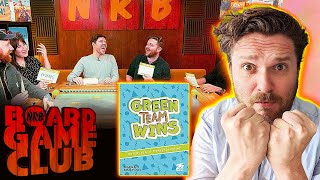
Green Team Wins has earned a reputation in the board gaming community as one of the finest party games to emerge in recent years. Reviewers across the spectrum, from dedicated hobbyists to casual family gamers, consistently return to it with enthusiasm. Board Game Spotlight's Derek called it "the epitome of an incredible party game" and backed that claim with action: he loved the prototype so much that he made his own print-and-play version, cutting out and sleeving over 100 cards before the retail release arrived. That kind of devotion is rare.
The BoardGameGeek podcast guest and seasoned reviewer Steph Hodgej called it "the perfect party game," pointing to its near-limitless scalability as a key strength. The Dice Tower's Sam highlighted how Green Team Wins stands out even among non-gamers: it does not make players do embarrassing stunts or feel stupid for not knowing something, yet it still produces enormous laughs and lively arguments. Totally Tabled's Shaggy brought it on a multigenerational family vacation and watched it connect a pre-teen, a teenager, and grandparents who have no interest in board games. Might I Suggest A Game's Alex positioned it as the ideal dessert course to end a game night, something that does not demand mental heavy lifting but sends everyone home smiling.
The response at Gen Con tells a parallel story. Board Game Spotlight reported that Green Team Wins sold out on the very first day of the convention, with tables of 10 to 15 people playing it simultaneously, holding up their boards and yelling at each other's answers. That kind of public energy is difficult to manufacture, and reviewers noticed it before the game even reached retail shelves.
Core Mechanics That Define Green Team Wins
Written Answers and Simultaneous Reveal
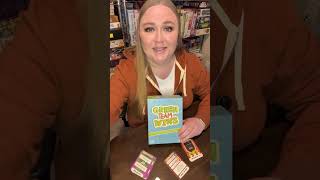
The heart of Green Team Wins is deceptively simple: every player receives a dry-erase board and writes their answer to the same question in secret, then all answers are revealed at once. There are three question formats rotating through the deck. This-or-that cards present exactly two choices, like "table or booth" or "kids table or adults table." Best-of-three cards offer a multiple-choice question such as "what is the deadliest natural phenomenon: hurricanes, tornadoes, or earthquakes?" Fill-in-the-blank cards are the most open-ended, prompting something like "dog blank" or "rain blank," where any word might be written.
Totally Tabled's Shaggy found that the fill-in-the-blank format produced the most laughs and the most conversation in his group, because players had to genuinely think about what the people around them might write. Tabletop Tolson's reviewer noted that the holiday expansion cards demonstrate how well the format adapts to themed play, with questions that feel natural to the moment without forcing it. The simultaneous reveal is the engine that makes all of this work: there is no hidden information held by a game master, no clue-giver under pressure. Everyone writes, everyone reveals, and the table reacts together.
Betting on the Majority and Compound Scoring
The strategic layer beneath the social surface is a majority-guessing mechanic that rewards thinking about your group rather than stating your own preference. Players are not really answering what they believe; they are predicting what everyone else will write. Board Game Spotlight described how this becomes "kind of meta" when playing with people you know well: you might go against your own instinct because you know how a particular person thinks, or you might try to anticipate whether they will play to the crowd or go rogue.
Scoring compounds this tension. Every player begins on the orange team. Matching the majority answer moves you to the green team, where you earn bonus points for every consecutive correct answer. A wrong answer drops you back to orange, and orange players cannot score at all. The Tabletop Tolson reviewer walked through the system clearly: one point for a correct answer on orange, two points for staying on green. This creates a gentle push-your-luck feel without any dice or randomness: the risk is purely social. Totally Tabled's Shaggy noted that his family found the full scoring system slightly complicated for their setting and happily stripped it back to a simple one-point-per-majority system, which worked just as well as a casual activity.
The Green Team Wins Experience
Laughter, Surprise, and Genuine Connection
What reviewers describe most vividly is not winning or losing but the moments of surprise when answers are revealed. Board Game Spotlight's Derek summed it up: "you never know what people are gonna say, and it's also fun when you know people because you're like, I know what he's gonna say." Might I Suggest A Game's Alex captured the same feeling from the other side: "I always love those rounds where I'm super confident that this answer is going to be in the majority and then I am the only person that answered that. Turns out I guess I'm kind of a weirdo." That combination, confidence shattered by a reveal, is what consistently produces laughter at the table.
Board Game Spotlight's Lizzy described how the game functions as an icebreaker: "people who don't necessarily enjoy party games open up with this game. You can get people to come out of their shells." The BoardGameGeek podcast's Amanda observed that at convention tables of 10 or 15 players, the game "gets rowdy," with people yelling in disbelief when someone they thought they understood writes something completely unexpected. The Dice Tower's Sam emphasized that this energy does not depend on humiliating anyone: the game asks for opinions, not performances.
Accessibility Across Groups and Settings
A repeated theme in reviewer commentary is how cleanly Green Team Wins scales across audiences. Jamie from Tabletoptiktok described it as a game that works whether or not players know each other, because the questions do not require shared knowledge or inside references. Totally Tabled's Shaggy confirmed this in practice: three generations of his family played without confusion. The Dice Tower's Sam specifically framed it as a gift for a non-gamer, noting that you could open it at a Christmas party or office gathering and have everyone playing within a minute.
The dry-erase boards mean no paper or pencils are needed, and extra players can participate with scraps of paper if the boards run out. The BoardGameGeek podcast noted that players can come and go during a session without disrupting the game. Steph Hodgej called out this flexibility as central to what makes it a great holiday gathering game: "people can just join in and leave if they want to leave." Tabletop Tolson's reviewer reinforced this for the holiday expansion specifically, pointing to how the themed cards slot naturally into the main deck or can be played on their own for a fully seasonal experience.
What Makes Green Team Wins Stand Out
The Social Reading Layer
What separates Green Team Wins from simpler opinion games is that it rewards genuine social attention. Players who think carefully about the people around them, who notice preferences and tendencies, outperform those who just answer instinctively. Board Game Spotlight's Derek described this as the game being "approachable" in the same space as Just One, but with an additional layer: "it opens up conversations, you get to learn about people, it's a fun get to know you game." At the same time, with people you know well, it flips: you are reading their reading of the room, trying to anticipate whether they will go with their genuine preference or play to the crowd.
This layer is why the game works across such different player relationships. Strangers at a convention demo and couples who have known each other for years are both trying to do the same thing, predict the group's consensus, but the information they draw on is completely different. The Tabletop Tolson reviewer noted that with a group of women from her organization who had never played together, the game produced exactly the same chemistry that Telestrations had: unstoppable laughter and the kind of shared experience that builds social bonds quickly.
Replay and Expansion
Reviewers consistently praised the volume of cards in the base game and the thoughtful design of the holiday expansion. Tabletop Tolson's reviewer covered the holiday pack in detail, walking through examples of themed fill-in-the-blank questions like "cold blank" and "shopping blank," and this-or-that choices like "kids table or adults table." She noted that the card backs match the main game, so the holiday cards can be shuffled invisibly into the base deck or played separately for a fully seasonal session. Jamie from Tabletoptiktok pointed out that the expansion fits into the main box, making storage effortless.
The question variety also contributes to long-term replayability. Because fill-in-the-blank cards have no fixed correct answer, the same card plays differently depending on who is at the table. A group of board gamers writing "first player" for the prompt "first blank" will have a very different session than a group of coworkers who have never heard of first-player tokens. The game is, in a meaningful sense, shaped by the specific people playing it each time.
Potential Drawbacks
Player Count and Energy Requirements
Reviewers were consistent on one point: Green Team Wins is better with more people. The BoardGameGeek podcast's Amanda said directly that "it's definitely more fun at a higher player count," and Steph Hodgej agreed, noting that the game plays any number in principle but really comes alive in the 10-to-12-player range where it becomes "kind of bonkers." At lower counts, the majority-guessing mechanic loses some of its tension because there are fewer possibilities for the group to diverge, and the reveal carries less surprise.
The game also requires players who are willing to engage. Totally Tabled's Shaggy noted that the full scoring system could feel complicated in a truly casual setting, though he found a simple workaround by stripping scoring back. The Dice Tower's Sam acknowledged that games requiring social reading can create an awkward dynamic if some players are reluctant to participate or feel self-conscious about their answers. Green Team Wins does not force anyone to perform or be funny, but it does ask everyone to share something, and groups with very guarded participants may not get the same energy from it.
This-or-That Questions and Question Quality Variation
Among the three question types, the this-or-that format drew mild criticism from Totally Tabled's Shaggy, who found it his least favorite because binary choices tend to produce less interesting divergence than the other formats. With only two options, many players simply write the same answer, and the reveal carries less surprise. The best-of-three and fill-in-the-blank formats, by contrast, create more room for disagreement and the unexpected answers that produce the most laughter.
This is a structural observation rather than a serious flaw, and it is one the game's card distribution addresses: there are equal numbers of each type shuffled together so no single format dominates a session. The holiday expansion's themed questions drew praise across the board, suggesting that the content quality is strong when the subject matter gives players a clear frame of reference to work from.
If You Enjoy Green Team Wins
Reviewers frequently mentioned Just One in the same breath as Green Team Wins, describing them as occupying a similar social space: easy to explain, cooperative in spirit, and built around the moment of shared revelation. If the cooperative angle appeals, Just One is the natural companion.
For groups who love the majority-guessing core but want something with a purely cooperative goal, Blob Party was described by Totally Tabled as "almost like the cooperative version of Green Team Wins," where teams merge rather than compete.
If your group enjoys the conversational, opinion-driven energy of Green Team Wins but wants something with a physical spectrum and clue-giving structure, Wavelength was praised by multiple reviewers as another guaranteed group hit, though it puts more pressure on the individual clue-giver.
Herd Mentality and Jackbox Party Games were mentioned alongside Green Team Wins by community members looking for digital-friendly or larger-group alternatives. Codenames and Telestrations came up as classics in the same social-game tier, with Telestrations specifically praised as having the same unstoppable-laughter quality that Green Team Wins delivers. The Mind was cited for fans drawn to the simultaneous-action, read-your-group dimension of Green Team Wins.
What Reviewers Are Saying
"Green Team Wins is just the epitome of an incredible party game. I don't think there's a better party game. I've played Time's Up, I've played Monikers, I've played you name it. There is no better party game. I mean, this is my opinion. But green team wins is the king."
— Derek, Board Game Spotlight
"Green Team Wins is fantastic because it plays any number of players really. People can just join in and leave if they want to leave. This is like the epitome of a party game, right? This is like the perfect party game in my opinion. Everybody has opinions and this is a perfect example of how you can express those opinions."
— Steph Hodgej, BoardGameGeek Podcast
"This game is super simple and really fast paced but it leads to a ton of laughs and mostly a lot of people at the table trying to justify their answers. Even though I suck at this game I still really enjoyed it and I think this is a great game to finish off your game night."
— Alex, Might I Suggest A Game