









Gutenberg Deep Dive
What the Community Thinks About Gutenberg
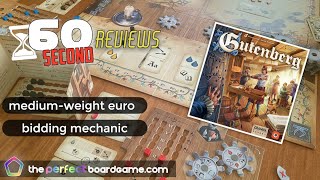
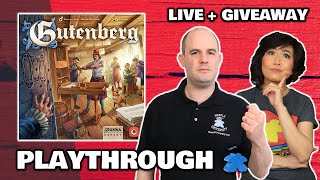
Gutenberg has captured the attention of board gaming reviewers across multiple channels, earning consistent praise for its elegance and accessibility. Channels like Meeple University and Board Game Coffee highlight how well the theme integrates with the mechanics, creating a cohesive experience where every action feels thematically appropriate. The game balances strategic depth with smooth play, letting players grasp the systems quickly and proceed without constantly consulting the rulebook. Reviewers from Rolling Dice & Taking Names to Our Family Plays Games describe it as a polished medium-to-heavy euro that rewards careful planning while remaining approachable, the kind of design that shows extensive playtesting in every icon and board element.
Core Mechanics That Define Gutenberg
Simultaneous Action Selection and Initiative
At Gutenberg's heart lies a distinctive system where players commit cubes to a set of action tracks, with the order of resolution determined by how heavily each track is contested. Rather than a traditional turn-by-turn action economy, players signal their intentions and then resolve those actions in a sequence shaped by competition. This creates tension between claiming the actions you most need and risking being outpaced on a popular track. Reviewers note that the mechanism feels intuitive after a round or two, since the board layout naturally communicates which action corresponds to which section. Published by Granna and designed by Wojciech Wisniewski, the game makes this selection layer the engine that drives everything else.
Contracts and Engine Building Through Type and Ink
The game's economy revolves around fulfilling printing orders that demand specific combinations of movable type and ink. Players gradually acquire wooden letter pieces and ink tokens, paying progressively higher costs as they expand their capacity. Completing contracts generates income and points, with bonus rewards when refinement requirements are met. This creates natural engine building, where early investments in efficiency pay dividends in later rounds. Specialization tracks develop over the game, unlocking milestone rewards that provide free resources or reduced costs, so progression feels organic rather than scripted. The interplay of contracts, type, and ink keeps players weighing immediate income against long-term capacity.
The Gutenberg Experience
Thematic Immersion in a Historical Setting
Gutenberg excels at making you feel like a 15th-century printing pioneer without sacrificing mechanical elegance. Every rule has a thematic justification: you collect letters as movable type, buy ink to fulfill orders, develop specializations like typesetting and illumination, and compete for patronage and fame. The historical period grounds the experience authentically, and the components, from the reversed wooden letters to the gear-driven board elements, reinforce the setting. Players report feeling genuinely immersed in running a printing house, making decisions about which orders to chase and which specializations to pursue that reflect period-appropriate business concerns rather than abstract optimization.
Elegant Flow and Pacing
Despite its middleweight complexity, Gutenberg flows remarkably smoothly. The game resolves across several rounds, providing meaningful decision depth without dragging. Players rarely need to consult the rulebook mid-play, and the board layout naturally guides the sequence of actions. A rotating gear element adds a timing layer that rewards planning ahead without overwhelming the decision space. Each phase progresses quickly once the action order is set, and the satisfying completion of contracts provides regular milestones that maintain engagement from setup to final scoring.
What Makes Gutenberg Stand Out
Outstanding Component Quality and Aesthetic Design
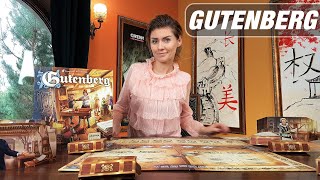
The production quality immediately impresses. The wooden type pieces are crafted with authentic reversed lettering, mirroring real printing-press type, and they are satisfying to handle. The gear mechanisms are genuinely clever, rotating to represent the passage of time and mechanically showcasing the bonuses available each round. The board art evokes a period-appropriate sensibility without overwhelming the functional clarity necessary for play. Component organization and design flourishes demonstrate respect for the player experience, so the game looks striking on the table while remaining intuitive to navigate. Reviewers consistently credit the publisher's polish, noting how much care went into every icon and board detail.
Accessibility Meets Strategic Satisfaction
Gutenberg achieves the rare balance of being easy to learn yet offering genuine strategic choice. The action-selection system immediately communicates what players can pursue, removing the need for extensive rules explanation. Yet committing cubes to contested tracks creates meaningful decisions, and the shifting composition of available contracts forces adaptation each round. Players consistently report that the game feels manageable for newcomers while offering enough decision complexity to reward experienced strategists. This accessibility without dumbing down the choices is precisely what reviewers single out as exceptional design.
Potential Drawbacks
Competitive Dynamics Shift at Higher Player Counts
While the game plays well at two players, some reviewers note that the competitive tension scales differently at four. With more players, the action-selection system means more competition for specific tracks, leading to situations where popular actions become contested and less optimal choices become necessary. The game functions smoothly at all counts, but the strategic interaction shifts from head-to-head tension to managing a more diffuse, crowded environment. This is not a flaw so much as a change in feel, though players expecting tight two-player battles might find four-player games more chaotic and less controllable.
Familiar Mechanics Rather Than Innovation
Gutenberg executes proven mechanics with exceptional elegance rather than introducing wholly novel systems. Action selection, contract fulfillment, track advancement, and engine building are all established patterns in euro design. Some players seeking mechanical innovation or asymmetry might find the systems familiar. That familiarity, however, is precisely what enables the game's accessibility, and the execution elevates these patterns significantly. For many, elegant mastery of established ideas trumps novelty, but those hunting for a revolutionary new mechanism may feel Gutenberg retreads comfortable ground.
If You Enjoy Gutenberg
Players who love Gutenberg should explore Viticulture, another medium-weight euro where action selection drives a production engine centered on fulfilling wine orders. Like Gutenberg, it rewards careful planning and resource management while maintaining surprising depth beneath accessible mechanics. Tuscany, the expansion to Viticulture, extends that experience for players ready to deepen their engagement with the core system. Gaia Project appeals to Gutenberg fans who want heavier spatial complexity, sharing the satisfaction of building gradually more efficient production while operating on a grander sci-fi scale with more intricate interaction. Each rewards the same engine-building patience that makes Gutenberg click.
What Reviewers Are Saying
"The game is super well developed and produced, and the whole kudos goes to Granna. You can see so much playtesting, so much polishing, so much care about every single icon in the game. It feels like a German design, very well put together, with developers debating how to make it even more smooth and easy to understand for the players."
— Rolling Dice & Taking Names
"As a 15th-century printer pioneer, you will compete for the fame of your printing house. You take on the role of one of the historical characters and fulfill your customers' orders. Love it, love it, love it. Some good euro."
— Our Family Plays Games
"Every rule makes sense; you understand what you are doing. You are taking the orders to print the books, you are buying the inks to print these books, you are buying the fonts to print these books. Everything in this game makes total sense."
— Board Game Coffee