










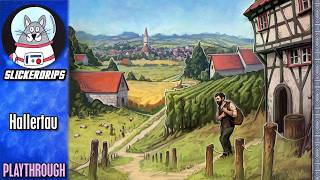
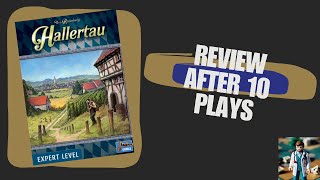






Hallertau box art

Hallertau

Game ID: GID0151351
Collection Status
Description

The Hallertau in Bavaria, Germany is the largest continuous hop-producing region in the world. It prides itself upon being the first in Middle Europe to cultivate hops. This game is set around 1850, when the Hallertau became what it is today.

As chief of a small Bavarian village in the Hallertau, your objective is to increase its wealth and prestige in the eyes of the world.

To achieve this, you will need to supply the local crafts folk with goods from agriculture and sheep breeding.

Place your workers, play your cards right, and let your village shine!

Progressive Worker Placement: Action spaces can be used multiple times, becoming more expensive in the process.
Two-Field Rotation System: Fields lose their potency over time so fallowing fields allows them to become increasingly effective.
Card Combos: You can play cards at any time; this timing—and the combination of cards—can be very powerful.
Sheep with an Expiration Date: Breeding sheep early comes with a lot of perks, but, eventually, sheep will die of natural causes.

—description from the back of the box

Year Published
2020
Transcript Analysis
Browse transcript mentions, sentiments, pros/cons, mechanics, topics, quotes, and references.
Total mentions: 6
This page: 6
Sentiment: pos 4 · mix 2 · neu 0 · neg 0
Mentions per page
Top
Showing 1–6 of 6
Video Fm2_9wm8uww Unknown Channel playthrough at 0:00 sentiment: positive
video_pk 43001 · mention_pk 130810
Unknown Channel - Hallertau video thumbnail
Click to watch at 0:00 · YouTube ↗
Overall sentiment (raw)
positive
Pros
  • Rich, thematic farming puzzle with deep engine-building.
  • Strong solo mode with meaningful and scalable decisions.
  • High variety of cards and decks supports replayability.
  • Tight integration of farming resources with community-center progression.
  • Clear opportunities for planning and long-term engine growth.
Cons
  • Card randomness can be divisive for some players and setups.
  • Rules can be dense and the game is time-consuming to teach and play.
  • High counting and tracking workload can be fiddly, especially for new players.
Thematic elements
  • Resource management, agriculture, and community building.
  • A farming village in a historical European setting with fields, sheep, and community growth.
  • Card-driven, worker-placement engine with evolving community center and seasonal progression.
Comparison games
  • Oranum Burger Canal
  • Black Forest
  • Feast for Odin
  • Slay the Spire
Mechanics (from transcript analysis)
  • Boulder/building advancement and tools — Buildings move along tracks using tools; end-of-round reshuffle keeps tension, rewarding tool use and planning.
  • Deck/cards with modular decks — Four decks (gateway, field, farmyard, bonus/points) are used; players draw and play cards when requirements are met, granting various bonuses.
  • Layer building — Buildings move along tracks using tools; end-of-round reshuffle keeps tension, rewarding tool use and planning.
  • Phase-based round structure — Rounds consist of multiple phases: setup, worker placement, card resolution, farmyard actions, harvest, and endgame scoring.
  • Resource management — Resources include barley, flax, rye, wool, milk, meat, jewelry, etc., with field levels determining harvest yields.
  • Resource tracking and harvesting — Resources include barley, flax, rye, wool, milk, meat, jewelry, etc., with field levels determining harvest yields.
  • Solo scoring against self — There is no opponent; scoring is against your own engine, with progress toward the community center driving endgame points.
  • Variable Phase Order — Rounds consist of multiple phases: setup, worker placement, card resolution, farmyard actions, harvest, and endgame scoring.
  • worker placement — Players place workers on action spaces; costs depend on space and round progression, with quadrant clearance rules altering available actions.
Video topics + discussion points
No key topics recorded for this video.
Quotes (from this video)
  • The main thing you'll be doing is placing workers on a space carrying out that action.
  • This is Uwe Rosenberg's design from 2020.
  • Halatau... the last one that I fell in love with.
  • It's my favorite thing of the last year.
  • It's a beautiful puzzle.
  • In a nutshell, that's the game in a nutshell.
References (from this video)
No references stored for this video.
Video 0egI5TCu0Fc Board Gaming Doctor game_review at 0:40 sentiment: mixed
video_pk 37270 · mention_pk 111922
Board Gaming Doctor - Hallertau video thumbnail
Click to watch at 0:40 · YouTube ↗
Overall sentiment (raw)
mixed
Pros
  • cozy and familiar theme that resonates with Rosenberg fans
  • high variability from deck combinations and card play
  • tight, interactive yet strategic worker-placement with meaningful decisions
  • strong thematic integration (fields, sheep, buildings) that supports intuitive learning
  • solid solo mode with puzzle-like rhythm and predictable scoring structure
Cons
  • card draw luck can dominate outcomes at times
  • storage/organization of goods and resources can become cramped on the tracker
  • can feel repetitive or rote across multiple plays for some players
  • interaction is lighter than Agricola, which may disappoint players seeking heavier conflict
Thematic elements
  • farming economy, resource management, community development
  • Rural Bavarian village in the Hallertau region, focusing on farming, crafts, and village wealth
  • cozy, procedural progression with thematic ties to agriculture and building a village
Comparison games
  • Anno 1800
  • World Wonders
  • Agricola
  • At the Gates of Ly Yang
Mechanics (from transcript analysis)
  • card-driven action system — 10 decks (Farmyard and Gateway decks) plus Bonus and Point decks influence available actions and scoring opportunities; cards can be played at various times to trigger combos
  • deck variability and endless combos — random deck selection per game creates varied objectives and resource interactions, enabling cascading card-driven combos
  • progressive worker placement — players place workers on a 4-quadrant board; actions become increasingly costly—fewer workers on a spot require more workers in subsequent rounds; board resets each round
  • resource conversion and building progression — resources are spent to advance buildings on the community/crafting track; end-of-round shifts move buildings forward and unlock new requirements
  • Resource management — resources are spent to advance buildings on the community/crafting track; end-of-round shifts move buildings forward and unlock new requirements
  • two-field rotation crop management — fields rotate yields; planting decisions determine crop yields across rounds, adding a dynamic crop management layer
  • worker placement — players place workers on a 4-quadrant board; actions become increasingly costly—fewer workers on a spot require more workers in subsequent rounds; board resets each round
Video topics + discussion points
No key topics recorded for this video.
Quotes (from this video)
  • this game feels cozy or familiar like greeting an old friend
  • the rules are intuitive and the math puzzle is pretty much the same from round to round
  • the huge amount of decks of different cards that are provided in each game create the sense of endless variability
  • I think it captures the feeling of working the farm the best that you can
  • I know that I can always return to this game and have a great time with it
References (from this video)
No references stored for this video.
Video Kr8VNAfFrh8 Unknown Channel game_review at 0:59 sentiment: mixed
video_pk 30516 · mention_pk 89818
Unknown Channel - Hallertau video thumbnail
Click to watch at 0:59 · YouTube ↗
Overall sentiment (raw)
mixed
Pros
  • Deep, intricate puzzle that rewards long-term planning and clever card plays
  • Innovative twist on worker placement with multiple spots and dynamic space pricing
  • Rich, varied card system (330 cards across 10 decks) that creates emergent strategies
  • Strong solo mode that provides satisfying play without adding new rules
  • Relatively quick setup for such a meaty game with appropriate storage solutions
  • Thematic flavor and world-building feel authentic to a farming/agrarian setting
Cons
  • High cognitive load and heavy accounting, which can be exhausting and opaque
  • Visual and mental tracking of 13 resource types and multipliers is demanding
  • Balance concerns due to the sheer number of cards and potential randomness
  • Rounds lengthens and can feel bloated for new players or those seeking lighter play
  • Card randomness can feel punishing when draws are unfavorable
Thematic elements
  • farming, resource management, and community-building with a satirical nod to agricultural life
  • A rural community center and farm-oriented town undergoing redevelopment and expansion
  • analytical, humorous, and opinionated critique of farming euro-design
Comparison games
  • A Feast for Odin
  • Agricola
  • Railroad Inc
Mechanics (from transcript analysis)
  • 13 distinct resource types with interlocking rules — The game features a wide variety of resources (crops, animals, and derived goods) that interact in complex ways, driving deep optimization and difficult accounting.
  • Crop planting and rotation mini-game — Fields can be planted to yield crops over rounds; yields depend on field level, and rotation mechanics affect future production, encouraging long-term planning.
  • Deck-based card system with multiple decks — Four decks plus optional free decks produce up to 10 decks and about 330 cards, each providing distinct abilities and modifying game tempo and strategy.
  • Dynamic action space scarcity and demand-driven spacing — Spaces become more or less desirable as they are used, with demand dictating availability and costs, creating a living, evolving engine.
  • End-game objective via moving the community hall — The primary path to points is relocating the central community hall to a better location, framing the entire engine-building effort around a single scoring objective.
  • End-of-round movement costs for buildings — Moving buildings incurs resource costs, and advancing the community center requires coordinated movement of all five buildings, imposing strategic tension across rounds.
  • Movement points — Moving buildings incurs resource costs, and advancing the community center requires coordinated movement of all five buildings, imposing strategic tension across rounds.
  • Resource management — To perform certain actions, players must pay costs that scale with the current round, creating pressure to manage scarce resources like meat, milk, and flax.
  • Round-based resource costs that scale with round number — To perform certain actions, players must pay costs that scale with the current round, creating pressure to manage scarce resources like meat, milk, and flax.
  • Sheep aging and death timing — Sheep age and can die early unless actions extend their life; advancing age adds risk and strategic depth to animal management.
  • Solo mode as a designed, compelling variant — A robust solo mode exists that emphasizes score attack with minimal new rules, providing a self-contained mathematical challenge.
  • worker placement — Players assign workers to a central board; each space may offer multiple spots or sequence-based benefits, with top-line actions reset each round influencing player decisions.
  • Worker placement with multiple spots per action space — Players assign workers to a central board; each space may offer multiple spots or sequence-based benefits, with top-line actions reset each round influencing player decisions.
Video topics + discussion points
No key topics recorded for this video.
Quotes (from this video)
  • this thing is so unashamed of what it is
  • it's not here to excite you
  • the cards are unbearably random
  • not a slam dunk winner but it's got some charm and it's got some pluck
  • i'll keep on playing it
  • the one saving grace that stops halitau from ending up in the forgotten mediocrity discount bin is the solo mode
References (from this video)
No references stored for this video.
Video 9RyaNJJhZSs John Gets Games general_discussion at 32:54 sentiment: positive
video_pk 2706 · mention_pk 7943
John Gets Games - Hallertau video thumbnail
Click to watch at 32:54 · YouTube ↗
Overall sentiment (raw)
positive
Pros
  • Elegant integration of mechanics
  • strong production quality
Cons
  • Steep rulebook, dense for new players
Thematic elements
  • Agricultural economy and cooperative/competitive farming
  • German hops farming region
Comparison games
  • Agricola
  • Caverna
  • Nations
Mechanics (from transcript analysis)
  • economic engine — Develop a balance of production and trade to maximize points
  • worker placement — Assign workers to harvest, build, and optimize production
Video topics + discussion points
No key topics recorded for this video.
Quotes (from this video)
  • the snake board is better overall
  • my ad revenue has doubled since i added the advertisements into the middle of the videos
  • i'm choosing to make this my full-time job
  • 2021 will probably have more videos than any other year that i've done
  • rules are still overwhelming but the writing is exciting
  • i don't really want to flood people's subscription feeds with three or four videos at once
References (from this video)
No references stored for this video.
Video zD_qiW67avc Foster The Meatball general_discussion at 11:28 sentiment: positive
video_pk 2025 · mention_pk 5789
Foster The Meatball - Hallertau video thumbnail
Click to watch at 11:28 · YouTube ↗
Overall sentiment (raw)
positive
Pros
  • unique resource-track mechanic
  • UB-like feel
Cons
  • complex
Thematic elements
  • Resource manipulation and upgrading a moving house-track
  • Medieval Bavarian-inspired village economy
  • economic engine with evolving track
Comparison games
  • Agricola
  • UVE-inspired designs
Mechanics (from transcript analysis)
  • Resource management with a moving track — track advances to score points while resources are spent to progress
Video topics + discussion points
No key topics recorded for this video.
Quotes (from this video)
  • it's a deck deconstruction game where you have a bunch of cards in your hand with differing values
  • it's mean but like the funny thing is it's mean but like you don't necessarily get a Target so somebody usually ends up being the punching bag
  • we did a video on the new iteration of libertalia Winds of galecrest from stonemeyer games you can go check that out
  • this is one of those games where it's like a badge of honor if you win and we've just had such a great time with it
  • it's a really cool experience I think that's the best way this is a really cool experience of a game to play
References (from this video)
No references stored for this video.
Video vEtxq7z_RFc Rolling Dice and Taking Names game_review at 57:22 sentiment: positive
video_pk 15 · mention_pk 18
Rolling Dice and Taking Names - Hallertau video thumbnail
Click to watch at 57:22 · YouTube ↗
Overall sentiment (raw)
positive
Pros
  • unique progressive cost mechanic adds tension
  • deep, satisfying engine-building and village development
Cons
  • rules can be intricate; setup and tracking can be fiddly
  • theme is somewhat abstracted from hops/beer concept
Thematic elements
  • agriculture, craft production, and village growth
  • A Bavarian hop-growing village evolving into a prosperous town
  • economic/resource management with village-building arc
Comparison games
  • Gates of Mara
Mechanics (from transcript analysis)
  • area-based progression — building advancement and track progression impact worker supply
  • progressive worker placement — cost to place workers increases over the round sequence
  • resource/crop management — manage fields, crops, and livestock to advance buildings
Video topics + discussion points
No key topics recorded for this video.
Quotes (from this video)
  • it's a fantastic family game
  • the endurance deck is the core mechanic
  • progressive worker placement
References (from this video)
No references stored for this video.
Transcript Navigation
Top
Showing 1–6 of 6
View on BoardGameGeek