/pic7315662.jpg)
When you think of a Village builder you sometimes think of card tableaux or static hex tile grids.
Think again!
Lots of buildings, all with different shapes, all fitting together in interesting ways.
One central Hamlet that the players contribute to, with its own self-forming demand and supply economy.
Villagers walking through the Hamlet, delivering food to households and building resources to construction sites.
And one day, the Church will finally be built, and the once-little Hamlet has become a fledgling town.
Who will be the biggest benefactor when that happens?
Including solo mode by Nick Shaw & Dávid Turczi
—description from the designer
Hamlet is a medium weight competitive village builder where players are communally turning their Hamlet into a bustling little town. In this tile placing game, players construct buildings that everyone can use to create materials, refine resources, earn money and make important deliveries to construct the Hamlet’s big landmark - the Church.
The game features irregular shaped tiles that connect together without a grid to form a village that is completely different every time. The tile placement organically creates interconnecting paths that the villagers use to transport resources across the village. This leads players to construct boards where no two games will ever feel the same. Since the buildings are communal, this also creates a fluid economy, where players are always working hard to provide the village with the resources that are most needed.
The game is designed by David Chircop (Petrichor, The Pursuit of Happiness). It plays between 1 to 4 players, with a solo mode currently being developed. It will be published by award winning studio Mighty Boards (Excavation Earth, Posthuman Saga).


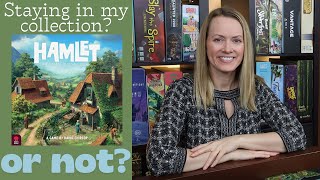
- Innovative shared-resource mechanic with road-building twist that adds inter-player interaction
- Donkeys provide meaningful mobility and network expansion
- Clear, evolving action economy with market and worker activation
- Endgame incentives via green flags and church completion, encouraging planning
- Tile-and-network theme provides a flavorful structural feel and variability with setup
- High cognitive load and busy board, especially at lower player counts; can be overwhelming
- 3D church component blocks visibility and interrupts table flow; not ideal for all setups
- Limited market tile variety and perceived replayability, with few market tiles available
- Learning curve is non-trivial; not guaranteed to feel compelling or fast with two players
- Resource mapping (wood vs stone vs other resources) can be counterintuitive at first
- growth through building, route planning, and resource management
- Medieval European village development from hamlet to village via church construction and road networks
- procedural, system-driven progression with endgame church trigger
- Rebirth
- Canvas
Mechanics (from transcript analysis)
- blueprint_building — acquire blueprints for specific buildings; to build you must place a worker adjacent to a legal space and spend resources.
- donkey_transport — donkeys increase carrying capacity, helping move resources along routes to build locations.
- End Game Bonuses — green-flag bonuses and endgame scoring tokens reward specific roles; church completion ends the game and upgrades a hamlet to a village.
- endgame_scoring_and_bonuses — green-flag bonuses and endgame scoring tokens reward specific roles; church completion ends the game and upgrades a hamlet to a village.
- market_and_coin_economy — coins are used to pay for resources and recruit workers; the market allows conversion of resources into points and currency.
- Network/Route Building — players extend their network by placing roads and connecting tiles to score via connected features.
- route_building — players extend their network by placing roads and connecting tiles to score via connected features.
- shared_resources — resources on the board are available to all players; ownership is not exclusive and access is via actions at locations.
- special_locations_and_resources — special locations (stone mason, sawmill, etc.) generate unique resources and unlock more complex builds when acquired.
- tile_shapes_and_draw — tiles come in varied shapes (diamonds, hexes, triangles, etc.) and are drawn from a bag, creating a changing board layout.
- Worker Placement — workers are activated to perform actions, with activation capable of chaining as the player expands their workforce.
- worker_activation — workers are activated to perform actions, with activation capable of chaining as the player expands their workforce.
Video topics + discussion points
Quotes (from this video)
- It's a solid worker placement activation with a new twist on the tile placement.
- I like that a lot, but maybe not the variety and not the replayability that I'm looking for.
- This is just shy of three out of five on complexity. It's a mediumweight strategy game.
- I would rather play Rebirth.
- The market's a great place to just send resources to gain victory points and dollars.
- The 3D church blocks visibility; it's hard to see what's going on behind it.
- When they're gone, they're gone.
- Not necessarily going to stay in my collection.
References (from this video)
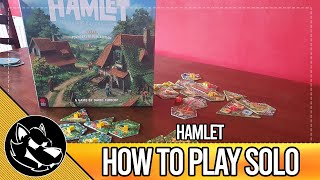
- Interesting solo gameplay mechanic
- Complex resource management
- Multiple strategic options
- Village development and resource management
- Village building
- Solo gameplay tutorial
Mechanics (from transcript analysis)
- Blueprint Construction — Building production buildings and landmarks
- Donkey Chain — Moving resources using connected donkeys
- Resource Management — Collecting and using various resources like wood, stone, wheat
- Worker Placement — Placing workers to perform actions in different locations
Video topics + discussion points
Quotes (from this video)
- The bot doesn't have to worry about donkeys bringing the goods across the chain like you would
- You can always tell it's a landmark because it has the flag token on the description
References (from this video)
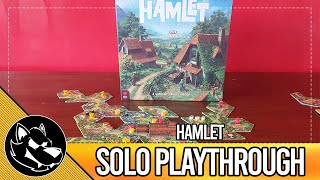
- Quick play time
- Unique tile shapes
- Interesting donkey movement mechanic
- Unique building designs
- Shallow gameplay
- Repetitive actions
- Cluttered board
- Randomness of blueprint bag
- Unbalanced solo bot
- Village building and resource management
- Medieval European village
- Worker placement
- Sonny Boy Door
Mechanics (from transcript analysis)
- Resource Management — Collecting and trading resources to build village
- Tile Placement — Placing unique shaped tiles to construct village
- Worker Placement — Players use workers to collect resources and build structures
Video topics + discussion points
Quotes (from this video)
- the bot can be easily controlled when you learn how much he needs
- it's a game that's best played with three people
References (from this video)
Mechanics (from transcript analysis)
Video topics + discussion points
Quotes (from this video)
- ebb and flow
- longest road scores two points per tile
- one point per segment connected to mountains