








Happy City Deep Dive
What the Community Thinks About Happy City
Reviewers come away from Happy City with a warm, largely positive verdict. Published by Game Right, the game was designed by Aru and Toshiki Sato with illustrations by Makato Takani, according to kovray. Players build a city from a shared market of buildings, collecting income, residents and hearts until one player places their tenth building. Meeple University frames it as a straightforward tableau builder that is easy to set up and teach, and kovray calls it a friendly game that teaches players what they want from a drafting market.
The agreement runs deepest on accessibility and speed. Danny of Board Game Sanctuary describes it as a very fast, short, snappy game, while Adam Porter of Adam in Wales - Board Game Design calls the design very simple and almost a game for children. Reviewers diverge on depth. Meeple University argues that a game with only three icons offers a surprising number of strategies, particularly around how early a player commits to income, and kovray says it carries the flavor of an engine builder in a compact package. Adam in Wales is less convinced, calling the game very light for experienced players, and kovray acknowledges it may feel too simple for some groups. The consensus is that Happy City is an excellent entry point whose strategic ceiling depends on who is sitting at the table.
Core Mechanics That Define Happy City
Card Drafting
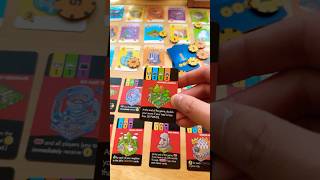
Card drafting sits at the center of Happy City, which the rules define as picking cards from a common pool to gain an immediate advantage or to assemble a collection. Buildings sit in three decks split by price, with the cheapest costing one to three coins and the most expensive costing six to nine. On a turn, a player may discard one face-up building and then reveal cards from any of the decks until three are visible. They can then buy a visible building, buy a residence, or take a coin from the bank. Meeple University walks through this rhythm, noting that a player can start with the cheap decks and move up the price ladder as the game progresses. Because the display is so narrow, every choice claims a scarce resource. Danny of Board Game Sanctuary stresses that players must be decisive about what they take, and kovray describes the display as a contest over the same few cards.
Income
Income drives the early game. Buildings carrying coin symbols pay out during each income phase, and Meeple University observes that how early a player goes for income dictates how hard they can push their purchases later. Kovray points out that starting income is very small, so the excitement of reaching the expensive buildings builds gradually. Some buildings pay out based on how many matching buildings a player already owns, which rewards building a coherent tableau. Because a coin is also available to any player who passes, income sets a floor for trailing players. Kovray notes that passing decisions matter a great deal as the player count rises. In a broader tableau building primer, Adam Porter of Adam in Wales - Board Game Design explains that the basic version of the game awards more residents or happiness, while the advanced version gives access to a wider range of actions, ongoing abilities and scoring opportunities.
The Happy City Experience
Quick and Snappy Tension
Happy City feels brisk from the first turn. Danny suggests playing best-of-five sessions, since a single game lasts about fifteen minutes and rewards repeated play. Kovray says the game is so quick that players simply want to keep going, and enjoys seeing new cards appear every turn with different combinations to explore. Speed does not remove tension. Each purchase may add income but can lower the final score, so players constantly weigh short-term gain against end-game value. Danny sums up the feel by saying the game is super fast but super tense.
Cheerful, Lighthearted Warmth
The art and theme give the game its personality. Meeple University notes that the light cartoon style hides many small touches, from a museum with a skeleton out front to a go-kart track and a pool hall shaped like a table, and calls the artwork extremely cute. Kovray says the game is a really happy game and that it feels like building your own little city, while Danny says it makes their heart glow. Kovray describes the game as friendly and easy to introduce to nearly anyone.
What Makes Happy City Stand Out
Expert Buildings and Variety
Reviewers return again and again to the special buildings. Meeple University explains that the expert variant replaces the basic buildings with powered ones, such as a building that grants two hearts while other players receive money, or one that lets a player buy cards at the lowest price of a matching deck. Kovray notes that bonus buildings can be claimed only once per game, which makes timing a real decision. Adam in Wales adds that gathering certain combinations of colored cards grants additional cards for free. Danny praises the sheer variety, saying that each game brings a different set of special buildings to pursue. Kovray adds that the expert variant is an easy way to make the game more challenging for experienced groups.
A Market That Pushes Back
The three-card display creates a constant contest between players. Kovray describes how a player with more coins can keep drawing from the expensive decks to force opponents to discard the cards they want, and how a card that another player needs can be removed at the start of a turn. Kovray says they especially like the limit to three visible cards, noting that the design could easily have drawn three per deck. Instead, the shared and scarce display produces what kovray calls a tug and pull between players who want the same things, which keeps turns interactive even when everyone is building a separate tableau.
Potential Drawbacks
Limited Visibility in Two-Player Games
Kovray flags that only three cards are visible at once, which creates an element of take that is unintentional but can hurt when it happens. The effect is most pointed in two-player games, where the single card a player needs may be taken or discarded by the opponent. Danny also describes the market as very narrow, so a turn can be shaped more by what remains than by what a player planned. These reviewers treat the issue as a side effect of a tight display rather than a fatal flaw, but it is the criticism that surfaces most often for smaller tables.
Lightness for Experienced Players and Pass Decisions
Adam in Wales describes the game as very light for experienced players, and kovray suggests it may feel a little simple for anyone not invested in quick 30 minute games. Pass decisions also weigh heavily. Kovray warns that players should watch closely when someone passes to take a coin, since the card count really matters and players almost always want to match the pass. That is easy to track in two-player games, but in larger groups kovray has seen it not be worth the effort. Meeple University also notes that the Factory card, which pays two income, is one that players tend to dislike.
If You Enjoy Happy City
Players who enjoy Happy City's city-building theme and steady income-driven purchasing will find a similar appeal in Machi Koro 2, which shares the town-building focus and quick play that reviewers praise. Players who like watching a settlement grow from modest beginnings will also enjoy SimCity, a comparison that Meeple University draws directly, observing that the cute city-building atmosphere reminds them of the classic PC game. In both cases the appeal comes from building something visible, watching income compound, and making purchasing decisions that shape the final picture.
What Reviewers Are Saying
"For something that looks so simple that only has these three icons, there's surprisingly many options that you can go for."
— Meeple University
"It is a really happy game. I particularly am really drawn to the art in this game and the different types of buildings, because it does feel like you're making your own little city."
— kovray
"So you're kind of trying to think, well, do I really need that card? It's going to give me more money, but it's going to lower my scoring value at the end. There's a few of those little micro decisions that really makes this game super fast, but super tense."
— Danny, Board Game Sanctuary