














Herd Mentality Deep Dive
What the Community Thinks About Herd Mentality
Herd Mentality has earned a devoted following among party-game fans for its deceptively simple premise and the way it turns into a window onto how people think. Actualol affectionately calls it the pink cow game and ranks it highly among festival favorites, Board Game Hangover champion it as a reliable icebreaker, and Our Family Plays Games recommend it as an easy crowd-pleaser. What begins as straightforward fun becomes more revealing as players realize that winning means abandoning clever answers in favor of the most obvious ones, a twist that generates genuine laughter and self-recognition at the table.
Core Mechanics That Define Herd Mentality
Simultaneous Answers and Majority Matching
At its heart, Herd Mentality runs on elegant simplicity. Each round, players receive a question and write their answers simultaneously without discussion. Points flow only to those whose answer matches the largest group, the herd, with no reward for the second-largest answer. This creates an immediate tension: being clever and contrarian becomes a liability. Instead, players must think like the crowd, anticipating which answer will seem most obvious to everyone else at the table, published by Big Potato Games as a pure distillation of that single idea.
The Pink Cow and Strategic Restraint
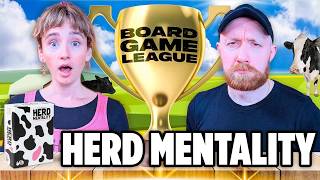
The pink cow, a plush bovine token, embodies the game's emotional core. Any player whose answer stands entirely alone takes the cow, carrying it until someone else becomes the sole outlier, and a player holding the cow cannot win the game even with enough points otherwise. This makes the cow both a mark of shame and a strategic anchor that keeps a runaway leader in check. Reviewers describe how the cow shapes table behavior, with players actively trying to shed it and unconsciously adjusting their answers to avoid standing alone.
The Herd Mentality Experience
A Game Played in the Mind
What sets Herd Mentality apart from other party games is that it is fundamentally a mental exercise. The card reveal is almost secondary to the quiet moment of thinking beforehand, as players wrestle with what others will write and what others think they will write. This turns every question into a small study in group psychology, where the fun comes from discovering how aligned, or how divergent, a group's instincts really are.
Icebreaker Magic for Strangers
Reviewers consistently praise Herd Mentality for bringing unfamiliar groups together. Actualol observed that at a festival, people who did not know each other gravitated toward it because it gently challenges the differences between them, surfacing how groups think differently across culture, generation, and background. Board Game Hangover frame it as the ideal opener for a gathering of old pals or new acquaintances who might be shy about where to start. The game makes the group itself the interesting object, which is exactly why it lands so well with mixed crowds.
What Makes Herd Mentality Stand Out
Minimal Setup, Maximum Engagement
There is almost nothing to explain mechanically: players write answers, reveal, check for majorities, and pass the cow. Our Family Plays Games confirm it works with kids, parents, and grandparents alike because the rules are so simple and the game so short that almost anyone can join. What looks trivial on paper, a pen, a board, and a question card, becomes a surprisingly robust social engine that scales across ages and gaming experience.
Surfacing Group Identity
The deeper appeal is how Herd Mentality reveals a group's shared, or unshared, reference points. Actualol noted that watching different answers emerge highlights cultural and generational differences in a way that sparks conversation rather than conflict. Because the goal is to match the herd, the game rewards understanding your specific table, which makes each group's session feel personal and distinct from any other.
Potential Drawbacks
Replayability Declines With the Same Group
Herd Mentality's central mechanic depends on genuine surprise, and that surprise fades with repeated plays among the same people. Board Game Hangover note that once a group has answered a question, players remember the likely answers and become harder to catch out. For new groups or one-off gatherings this is irrelevant, but for a standing game night it suggests Herd Mentality works best as an occasional guest rather than a rotation staple.
Questions That Miss or Alienate
The question deck carries cultural assumptions, and Board Game Hangover point out that some prompts are quite localized, so players from a different culture may want to skip them. Certain questions can also land awkwardly with particular groups, and the simple fix, skipping a question that does not suit the table, works but briefly interrupts the flow. The game asks for a little social calibration to keep every prompt fun for everyone present.
If You Enjoy Herd Mentality
Reviewers connect Herd Mentality to other interaction-driven party games that reward reading the room. Wavelength is the closest sibling, asking players to predict how others perceive a spectrum rather than a question. Just One delivers cooperative word-guessing built on group consensus, scratching the same itch for shared thinking. And for a lighter, faster filler with the same crowd-pleasing energy, Codenames rewards getting on the same wavelength as your teammates, the very skill Herd Mentality turns into a game.
What Reviewers Are Saying
"There's something special. The game in itself is great, but just being given the pink cow of shame just takes it up a notch."
— Actualol
"It's a really good icebreaker game. If you're getting together with old pals and everybody might be a bit shy or don't know where to start, start with this one."
— Board Game Hangover
"Once we introduced people to it, they pop into the board game lounge for ten minutes and they're playing it an hour later. A sign of a good game is when people stay longer than expected."
— Actualol