
Heroes of Land, Air & Sea is an immersive and strategic 4X-style board game that transports players into a world of epic battles between orcs and humans, dwarves and elves, and warring kingdoms. With beautifully crafted miniatures, this game brings to life the thrilling tale of heroes who shape the course of war.
In this game, players take on the role of one of these iconic factions, vying to expand their kingdom and conquer new territories. Every great kingdom starts small, and players begin their journey with just a humble town hall, a handful of peons, and a lone warrior. From this modest beginning, players must venture out, explore the surrounding lands, strengthen their workforce, build a formidable army, and develop their kingdom. This requires careful decision-making, resource management, and strategic warfare.
As players progress and achieve milestones in their kingdom's development, they unlock a multitude of advantages. Peons evolve into mighty warriors, warriors ascend to become powerful heroes, and town halls transform into majestic castles. Players also gain access to water vessels and air vessels, as well as mythical creatures. By boarding these vessels and creatures with their units, players can traverse the expansive game board more swiftly and position their armies for devastating attacks.
Warfare in Heroes of Land, Air & Sea employs a meticulously designed cost/reward system, outlined on tactics cards that players must secretly select. The availability of these tactics cards depends on the units involved in the conflict. It is during these intense battles that players must showcase their strategic prowess and fight for victory, knowing that history is written by the victors.
Furthermore, Heroes of Land, Air & Sea features two distinct economic systems. The first involves the risky acquisition and careful management of vital resources such as food, ore, and mana. The second system introduces a unique twist on worker placement, where players must strategically allocate their peons to construct buildings. However, it’s important to note that these peons could also be utilized for exploration, expansion, exploitation, or even extermination! Achieving the perfect equilibrium between these two systems is absolutely pivotal for securing victory in this thrilling game.


Images

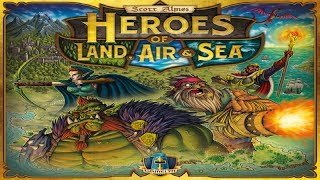
- Visually appealing aesthetics with 3D ship models and tiered capital pieces.
- Dripping in theme with backstories for heroes and factions.
- Well-done combat system with near-perfect information and deduction.
- Thematic epilogues in the rulebook based on faction wins.
- Overstuffed with mechanisms that don't cohere into a clear identity.
- Lack of excitement and engagement during gameplay.
- Leads to analysis paralysis due to complexity and unclear strategy.
- Unintuitive spell system.
- Combat rewards both attacker and defender with victory points, diminishing the incentive to fight.
- Faction abilities are not unique enough compared to other games in the genre.
- Difficulty in keeping track of numerous abilities across different buildings and heroes.
- The rulebook provides backstories for heroes and explanations for why factions are fighting.
- Tiny Epic Games
- Tiny Epic Zombies
- Tiny Epic Galaxy Defenders
- Tiny Epic Quest
- Lords of Hellas
- Cosmic Encounter
- Rising Sun
- Twilight Imperium
Mechanics (from transcript analysis)
- 4X — The game is described as a 4X game with elements of eXplore, eXpand, eXploit, and eXterminate.
- action selection — Players choose from a set of actions. Some actions can be copied by other players if they have specific units (serfs). There's a focus on capital actions which can lead to double actions.
- Area Control — Expanding presence on the board with warriors and building towers are mentioned as ways to gain presence and transfer units between.
- Building Construction — Players construct buildings that provide abilities, with higher capital levels granting access to more powerful abilities. These buildings are not placed on the board but are kept by the player.
- Combat — Combat involves playing cards from a shared hand of seven cards, offering near-perfect information with no luck involved. Cards have resource costs and different abilities, with restrictions based on available units. Process of elimination and reading the opponent are key. However, both players gain victory points from combat cards, regardless of winning or losing, which is seen as a significant negative.
- Hero units — Players have three unique heroes with abilities that tie into their capital and buildings. These heroes can be brought onto the board based on the buildings constructed.
- Resource Management — The game involves managing three different types of resources used for building and recruiting units.
- Set Collection — Revealing tokens on every spot on the map (Exploration) is a win condition. Building towers on the board is also part of achieving victory points.
- Spellcasting — Players can draw and cast spells from a common deck. Spells have resource costs (mana) and can be scribed for later use. There's a spell limit to manage.
- Unit recruitment — Players recruit serfs (for building and actions) and warriors. Building a steady influx of serfs is emphasized for resource generation and action copying.
Video topics + discussion points
Quotes (from this video)
- I personally feel that there is just a lot of stuff that is put into this game and it doesn't really know what it wants to do.
- When playing this game I was constantly thinking to myself what am I missing here?
- The combat in this game is is actually very well done.
- I hate the fact that both players get victory points [for combat].
- I love the aesthetics of it.
- This game made me feel like I did [have analysis paralysis].
- At the end of the day I have no interest in playing this again.
- I think it is an average game.
References (from this video)
- Great components
- Assembly of little ships is notable
- Similar mechanics to Tiny Epic Galaxies and Tiny Epic Kingdoms
- Very long playtime
- Not tiny or epic in scale
- Tiny Epic Galaxies
- Tiny Epic Kingdoms
Mechanics (from transcript analysis)
- 4X game — It is a 4X game.
- Lead and Follow — It uses similar mechanics to Tiny Epic Galaxies and Tiny Epic Kingdoms, including lead and follow.
Video topics + discussion points
Quotes (from this video)
- if you stay tuned until the end we'll give you a review of tiny epic tactics
- what is your favorite tiny epic games
- I always had the most fun with tiny epic Western
- Tiny Epic Galaxies and zombies do I have the big one yeah well you can explain why both
- It's a really good trap or game we just there's a conversations recently and I think was tweeting and it what's your favorite travel game I was like any of the tiny epic games
- it's a little bit too epic for its box silly face you just have to be efficiently packing it together
- I think the co-op is a little more fun than the semi competitive semi co-op one
- The game's a good reminder of the difference between tactical combat and strategic combat
- Yeah it actually it's tacked yeah the difference between short term grab the points when they're on versus long term defend don't get hit
References (from this video)
- Part of Scott Alms' 'Tiny Epic' series, implying a certain design philosophy.
- The sheer number of boxes and expansions makes it 'dorky' and potentially overwhelming.
- The box size is compared to the Terraforming Mars collector's edition.
- Tiny Epic series
Mechanics (from transcript analysis)
- Modular — The game consists of a base game and numerous expansions, allowing players to customize their experience.
Video topics + discussion points
Quotes (from this video)
- mind clash is all about making their games just over just overboard with production values and just making them cool cool cool
- the art is neat it's original um like i say it's hard a lot of these games you look at it and you're like oh well that's that's back to the future you look at this you're like oh that's star trek but this one it's hard hard to put a finger on it isn't it
- if you know trickerion you know what's what's happening and then they did something really really smart and really really sneaky
- the components are amazing i like them i really like the feel them
- my first live stream thank you for joining me
- i'm a storage nerd
- this is a kickstarter product if you couldn't tell
- it's a loan but it's a fun loan
- the future is a scary place folks
- whoa what happens when you need to burp or fart on a live stream do you know
- Look at this thing this is crazy
- Mineclash is all about making their games just overboard with production values and just making them cool cool cool
- The vision, the artistic vision, is so weird, it's so funky and out there
- If you're a geek and I know you probably are this game is for you
- These are the coolest things, and they'll look better once I get them out of the bag
- I was so disappointed when I bought it... and then I played it and it's wicked, I loved it, it's so cool.
- It's like kitchen sink game design and people have faulted it for that.
- Perseverance is like Lost meets Jurassic Park
- It seemed like a really unique concept to me but weird, is that weird?
- and they said this will never be available at retail and then they released a version of it at retail I was like damn you
- they said we will we're not going to do gollum versions of these other games and then they released them
- Spacious and component-heavy
- The host notes that Nemesis requires more space than the Anachrony Infinity Box, and mentions a friend's extensive collection of 'Too Many Bones' components.
- Expansive and modular
- The game consists of a base game and numerous expansions, allowing players to customize their experience.
- Audacious (Collector's Edition)
- Social Deduction
- The host compares it to 'werewolf' and questions if it includes a literal clock tower.
References (from this video)

Mechanics (from transcript analysis)
Video topics + discussion points
Quotes (from this video)
- your stuff is great people really like your stuff dare I say perhaps better than my stuff
- almost every video you've done if not all of them have been solo gaming
- I went on Board Game Geek one day I stumbled across it and I was like unofficial solo modes that's a thing
- July 2017 and literally that's what I started with alra and I just bothered everybody and I was like Hey I'm going to play this like 20 times in like the span of a few weeks and nobody got annoyed so I stuck around
- I have the most watched video of any video on gaming with Edo after a decade of video you're the winner
- many reasons uh I like just exploring new games without having like the pressure of like take your turn and like I got to do this and so everybody else can play can take my time
- it's almost like are you coming into solo games for the first time have you basically never played board games or you're like oh I played like a couple as a kid but now I want to get into it or is it like the the other path where it's like yeah I play a bunch of board games but now I don't have a group or I want to explore playing on my own
- I love it it's fun and I think also like looking at that development it is like when you play solo you're the only one playing so there's this whole thing where you're like if I win my first time without you know just getting lucky and I I have no idea what I'm doing and I won why do I play again
- there's something special about games that let you get to negative points
- I certainly am a big fan of of your work
References (from this video)

Mechanics (from transcript analysis)
- Area Control — Mentioned as a common mechanic in fantasy games that is also used in Area Warfare.
Video topics + discussion points
Quotes (from this video)
- It's got this dark fantasy, like demons and cultists.
- It feels like you're playing a movie.
- It's that paranoia, that tension, that makes Nemesis so good.
- The narrative is so strong in Arkham Horror LCG.
- Spirit Island is just brilliant.
- It's just a fantastic puzzle.
References (from this video)

- Epic battles
- Huge table presence
- Satisfying component play
- Balances multiple game aspects beautifully
- Long play time
- Significant setup and teardown
- Rules overhead for new players
- Competes with other epic strategy games that might be easier to set up
- Epic fantasy battles, faction warfare
- Fantasy world with multiple factions
- Epic scope, strategic maneuvering.
- Blood Rage
- Kemet
Mechanics (from transcript analysis)
- Area Control — Players expand their presence across the map.
- asymmetric factions — Each faction feels powerful and unique.
- Combat — Features strategic combat between factions.
- miniatures — Uses miniatures for troops and heroes, adding to table presence and gameplay.
Video topics + discussion points
Quotes (from this video)
- my shame is going to come out right now, and you probably have games like this, too. But these are my top 10 games that I wish I played more.
- Oathsworn right here, this story is rich, dark, full of meaningful choices that really impact the whole story.
- It feels like a hybrid of a premium fantasy novel RPG campaign and a tactical boss battling game.
- First off, on a personal level, my minis are everywhere.
- This is Firefly, Firefly the game.
- it perfectly captures the feel of the TV show.
- Every game becomes a memorable smuggling adventure.
- Shadows of Brimstone I did not I mentioned before I did not grow up playing D&D or an RPG. I wasn't allowed to, but Shadows of Brimstone it gives me that.
- Shadows of Brimstone is a fantastic blend of western horror, science fiction, and fantasy.
- There is a a massive setup and teardown.
- This is one of the the most rewarding D&D style games out there.
- These are the type of games that type of games that create stories that you'll be talking about years later.
- Give me your shame. Let your shame come out in the comments. Tell me the game that you want to play more because but you just can't.
References (from this video)

Mechanics (from transcript analysis)
Video topics + discussion points
Quotes (from this video)
References (from this video)

- Asymmetric factions with unique abilities and builds
- No dice; randomness comes from card-driven outcomes
- Towers and capital upgrades add strategic depth and long-term planning
- Sea travel and exploration add variety to map control
- Players can cap out on resources, potentially stalling engine
- Complex and large rule set; challenging for new players
- Early game weaknesses for certain factions can be punishing
- 4X style gameplay (expand, explore, exploit, exterminate) with asymmetric factions and capital-building
- Fantasy realm with dwarves, elves, and orcs on multiple continents
- Instructional playthrough with live gameplay and rule explanations
Mechanics (from transcript analysis)
- Actions (March, Muster, Recruit, Tax, Build, Research/Spell casting) — Multiple rounds where players take two actions per round and may follow in others' actions; resources are spent to gain units, build, and advance
- Capital city leveling — Capital city can be upgraded through levels; bonuses unlock and affect abilities and spells
- Combat and tactics cards — Battles resolved using tactic cards chosen secretly; outcomes influenced by card effects and special abilities
- Cube Tower — Buildings reduce costs and grant bonuses; Towers provide resources and points and influence mobility
- End Game Bonuses — End when certain conditions are met (expand, explore, exploit, exterminate); points come from units, regions, city levels, and buildings
- Endgame triggers and scoring — End when certain conditions are met (expand, explore, exploit, exterminate); points come from units, regions, city levels, and buildings
- Exploration tokens and exploration — Board regions flipped when moved into; tokens grant resources or trigger effects; portals and sea routes add depth
- Resource Management — Track resources such as food, ore, and mana used to recruit units, build, and perform actions
- Sea travel and ships — Barges and dragons travel across the map; sea exploration spots add strategic options
- Special buildings and towers — Buildings reduce costs and grant bonuses; Towers provide resources and points and influence mobility
- Units and asymmetric heroes — Four races with unique units and hero abilities; examples include Priestess, Assassin, Dragon, Sea Turtle, Berserker
Video topics + discussion points
Quotes (from this video)
- "there are no dice in this game which is a good thing"
- "the game ends when one of these four endgame conditions"
- "there are many different asymmetric abilities"
References (from this video)
- Elegant, streamlined rules for a large, component-rich game
- Compact rule set and clear action economy with two actions per round
- Sophisticated upgrade paths and powerful synergy between buildings and heroes
- Thematic flavor with engaging combat interactions via the card system
- Huge box and space/storage issues; box size mismatches pallet shelves
- High price and cost vs content; expansions feel necessary to get value
- Rulebook and spells/info can be overwhelming; many rules require FAQ or external references
- Lack of a clear objective or narrative; combat can feel repetitive or unsatisfying
- Balance concerns due to many combos and dependency on player choices
- Notoriously space-intensive when including expansions; risk of scope creep
- Conquest, economy, and large-scale combat
- Fantasy world inspired by empire-building with Africa-themed landscape and towers, airships, and sea vessels
- Narrative through engine-building and strategic combat with card-driven battles
- Twilight Imperium
Mechanics (from transcript analysis)
- Asymmetric unit upgrades via 'blood' mechanics — Blood type tier systems upgrade units and unlock second-level abilities and new production; special 'blood tank' mechanic allows turning serfs into warriors.
- Capital and buildings upgrade system — Upgrading capitals unlocks new abilities; second level unlocks additional spell and upgrades both existing and future buildings; builds a sense of progression.
- Combat card system with hidden hand — During combat, players secretly choose one of seven combat cards; cards interact and cancel; simultaneous reveals; defender and attacker both play cards and resources must be spent.
- Exploration and terrain control — Explore tokens are revealed; outposts and towers produce units and enable unit teleportation; ships transport units; two-row limit on boats/ships.
- Forex-like progression (extend, explore, expand, explode, exsanguinate) — The game uses a path of growth with economy and military expansion that pushes toward endgame conditions.
- Resource Management — Players must pay resources for played combat cards; if insufficient, they sacrifice units but still participate; strength-based resolution with magic/spells.
- Resource management and combat resolution — Players must pay resources for played combat cards; if insufficient, they sacrifice units but still participate; strength-based resolution with magic/spells.
- Two-action per round with action shields — Each round you receive two actions; you can pre-commit serfs to actions to enable free participation by others; cap actions with capital vs command.
Video topics + discussion points
Quotes (from this video)
- it's big but it never feels overbearing there is a lot of stuff but it all fits elegantly into a very sleep rules framework
- this box is so big it comes with an actual extra friend inside
- I really like this system of upgrading your things
- the highest strength wins
- this box half a centimeter too big to fit on the standard pallet shelf
- I would rather buy Twilight Imperium which comes with 17 playable races
References (from this video)

- Impressive table presence
- Rich theme
- Complex for newcomers
- 4X empire-building with multiple win conditions
- Global-scale, four-path conquest (land, air, sea, etc.)
- grand strategy with table presence
- other large-table 4X titles
Mechanics (from transcript analysis)
- 4X framework — Explore, Expand, Exploit, Exterminate with multiple routes to victory
- area/territory control and 4X framework — Explore, Expand, Exploit, Exterminate with multiple victory paths
Video topics + discussion points
Quotes (from this video)
- we just finished our first playthrough of Copenhagen the deluxe edition
- Kickstarter this fall with analog games means it's a game where you are constantly trying to meet the demands of the King
- four paths to victory
- table presence is incredible
- everyone was so welcoming and I can't wait to go back
- subscribe to our Channel
References (from this video)

- huge impressive game with great components
- asymmetric clans with different abilities
- explore expand exploit exterminate mechanics
- looks amazing on the table
- supports large player counts
- surprising game length despite scope
- multiple expansion options
- neoprene mat upgrade available
- game can end sooner than players want
- players may want to extend playtime
- fantasy_exploration
- conquest
- clan_warfare
- epic_scale
Mechanics (from transcript analysis)
Video topics + discussion points
Quotes (from this video)
- Dominion set the standard and then it was great because then everybody came came around they stood on the on Dominion shoulders and they improved deck-building
- the epitome of like what is an action game you don't watch those movies where you're like I just want to sit back turn off my brain just have a good time that's what this is
- very zen right it's very zen
- it seems a little silly but it's the best kind of silly
- the more people the better this game feels
- people will agree to like not explore that last space or not do that last thing that's gonna trigger the end of the game just to keep going
- if you go in here as just like run-and-gun Batman rolled dice and just punching faces you're gonna get crushed
References (from this video)
- strong IP-style appeal and table presence
- enjoyable core loop and visual appeal
- minis and components can be oversized for small tables
- not as streamlined as some lighter games
- epic bravery and exploration with multi-faction synergy
- fantasy-themed conflict with multiple factions and routes to victory
- tableau-building with multiple paths to victory
- Tiny Epic series (for scale and expansion philosophy)
Mechanics (from transcript analysis)
- area control and factional play — Players vie for control and resources across a shared map.
- team-based synergy — Players collaborate through special abilities between factions.
Video topics + discussion points
Quotes (from this video)
- Tiny Epic Galaxies is by far my favorite tiny epic game
- it's so good, I can't wait to play it
- worldwide six games with the game hall bag—worldwide, anybody can win
- the art is amazing
- this game has no right to be as good as it is
- I'll play this game anytime
References (from this video)
- Strong solo mode
- Epic potential for multiplayer with the right group
- Distinct Warcraft 3 vibe that differentiates it within the 4X genre
- Undead faction not included in the base game and requires a separate expansion
- Large table footprint; a true table hog
- Limited base-box faction variety; storage and organization can be challenging
- Conquest and faction-based control across a large map, with flying units and modular combat
- A Warcraft 3–inspired fantasy world with empire-building and territory expansion
- Epic, high-fantasy war-theatre ambiance with heroic and mythical overtones
- Scythe
- Space Empires for X
Mechanics (from transcript analysis)
- 4X (eXplore, eXpand, eXploit, eXterminate) — Players explore a fantasy map, expand their empires, exploit resources, and engage in combat to dominate regions.
- Area Control — Territories and key locations are contested through unit presence and combat outcomes.
- area control / conquest — Territories and key locations are contested through unit presence and combat outcomes.
- Asymmetric Mechanics — Base game includes multiple factions with distinct capabilities; undead faction is only available via expansion.
- Factions and asymmetry — Base game includes multiple factions with distinct capabilities; undead faction is only available via expansion.
- Solo and automa gameplay — Supports a robust solo mode with automa opponents for single-player play.
- Unit production and deployment — Players build and move units (including flying units) to project power and secure objectives.
Video topics + discussion points
Quotes (from this video)
- this is basically a Warcraft 3 game in everything but name
- they did not include the undead faction here
- there's not a whole lot of 4X board games that are SOL it's a very very difficult thing to pull off
- I would just rather play Scythe
- it's a table hog it is gigantic it barely fits on my table
- I really wanted to play this multiplayer at some point
- storage solution for Heroes of land air and SE