/pic4848330.jpg)






















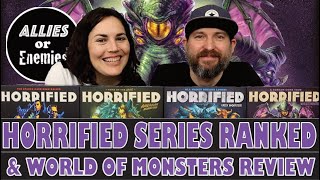



Horrified Deep Dive
What the Community Thinks About Horrified
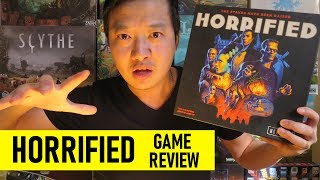
Horrified has earned a warm reception from board game reviewers as one of the most thematically satisfying cooperative games designed for a broad audience. The game casts players as citizens of a town under siege by classic Universal Studios monsters including Dracula, the Wolfman, the Mummy, the Invisible Man, the Creature from the Black Lagoon, and Frankenstein's Monster with his Bride. Allies or Enemies describes it as a title they "picked up on a whim with zero expectations and it has been a nice surprise," praising Ravensburger for keeping costs low without sacrificing quality. Might I Suggest A Game calls the gameplay "really easy to pick up and start playing right away" while noting it "hides a nice depth of strategy which makes it a great pick for newbies and veterans alike."
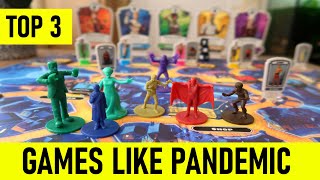
The comparison to Pandemic surfaces repeatedly. The Cardboard Herald calls it "pandemic seasoned spook," and Before You Play acknowledges the same loop of moving, collecting resources, and putting out fires before the situation overwhelms you. Meeple University points out that Horrified improves on the Pandemic skeleton through monster variety: each monster is defeated in a completely different way, preventing the game from feeling like a repeated routine. The general consensus is that Horrified works best as a gateway cooperative game, an excellent entry point for families and non-gamers, and a reliable crowd-pleaser for fans of the classic films.
Core Mechanics That Define Horrified
Cooperative Actions and Resource Management
The backbone of Horrified is its action-point system layered on top of shared resource management. Each hero takes four actions per turn (some heroes have three or five), spending them to move, pick up colored item tokens, share items with teammates in the same space, guide villagers to safety, or work toward defeating monsters. Crucially, items function as both tools and armor: they progress monster-specific tasks and can be discarded one-for-one to absorb monster hits. Before You Play highlights this tension vividly, as players constantly debate whether to burn a high-value item as a shield or hold it for the defeating blow.
The share action is particularly notable. Any heroes in the same space may freely trade items, and critically, this exchange does not have to involve the active player. Before You Play notes this is unusual compared to other cooperative games. The rule enables meaningful logistical chains: one hero can funnel a cache of red items to a teammate positioned to smash Dracula's coffins while a third escorts a villager to safety on the same turn. The Cardboard Herald characterizes the overall loop as "breath-holding pick up and deliver," capturing how tightly item logistics drive the tension throughout.
Unique Player Powers and Monster Asymmetry
Horrified achieves its replayability through two intersecting layers of asymmetry: hero abilities and monster variety. Each hero badge carries a different number of actions and a distinct special ability. Before You Play demonstrates this across their playthrough, showing how the Professor can move any hero or villager one space as a special action, while the Courier can teleport to any space occupied by another hero, and the Mayor commands five actions per turn. These differences encourage coordination around each character's strengths.
The monster asymmetry runs even deeper and is where reviewers agree the game truly shines. Watch It Played walks through defeat conditions: destroying all four of Dracula's coffins with red items before staking him with yellow items; moving the Creature from the Black Lagoon's boat marker along a river by discarding specific colors; gathering blue items to brew a cure for the Wolfman; and for Frankenstein and the Bride, teaching them humanity and engineering their meeting. Allies or Enemies finds this thematic integration delightful, noting that each monster's mechanics feel drawn directly from the source films. Before You Play calls the monster mats "really what make it just so cool," the place where complexity lives and where each combination creates a meaningfully different puzzle.
The Horrified Experience
Foreboding Tension That Feels True to the Genre
Horrified generates genuine dread through its pressure systems. The terror track climbs whenever a villager is defeated by a monster or a hero is knocked out of the fight. If it reaches its maximum, the players lose immediately. A second loss condition triggers if the monster deck runs out, meaning the town has been terrorized too long. The Cardboard Herald captures this escalation vividly, describing the early game as "rock climbing Mount Everest at a 90-degree angle." Allies or Enemies reinforces this: the monster AI card controls movement, attacks, and special events in a single draw, and the channel notes it is "one of the easiest to use AIs that we've come across and it works really well." The frenzy marker adds a further escalation layer, designating one monster as active twice per round, and the identity of the frenzied monster shifts over time, preventing players from ignoring any threat for too long.
Before You Play captures this suspense across a full playthrough, describing games where the terror track crept upward steadily and perk cards were burned just to skip a monster phase, with the team ultimately winning with one turn remaining. That single-turn margin, in a fully realized horror setting, is the experience Horrified is designed to deliver.
Thematic Immersion and Production Quality
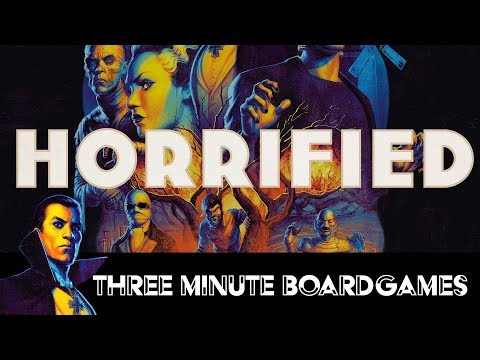
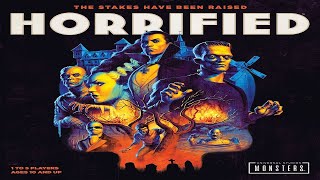
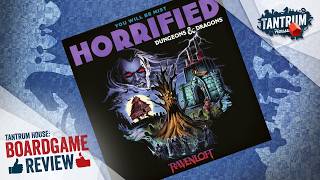
Reviewers consistently praise how well Horrified commits to its source material. Allies or Enemies notes that "what stands out most is the obvious love of the source material," pointing out that every location and villager name comes straight from the classic films, including Wilbur and Chick from the Abbott and Costello monster comedies and the detail that the Creature's boat is named the Rita. The channel adds that the game inspired them to rewatch all the original movies. The Cardboard Herald singles out the box art as "absolutely stunning," describing the illustration style as evoking "the traditional 1930s horror blockbuster format" and instilling "a real sense of anxiety and excitement." Before You Play praises the component quality, noting the board is beautiful and that Ravensburger includes a small surprise on the inside of the box lid. Might I Suggest A Game captures the thematic coherence of each monster's defeat condition simply: "the gameplay of each monster feels so in line with what that specific monster would do."
What Makes Horrified Stand Out
Monster Variety Drives Combinatorial Replayability
The core game ships with six monsters, and players choose two for a novice session, three for the standard game, or four for a punishing experience. Allies or Enemies estimates approximately 20 possible combinations in the base game, each with "a fairly different feel." Before You Play confirms that higher player counts are harder in part because more heroes attract monsters more frequently, but also because specific monster selections change which items matter and how the team must divide labor. Might I Suggest A Game points to the American Monsters expansion as further expanding the replayability ceiling, and the kovray channel covers World of Monsters and a Krampus expansion, each introducing monsters with fresh mechanics like the Sphinx's puzzle grid and Cthulhu's two-stage banishment ritual.
Accessible Design With Strategic Depth
Might I Suggest A Game puts it directly: Horrified is "really simple to learn and to teach" while hiding "a nice depth of strategy." Allies or Enemies echoes this, calling the rules "plenty simple enough for new gamers" while noting "there is enough here for more seasoned co-op gamers that want something a little bit lighter." The hero phase offers a small set of clear actions with no hidden information; the monster phase is resolved through a single card draw. This keeps downtime minimal and the board state legible at all times. Meeple University highlights the perk card system, earned by safely delivering villagers, as the layer that adds strategic dimension: those cards provide powerful one-time effects that can turn a desperate round in the team's favor.
Potential Drawbacks
Momentum Shifts as Monsters Fall
The Cardboard Herald raises a structural criticism that stands out: the game's tension tends to deflate as players gain the upper hand. "With each monster that you defeat you can hear an audible sigh of relief from everybody at the table," the channel notes, "but this quickly becomes a problem because the game loses its murderous momentum with each step that you get closer and closer to victory." The horror genre, the channel argues, should leave players shuddering until the final moment. Horrified instead starts at maximum intensity and gradually relaxes, which can make the endgame feel anticlimactic after a tense opening. The tension arc runs opposite to many successful cooperative games, where escalation continues until the last resolution.
Quarterbacking and Replayability Ceiling
Might I Suggest A Game names the quarterbacking problem directly: because the game is simple and fully transparent, experienced players can easily see the optimal move for every hero, and it can be tempting to tell other players exactly what to do. The channel recommends reminding dominant players that everyone is working toward the same goal, but acknowledges this is a structural tendency in light cooperative games rather than a flaw unique to Horrified. Allies or Enemies adds a related concern about long-term staying power, noting that "patterns start to emerge after a while" and the game "probably won't have the staying power of some of the big guns." The channel qualifies this by pointing to the 20-plus monster combinations available, suggesting that players who want more challenge after mastering the base game step up to four monsters or explore expansions rather than expecting the base box alone to remain fresh indefinitely.
If You Enjoy Horrified
Players who love Horrified's cooperative monster-hunting structure and are ready for more complexity have strong options nearby. Arkham Horror: The Card Game offers a significantly deeper cooperative experience set in Lovecraftian horror, with deck-building and campaign progression that rewards long-term investment. For those drawn to the Pandemic-style board management and escalating threat systems, the original Pandemic provides a thematically different but mechanically familiar challenge at a higher difficulty ceiling. Players who appreciate the thematic richness of Horrified but want a more immersive, app-driven experience can look toward Mansions of Madness Second Edition, which Might I Suggest A Game recommends in the same Halloween flight of cooperative horror games.
What Reviewers Are Saying
"This game feels like it's made for mass market but Ravensburger does a nice job keeping costs low without overly sacrificing on quality. What stands out most however is the obvious love of the source material. All the locations and villagers are straight out of the classic films. The whole thing actually inspired us to go back and watch all of the old movies."
— Allies or Enemies
"I love the thematic elements of this game. The gameplay of each monster feels so in line with what that specific monster would do and the type of terror they would induce if they showed up in your backyard. The game is really easy to pick up and start playing right away but it actually hides a nice depth of strategy which makes it a great pick for newbies and veterans alike."
— Might I Suggest A Game
"If you like cooperative games and you're a sucker for theme this game is really fun. This has a fun factor it's just straight fun. It is very enjoyable from the beginning all the way to the end. It's exciting, the mechanisms are very simple, and you can literally play it with anybody. You can break it out with the family who would enjoy this kind of theme."
— Before You Play