/pic3979771.png)



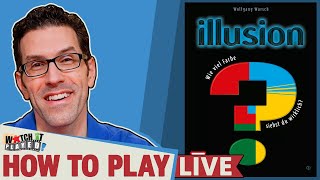








Illusion Deep Dive
What the Community Thinks About Illusion
Illusion has earned a special place in board gaming culture as one of designer Wolfgang Warsch's most accessible and consistently praised designs. Reviewers like Getting Games and Adam in Wales enthusiastically recommend it as a gateway game that works across player skill levels and ages, from casual players discovering board games for the first time to seasoned gamers looking for a quick filler that still delivers meaningful moments. The elegant simplicity combined with surprising depth has made it a reliable crowd-pleaser at game nights, family gatherings, and even travel situations.
Core Mechanics That Define Illusion
Color Perception and Estimation
At its heart, Illusion is a game about visual judgment. Each round, a color is named, and players must estimate how much of that specific color appears on each card relative to the others. This is not a game of memory or traditional strategy. Instead, it challenges players to make genuine visual assessments. You draw a card and must decide where it belongs in a sequence arranged from least to most of the target color. Is there more of that color on this card than that one, or less? The difficulty lies in the abstract patterns of overlapping shapes and colors that genuinely confuse human perception, making what should be simple surprisingly tricky.
The Challenge Mechanic and Risk-Reward
Instead of placing a card, you can challenge the existing sequence. If you believe someone placed a card out of order, you call it out, all cards flip to reveal the actual percentages printed on the back, and you win an arrow token if you are correct. If you are wrong, the player who last placed a card wins instead. This creates a beautiful tension: you can sit quietly and let people place cards you suspect are wrong, or back your own visual read and challenge. The first player to collect a set number of arrows wins, making every placement and challenge meaningful.
The Illusion Experience
Immediate Accessibility and Teaching
One of Illusion's greatest strengths is how quickly it teaches. The entire ruleset can be explained in minutes, and players begin engaging with real decisions immediately. Within a single turn, a new player understands the objective and the consequences. This accessibility extends across age ranges; reviewers note that young children can compete meaningfully against adults, since the game relies on visual perception rather than strategic knowledge or memory of complex rules.
The Social and Brain-Bending Moments
What transforms Illusion from a simple concept into a memorable experience are the moments of genuine confusion and table talk it generates. As cards accumulate in a line, players squint at the displays, debate whether a card belongs, and laugh when a confident placement turns out to be completely off. Reviewers describe playing it several times in succession because each game lasts only minutes, making it a filler people actually want to replay. The reveal of percentages that contradict what everyone's eyes suggested produces natural surprise and discussion.
What Makes Illusion Stand Out
Universal Appeal and Portability
Illusion comes in a tiny box with just a deck of cards, making it genuinely portable. Reviewers repeatedly praise it as an exceptional travel game, something you can pull out on a plane, at a bar, or at a convention. Despite the small footprint, it commands attention and engagement from everyone at the table. This combination of minimal space and maximum fun makes it valuable for casual situations where heavy, long games are impractical.
Leveling the Playing Field
Because Illusion relies on visual perception rather than strategic mastery or rules knowledge, it creates rare moments where newcomers and veterans compete on equal footing. A child's visual system works just as well as an adult's, so children can be genuinely competitive. Some reviewers suggest children might even hold an edge, since they carry fewer preconceptions about how colors should look.
Potential Drawbacks
Colorblind Accessibility Concerns
The most significant limitation is that Illusion, by its very nature, is challenging for colorblind players. While the game uses distinct colors, a player with color vision deficiency would struggle with the core visual task. This is not a design flaw so much as an inherent constraint of the concept, but it is worth considering when introducing the game to a new group.
Depends on Honest Judgment
Illusion relies on players making genuine visual assessments. Some players might be tempted to place cards based on where they think an opponent will challenge rather than where they truly believe the card belongs. This rarely becomes a problem in casual play, but the game's integrity depends on good-faith participation, particularly in more competitive settings.
If You Enjoy Illusion
If Illusion captures your interest, you might explore Liar's Dice and Skull, both of which combine bluffing, risk assessment, and the challenge of reading other players. All three emphasize intuition and nerve over strict strategy. If you appreciate Warsch's design philosophy, his other accessible hits like The Quacks of Quedlinburg and The Mind are equally creative, though they explore very different mechanics.
What Reviewers Are Saying
"It's completely a visual exercise of what percentage does this have. Does it have a larger percentage of red than this one? You slot it in, and then the next person draws a card and slots it, and there are more and more options of where you could slot. But the next person can also challenge and say I think something is wrong, and then you flip all the cards and they have the actual percentages on the back."
— Getting Games
"Number 72 is Illusion, a game by Wolfgang Warsch, who designed Quacks of Quedlinburg and The Mind. Illusion is one of the lesser known of his games and comes in a tiny little package, but it's really fun. It's all about colors and optical illusions, similar to the game Timeline if you've ever played that."
— Adam in Wales - Board Game Design
"There's nothing like it, it's a fun little exercise in the visual and the kind of conversation that strikes up. I love the times when we have a long line and it's like, do I think this is wrong? It's fun when someone challenges and it turns out we had it all right, and you almost feel this team camaraderie of hey, we did pretty good there."
— Rolls in the Family