/pic3749870.jpg)












Indian Summer Deep Dive
What the Community Thinks About Indian Summer
Indian Summer is part of Uwe Rosenberg's beloved polyomino tile-laying series, sitting alongside Cottage Garden and Spring Meadow. Channels like Before You Play, The Board Game Garden, and Actualol praise how it combines a brisk race to fill your board with interactive tile selection and the strategic use of uncovered treasures. The game stands out among its peers for capturing an autumn theme through both its mechanics and beautiful presentation while delivering engaging play that scales across player counts.
Core Mechanics That Define Indian Summer
Polyomino Tile Placement with a Twist
At its heart, Indian Summer is a polyomino tile-laying puzzle where players cover their personal forest-floor boards with leaf-shaped pieces. The critical innovation comes from holes embedded in each tile. These holes are positioned strategically by the player, and what matters is what lies beneath: berries, nuts, feathers, and mushrooms that serve as treasures. By carefully aligning tile holes over these treasures, players gradually reveal special abilities that grant advantages as the game progresses. This layering of placement puzzle and treasure strategy creates surprising depth beneath simple-looking rules.
Racing with Meaningful Decisions
Unlike Cottage Garden's point-scoring approach, Indian Summer rewards being the first to completely fill your board. The tiebreaker considers the treasures a player has collected, making the quality of placement decisions as important as speed. This combines a competitive race with thoughtful puzzle-solving, since rushing forward without planning can leave you holding uncovered treasures and facing defeat even if you finish first. A tile market for selecting pieces adds light interaction, since players can take tiles they do not need simply to deny better options to rivals.
The Indian Summer Experience
Beautiful Aesthetics That Enhance Gameplay
The visual presentation of Indian Summer is striking. The autumn-leaf theme comes through vibrantly in the tile artwork, and the colorful board creates an immediately inviting table presence. More importantly, the aesthetic choices support the experience: the visual clarity of the board helps players plan their placements, and the gorgeous components encourage repeated plays. The game rewards active engagement throughout because there is significant visible progress and visible competition as players race toward board completion.
Accessible Yet Strategic Play
Indian Summer excels at accommodating both casual and experienced gamers. The core concept, fill your board, collect treasures, and use their powers, is simple enough to teach in minutes. Yet meaningful decisions are everywhere: which treasures to prioritize, when to use ability powers, which tiles to claim from the market, and whether to pursue board completion or work on treasure synergies. The game plays relatively quickly, with turns flowing rapidly once players understand the puzzle-like nature of placement, since many can plan their moves while others execute.
What Makes Indian Summer Stand Out
A Tighter Take on the Polyomino Puzzle
While Cottage Garden introduced the series concept, many reviewers feel Indian Summer refines it. Cottage Garden asks players to maintain and flip multiple gardens, which can slow pace and add complexity without necessarily deepening strategic options. Indian Summer removes that friction: one board, one goal, constant visible progress. The race element also creates player interaction that can feel more muted in Cottage Garden's point-scoring approach. Multiple reviewers note that despite Cottage Garden's charm, Indian Summer is their favorite of the series, since the puzzle stays satisfying while the experience feels tighter and more engaging.
Engaging Across Player Counts
The game shines through its tile-market interaction. The shared market creates opportunities for tactical denial, and the ability to take other players' desired tiles adds unpredictability that scales well at higher player counts. Players consistently cite that Indian Summer works well with a full table, whereas some find Cottage Garden's simultaneous, multi-board management less exciting in group settings. The race element keeps everyone's progress visible, holding attention throughout the game.
Potential Drawbacks
Box Size and Setup Fiddliness
One consistent complaint is that the game box is oversized for its contents, making storage inefficient. Additionally, while the components are beautiful, setup involves organizing multiple shades of tiles by color, which can be finicky and time-consuming. Some players separate tiles into bags or containers to streamline future setup. This is not a gameplay issue, but it affects the casual pickup-and-play experience that many favor.
Variable Interaction at Different Player Counts
At two players, Indian Summer can feel less interactive than at four, since deny-drafting opportunities are reduced and the race feels less pressured. While the game plays acceptably at two, reviewers note that it truly shines with more players, where blocking and tile selection create richer decision-making. Solo play is viable but transforms the game into a pure puzzle without the competitive tension that makes the race mechanic engaging.
If You Enjoy Indian Summer
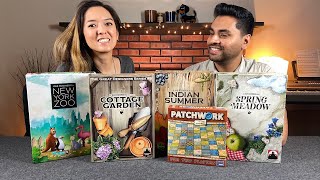
Players who love Indian Summer should explore other entries in Rosenberg's tile-laying portfolio. Cottage Garden remains a solid gateway tile-laying experience with a lovely floral theme, though many find it less engaging once they have played both. Spring Meadow offers different scoring mechanics and a lighter aesthetic, rounding out the series. For more polyomino puzzle satisfaction, Patchwork is a renowned two-player classic with a button-economy twist on tile placement. Fans of Indian Summer's blend of accessibility and depth should also investigate New York Zoo, Rosenberg's later polyomino game that adds animal meeples and breeding to similar puzzle foundations.
What Reviewers Are Saying
"You have your forest floor and you're placing tiles over top of these different blue and orange and pink spaces in order to get those things to help you place more tiles, and you're trying to ultimately complete the entire grid."
— The Board Game Garden
"I really like the race element. There's a lot of strategy that's involved in Indian Summer, so it is definitely my favorite of the trilogy."
— Before You Play
"I love that this is just one grid you're racing to fill, but that the game has so much thinkiness to it, where you've got a hole in each of the pieces, and where you put those holes is crucial because you're trying to reveal fruits from underneath."
— Actualol