





























Inventors of the South Tigris Deep Dive
What the Community Thinks About Inventors of the South Tigris
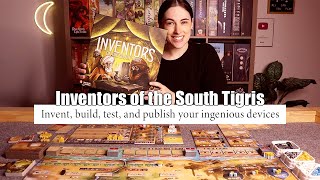
Inventors of the South Tigris represents Garphill Games at their most ambitious. An entry in the South Tigris series by Shem Phillips and S J Macdonald, it sets players in the medieval Islamic Golden Age as competing inventors race to design, build, test, and publish their creations. Reviewers from Meeple University to The Broken Meeple respect its mechanical depth and tightly interconnected systems, though they acknowledge it demands significant mental investment from anyone seeking mastery. The consensus is that this is the heaviest, crunchiest game the studio has produced.
Core Mechanics That Define Inventors of the South Tigris
The Cube Tower and Dice Brightening
At the heart of the game lies a distinctive dice and cube-tower system. Players manage dice across multiple states of availability, progressing them from exhausted through ready, determined, and inspired levels. Advancing a die to the determined level raises its pip value, and pushing it to the inspired state boosts it further, effectively turning any die into a high-value result. This brightening appears throughout the game via card effects and free actions, forcing players to choose when to unlock a die's full potential. The physical cube tower adds memory and randomness: cubes dropped in can stick and emerge on later turns, so each resolution carries the residue of prior decisions. Different colored dice unlock bonuses tied to specific actions, layering color choice on top of raw numerical value.
Crafts People and Progressive Specialization
Players manage a tower of specialized crafts people who grow more expensive but more valuable as they advance. Using one requires paying silver equal to their current level and flipping them face down. Once the bottom of the tower empties, a rotation occurs where the lowest tile moves to the top, creating a rising cost curve. Higher tower levels provide increasingly valuable bonuses, rewarding investment over time. This system creates a delicate balance between spending resources now and building long-term income for future rounds, and reviewers single it out as one of the design's most satisfying engines once it gets rolling.
The Inventors of the South Tigris Experience
The Multi-Stage Invention Lifecycle
Inventions flow through a four-step progression that mirrors how ideas move through society: inventing, building, testing, and publishing. Inventing requires dice meeting a pip threshold and placing an invention to gain influence. Building moves a device into production, requiring additional crafts people and resources. Testing involves placing dice to advance your ship down the river and collect workshop tiles. Publishing, the final stage, demands the most resources but delivers the most points. What makes this engaging is that different players can participate in different stages of the same invention, each earning rewards for their contribution. This semi-shared layer adds subtle negotiation and blocking within a fundamentally competitive game.
Engine Building Through Workshops and Synergies
The workshop system rewards tableau building and combo assembly. Players sail their ships down a river track to collect workshop tiles, placing them into personal rows. When you assign dice to a workshop row, every tile whose thresholds or color requirements are met activates, triggering chains of benefits. The strongest engines emerge from careful arrangement of tiles whose effects multiply together. Early games involve learning what combinations exist; experienced play shifts toward securing the right tiles early and protecting them from opponents. This layer provides the game's most satisfying moments, when a carefully planned sequence of workshops and dice cascades into a flurry of effects.
What Makes Inventors of the South Tigris Stand Out
Strategic Depth Through Interlocking Systems
The game excels at creating meaningful decisions where nearly every action branches into multiple consequences. Spending a crafts person advances the tower but locks that person until reactivated. Using a colored die grants a bonus tied to its color. Placing a worker reveals its action and blocks that space for others. Advancing your ship opens new opportunities but stretches your actions thin. No single system dominates; the interplay between tower advancement, dice progression, the invention stages, and workshop building creates a rich web of options. Players must continually weigh whether to shore up a weak area or double down on their strongest engine, and reviewers credit this density as the game's chief reward.
Thematic Coherence in the Golden Age
The design respects its historical setting without letting theme override function. Inventions combine board and card elements into whimsical creations, the crafts people evoke master artisans rising through their guild, and the river journey reflects real trade and travel. While the theme stays subdued compared to narrative-heavy games, it permeates the mechanics, grounding the otherwise dry optimization in a plausible, evocative world. That coherence helps the heavy systems feel purposeful rather than abstract.
Potential Drawbacks
Intimidating Complexity and a Steep Learning Curve
Inventors of the South Tigris stands as the heaviest game Garphill Games has released. The rulebook introduces extensive iconography, edge cases, and interdependent mechanics that are not immediately intuitive. Teaching it takes well over an hour even for experienced gamers, and first plays often involve floundering as players learn which strategies work and which paint them into corners. The planning required to sequence multiple turns ahead can paralyze analysis-prone players. Unlike earlier entries that stay accessible despite depth, this game rewards studying the rules between sessions. Some players will view this as thrilling complexity; others will find the barrier to entry prohibitive.
Tight Resources and Punishment for Early Mistakes
The game provides remarkably few free resources, making poor early decisions costly. Dice availability can dry up if players overcommit, silver shortages arrive quickly as crafts-people costs climb, and influence vanishes if spent carelessly. The game can punish the exploratory play that helps newcomers learn, as they discover too late that a path leads to a dead end. This tightness creates elegant puzzles for experienced gamers but frustrates those seeking forgiving, casual play. The result is a design that demands respect, where complacency is reliably penalized.
If You Enjoy Inventors of the South Tigris
Try Scholars of the South Tigris, which shares the setting and many mechanical underpinnings with a gentler teaching curve and less punishing resource management. Wayfarers of the South Tigris rounds out the series and offers alternative engines through different mechanisms. For heavy worker-driven euros with similar decisiveness, explore Hadrian's Wall, which demands careful sequencing of actions, or Raiders of the North Sea for a lighter on-ramp to the studio's design language. Those who enjoy orchestrating multiple overlapping systems toward one coherent strategy should also look at On Mars, which similarly rewards long-range planning across interlocking subsystems.
What Reviewers Are Saying
"This is hands down the chunkiest, weightiest, and possibly deepest game Garphill has ever put out. It's an absolute beast."
— 3 Minute Board Games
"In Inventors of the South Tigris you are competing as inventors, trying to be the best inventor by the end of the game. You're going to be doing this in different ways by using dice and also your workshop. With those dice you perform actions like inventing as well as building, so you're inventing the items, then building them, then publishing them. You can also test those inventions."
— The Board Game Garden
"This one is definitely the most complicated game that they have put out ever. I'm not joking, more complicated than something like Hadrian's Wall. This is a slog of iconography, interlinking mechanics, and little edge rules, which is what's concerning me about it."
— The Broken Meeple