
























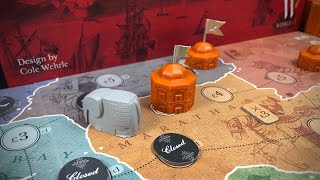

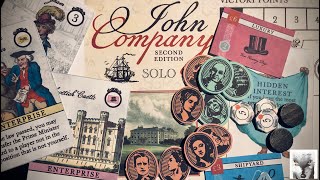

Over its 250-year history, the British East India Company grew to become one of the most influential commercial and political organizations in the world. Its profits catapulted the British Empire to global dominance and shaped the fate of some of the world's great nations, but its ascent was anything but easy. The Company was filled with diverging interests and struggled constantly at home and abroad.
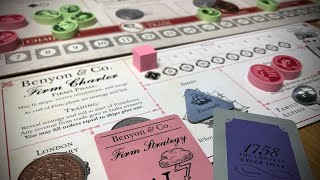
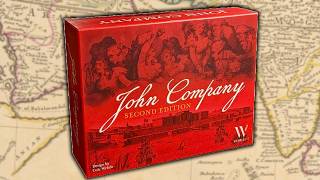
John Company attempts to tell the story of the British East India Company from the inside out. Players will steer their dynasties through the company's history, vying for position, power, and prestige. The goal of the game is simple: Use the Company and the Company's trade to secure your place in society back home. To this end, you guide your scions through their careers, exchanging favors for positions in London or plush colonial posts. Players collectively control the Company, facing tough budgetary decisions and conflicting interests. Should a Governor conduct a campaign to expand company holdings or invest in his region's infrastructure? Perhaps the honest tax revenues would be better diverted to expand his summer estate back home...
As the game continues, the Company may face open rebellion in India or outright failure as it grapples with increasingly bold attempts at regulation from the British government. It's even possible that the Company's trade monopoly will be revoked, leaving the players to form and operate their own trading firms. Each game offers a huge range of possibilities, informed chiefly by the decisions the players make. In addition, players can tailor their experience by using one of the three tournament scenarios that cover the Early, Mid, and Late Company that can be played in about 90 minutes. The game also offers a full campaign game that will take players from 1720 to 1857 in an evening.
Taking its inspiration from Phil Eklund's seminal Lords games, John Company offers Greed Incorporated by way of Republic of Rome — and with only sixty cards and multiple scenarios, John Company is one of the most accessible SMG offerings to date.
—description from the publisher
- Deep, historically resonant design; highly crafted; thought-provoking
- massive attention to detail and realism in mechanics
- Very long and heavy; learning curve can be steep; complex rules
- imperial governance, colonial trade, moral weight
- East India Company, imperial era
- historical simulation with heavy, morally nuanced decisions
- Root
- Oath
- Arcs
Mechanics (from transcript analysis)
- campaign_style_progression — The game spans multiple years with yearly steps and evolving strategies.
- hidden_information — Power dynamics and intentions are not fully transparent; inference is key.
- multi_role_system — Players hold and shift various company roles (presidency, director, chairman) affecting decisions.
- negotiation — Extensive negotiation and alliance-building; players influence company fortunes.
- negotiation_and_diplomacy — Extensive negotiation and alliance-building; players influence company fortunes.
Video topics + discussion points
Quotes (from this video)
- this is absolutely a big big dig in for me
- the rules are so simple
- mindboggling that someone can put together a game like this
- Big old dig in
References (from this video)
- Emergent ludal harmony through player interaction and role dynamics
- Meticulously structured rules that support a strong thematic experience
- Insightful portrayal of colonial capitalism and corporate governance
- Heavy onboarding with long, convoluted rules and potential jank
- Low perceived agency/autonomy for many offices; often player actions are dictated by chairmanship and position
- Significant time commitment; scenarios can run several hours and may lead to game-end due to debt or slow progression
- On-table readability and components could be improved; not the most attractive board
- Reliance on RNG and negotiation can produce volatile outcomes; balance can feel brittle
- Array
- 18th–19th century East India Company era, colonial India and global trade
- Satirical historical fiction; emergent narratives driven by player actions
- Oath
Mechanics (from transcript analysis)
- Deregulation and private firms (optional variant) — Deregulation allows creation of private firms to compete with the company; this is a later game state in some scenarios.
- Economic engine with debt and dividends — The company incurs debt; dividends can be paid to shareholders and affect standing; mismanagement can cause bankruptcy or survival.
- Event deck and stochastic disruption — Event deck introduces storms and events that modify map and impede actions; dice checks add randomness.
- Events — Event deck introduces storms and events that modify map and impede actions; dice checks add randomness.
- Long scenarios with time-skips and variability — Multiple scenarios cover different time frames; each setup yields different starting states and boards.
- negotiation — Boards emphasize bargaining and negotiation; player actions influence others; social enforcement shapes outcomes.
- Parliament voting on laws — Laws are voted on during Parliament meets; the Prime Minister draws a law and players vote using vote icons and money; laws change rules immediately.
- Power track and scoring — End-of-game scoring is based on power track values of assets; points are awarded for the most power and long game duration.
- Push-your-luck and table negotiation — Boards emphasize bargaining and negotiation; player actions influence others; social enforcement shapes outcomes.
- Retirement and promotion to offices — Family members retire randomly at the start of a round; you can pay to place them in a country house or advance in the hierarchy.
- Role-based action economy — Players assign family members to offices; each office provides a distinct set of actions, and turns progress in a chairman-to-chairman order.
- Trade, looting, and combat actions — Officers can loot or engage in attacks to generate money; territories can be opened or attacked; governors can be installed.
- Voting — Laws are voted on during Parliament meets; the Prime Minister draws a law and players vote using vote icons and money; laws change rules immediately.
Video topics + discussion points
Quotes (from this video)
- John Company does an incredible job of getting players to do as the title says and make heinous atrocities become not but mundane administration.
- You're not the good guys.
- This isn't a historical reenactment where you bat chess cuz you recognize the calicoax name but rather actually have to play and talk around its function.
- The vibes and ludal narrative harmony are full speed ahead.
- John Company represents this via all the random and out of your control occurrences constantly cropping up that flavor your table talk.
- This is incredibly powerful to have them understand that they are utilizing foundations of dysfunctional lies and greed. Not by spamming flavor texts or prominent names with the presupposition that players will already be knowledgeable on them, but instead by focusing on making the players have to act like the child is in pits of the time without ever needing to already know their IRL lore.
References (from this video)
- Deep historical simulation with political themes
- Time-intensive, high complexity
- Array
- 18th-century British East India Company
- Political, economic simulation
- Nemesis
Mechanics (from transcript analysis)
- economic/resource management — Players manage resources and strategy to influence history and power.
- Resource management — Players manage resources and strategy to influence history and power.
Video topics + discussion points
Quotes (from this video)
- we're trying to remove as much bias as we can when scoring
- it's not necessarily about standing out it's more about making content that we would have wished we watched before buying games
References (from this video)
- Colonial governance & commerce
Mechanics (from transcript analysis)
Video topics + discussion points
Quotes (from this video)
- Thunderbolt Apache Leader has sadly dropped to 199 on this list.
- John Company solo is great.
- Mr President is the biggest table hog—it's like one of the most ridiculous but like in an awesome way games I have ever seen.
- Paperback Adventures jumped up 560 spots this year.
- Pavlov's House changed the course of my videos and my gaming habits.
- Earth is going to rise up next year.
References (from this video)
- deep historical modeling
- emergent storytelling through governance decisions
- steep learning curve
- lengthy playtime
- corporate/government influence over empire; power dynamics
- British imperial era, late 18th-early 19th century colonial enterprise
- historical-societal simulation with multiple interwoven factions
Mechanics (from transcript analysis)
- asymmetric player powers — factions have different abilities and objectives
- economic/resource management — simulate board of directors decisions, resources, investments
- negotiation — players negotiate over decisions and influence outcomes
- negotiation and influence — players negotiate over decisions and influence outcomes
- player roles and action selection — players select roles that drive actions for a season
- Resource management — simulate board of directors decisions, resources, investments
Video topics + discussion points
Quotes (from this video)
- Wargaming is one of those Vickensteinian words that can just kind of be applied to anything.
- Root by Leader Games, Cole Worley's Design, which the first time I played it, it was strikingly close to one of the coin system games from GMT.
- There's nothing war gamers like more than arguing about what is or isn't a war game.
- Academia is in crisis in general these days and so I think maybe there's a little bit more flexibility in terms of developing ideas that come from outside academic culture coming directly from the designers or coming from amateur academics like myself.
- It's face to face if you can if you can manage it. You know, we all need this kind of community.
References (from this video)
- deepens immersion through narrative agency and family dynamics
- effectively melds RPG elements with a historical-emotional vibe
- live-table energy and audience engagement amplified by epistolary storytelling
- letters create memorable scenes and genuine character-driven moments
- setup can be fiddly (character sheets, birthdays, family trees)
- scaling to larger groups is challenging for the GM to manage smoothly
- benefits from quick-start aids (cheat sheets, prompts) to reduce friction
- family politics, personal agency, legacy, and identity within institutional facades
- 18th–19th century corporate colonial enterprises, governance and family power within a setting shaped by the East India Company
- epistolary, character-driven, genealogical storytelling using letters and family trees to drive action
Mechanics (from transcript analysis)
- character creation / cameo system — each player creates a family member with a name, birthday, and a place on a family tree, plus a personal stat set that informs behavior
- family-tree relationship mapping — a visual representation of kinship and alliances that shapes social dynamics and decisions
- GM-led narrative prompts — the GM provides prompts to trigger scenes and letters, driving tension and character development
- letter-writing prompts — players write letters from the perspective of their characters to advance plot and reveal motivations
- stat-driven roleplay (Braw, Charisma, Finesse, etc.) — character stats influence choices and persona embodiment, even when not tied to dice outcomes
Video topics + discussion points
Quotes (from this video)
- I think it's just one of those experiences that players are going to love
- this is a live play… a live play
- I would absolutely do that again I would do that over Discord
- the RPG elements that got introduced into the game
- it's a wonderful collective experience watching everybody just go deeper and deeper Madness
- it's the most fiddly thing on a game that people don't necessarily think is the most streamlined of possible though it is pretty smooth of a game John company
- I would want you to read the letters and see what everybody did
References (from this video)
- Described as a life-changing experience within gaming.
- Unique session with family member naming and storytelling elements
- No formal drawbacks discussed; emphasis on memorable experience
- colonial-era corporate intrigue and family dynamics
- Gen Con, social/role-playing overlay
- group storytelling and overlay elements
Mechanics (from transcript analysis)
Video topics + discussion points
Quotes (from this video)
- I got to know my colleagues better by going into the sweaty Gen Con trench with them and figuring out how to make everything happen
- this is my Gen Con wrapup before I get too far away from the event to fully remember it
- it's a lot lighter work when you know that uh your product is really good
- the real highlight of that for me was getting to meet Amabelle Holland who I absolutely adore
- the John Company game of my life like it was wild
- War Story which by the way was really really good
- Gen Con was freaking awesome
- there were so many nice people at that party and we all just talked about Kurt Vonnegut's game
- I got to hang out with basically the team from catastrophe of people that are doing some stuff on Stonewall Uprising
- I absolutely impulse bought some solo RPGs
References (from this video)
- Well-received by critics
Mechanics (from transcript analysis)
Video topics + discussion points
Quotes (from this video)
- There's an absolute ton of campaigns
- Campaigns get pushed off. Campaigns get canceled. Campaigns get added. There's a lot of changes on a regular basis
- Cascadia is a game system that I absolutely love
- Really enjoyed Honor's End
- Journeys of Heart of the Katsuagi is going to be my number three pick
References (from this video)
- facilitates rich player interaction and evolving incentives
- well-regarded for historical depth
- intricate systems increase design workload for solo bots
- agency and governance with complex player interactions
- British charter companies and colonial governance
- historical corporate intrigue
- Sovereign of Discord
- Oath
Mechanics (from transcript analysis)
- multi-actor negotiation — alliances and betrayals shape outcomes in a shared narrative
Video topics + discussion points
Quotes (from this video)
- necessity is the mother of invention
- the whole point is to get six people around a table and have them argue about this
- bot design is data structures it's all data structures
- rough edges are fine in our games at GMT we like rough edges
- the bot turns are to be as non-intrusive as possible
References (from this video)
- Rich negotiation-driven gameplay with strong solo support via crown AI and climate mechanics
- Layered economic system (debt, dividends, trade, and prizes) that supports emergent strategy
- Dynamic governance and diplomacy feel, with meaningful negotiation even in solo mode
- Clear feedback loops from dice checks, trades, and parliamentary outcomes
- High complexity and steep learning curve for new players
- Dense turn structure can lead to longer play sessions and downtime during multiplayer-style turns
- Rules-heavy, which may be taxing without prior familiarity with John Company mechanics
- Empire-building, corporate governance, and colonial trade
- 18th-century British India context with East India Company governance
- Negotiation-driven empire management with AI-driven crown and parliamentary politics
Mechanics (from transcript analysis)
- Climate and AI card — Climate shifts are driven by AI cards at chairman turns; climate mood (bullish/bearish) influences decisions and future actions.
- Combat and invasions — Invasion uses dice-based success checks; outcomes produce casualties, governance changes, or governorships depending on success or failure.
- Crown and parliamentary play — The crown acts as a second player with its own set of actions and a dynamic climate; parliamentary phase involves voting on laws with a candidate pool, bonuses, and a PM-style influence model.
- Debt and finance management — The chairman can take debt to increase the company balance (up to three debts unaided; more with director consent), affecting future economy and leverage.
- Family phase actions — Each turn, the crown/board presenter offers six options (enlist a writer, enlist an officer, seek a share, buy a shipyard, buy a workshop, buy a luxury); the active player selects one as their action for the turn.
- London season and attrition — Attrition phase retirees office-holders; retirement choices yield prestige prizes and influence London-season selection, affecting future leaders and prestige.
- Parliament voting and bonuses — Laws go to vote with a voting track; votes can be bought with money; crown ministers provide bonus votes; the PM wheel introduces policy bonuses.
- Special envoy and transfers — Director of Trade can open closed orders via special envoy actions and perform transfers of writers and ships across presidencies; dice-based checks determine success.
- Trade routes and ships — Open and closed orders define trade routes; ships are fitted, deployed to presidencies with trade potential, and can be leased as temporary ships or acquired as company ships.
Video topics + discussion points
Quotes (from this video)
- luxuries cost four pounds
- workshops cost five pounds
- dice are used to make these success checks
- a success is a roll of one or two
- parliament meets
- the chairman can take up to three debts
- storms in the south
- we flip a new ai card and set the climate
References (from this video)
- rich historical statement
- strong thematic integration
- heavy rules and complexity for some players
- historical narrative of capitalism and governance
- colonial era, corporate governance and society
- story-driven with political and economic play
Mechanics (from transcript analysis)
- economic/political decision-making — players influence policy and economic outcomes
- hand management — managing a hand of influence and governance actions
Video topics + discussion points
Quotes (from this video)
- I think we have seen a widening breadth of serious historical modeling in tabletop games.
- There is a golden age of historical gaming, with growth across topics, publishers, and designers.
- Pedagogy and game-based learning is a hopeful area for the future, especially in social sciences and humanities.