/pic4268499.jpg)






































Just One Deep Dive
What the Community Thinks About Just One
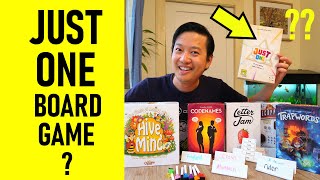
Just One has earned near-universal praise from board game reviewers, with recognition as one of the most accessible and engaging party games ever designed. Rolls in the Family calls it "one of the best accessible party games," while Adam in Wales describes it as a "cooperative party game" that deserves recognition at the highest levels of board game design. The Dice Tower considers it a guaranteed winner when gifted to any group, noting that "this is the one" that will reliably create a great experience regardless of the audience. Critics consistently praise its elegant simplicity, cooperative nature, and ability to draw laughter and engagement from players of all experience levels, though some highlight minor concerns about word selection and rule mechanics that don't significantly diminish the overall recommendation.
Core Mechanics That Define Just One
Limited Communication
Just One's defining constraint is the one-word clue rule, which forces players to distill their entire strategy into single words while considering what other players might write. On each turn, all players except the guesser write down exactly one word as a clue to help that player guess a secret word. After clues are revealed, any words written by more than one player are discarded before the guesser sees them. Rolls in the Family explains the tension beautifully: players must think not just about giving a good clue, but about avoiding the clues everyone else will give, creating a delicate balance between obvious and obscure guidance. This mechanic produces frequent moments where clues cancel completely, leaving the guesser with almost no information, which ironically creates some of the game's most memorable and hilarious moments.
Cooperative Gameplay
Just One stands out among party games by being fully cooperative rather than competitive, a structure that The Dice Tower identifies as increasingly valuable in the modern hobby. All players work together toward a shared score, with no winner determined by head-to-head competition. Each of the 13 rounds presents a new word to guess, and the group's final score depends on how many correct guesses they achieve. Rolls in the Family notes that this cooperative structure creates a fundamentally different social dynamic than competitive party games, removing the pressure of individual failure and replacing it with shared responsibility for the group's success. The mechanism allows players to join or leave without disrupting ongoing play, making it ideal for social gatherings where people naturally move between tables.
The Just One Experience
Lighthearted and Social
Playing Just One feels breezy and fun, with constant opportunities for laughter. Rolls in the Family describes the experience as "a good dynamic around the table," emphasizing how the canceled clues create surprising moments of humor when players independently arrive at identical thoughts. The game generates moments of shared creativity and recognition, such as when two players unknowingly write the same obscure word and react with surprise and amusement. Adam in Wales and others note that the low-pressure environment makes it inviting even for players uncomfortable with other types of party games. There is no winning or losing in the way that creates tension; instead, players collectively strive toward a "pretty awesome" score while enjoying the social experience of thinking together.
Quick and Accessible
Just One plays quickly and teaches in moments, making it an ideal gateway game for groups that haven't played board games together. Rolls in the Family emphasizes that "the rules teach like could not be simpler," noting that the game's title itself explains most rule questions. The setup takes seconds, gameplay is snappy, and the entire experience creates a low-friction, welcoming environment. The Dice Tower confirms that it works exceptionally well with groups that don't self-identify as gamers, making it a go-to recommendation when introducing board games to casual players.
What Makes Just One Stand Out
Authentic Cooperative Design
While many games claim cooperative gameplay, Just One fully commits to the concept in a way that feels genuinely different from social deduction games or hidden-role games. The Dice Tower highlights that the absence of competitive pressure addresses a real problem in the party game space: many groups find themselves with players uncomfortable with lying, deception, or direct competition. Just One creates a shared challenge where everyone's contribution matters equally and no single player becomes the "target." Adam in Wales praises it as a game where "people swapping in coming in stepping out" and "it won't ruin the game," making it perfect for dynamic social settings where participation naturally fluctuates.
Beautiful Simplicity as Innovation
The game's elegance lies in its ruthless focus on a single, powerful idea: one word, duplicates cancel, guess together. Adam in Wales, himself a designer, emphasizes that "having that simple an idea is something it has huge value" and notes that the game deserves recognition not despite its simplicity but because of it. The Dice Tower calls it "one of the most accessible games that you can have in your collection," and Rolls in the Family describes the design as "elegant." Multiple reviewers note that the game succeeds precisely because it doesn't overcomplicate things; the clue cancellation rule creates all the dramatic tension and humor needed without additional subsystems.
Potential Drawbacks
Word Selection Issues
Rolls in the Family notes that some words included in the game feel obscure or questionable, such as "Camembert," "couscous," and "Armistice," and that some entries use two-word phrases like "light bulb" or "belly button" where a single word would be expected. A few words appear to be typos. While this is not a major complaint, it suggests room for refinement in future editions. The inconsistency in word difficulty can occasionally create odd guessing challenges, though the community confirms this issue is minor enough that groups can simply skip problematic words if desired.
Limited Replayability Ceiling
Adam in Wales and The Dice Tower both acknowledge that the game has a finite pool of words, meaning dedicated players will eventually encounter repeated cards. The Dice Tower suggests that most players will get somewhere between three and ten good plays before the novelty of specific words begins to repeat. However, both critics emphasize that this is a natural limit of the card-based design rather than a design flaw, and the low cost and quick play time make the value proposition compelling even if play eventually tapers off.
If You Enjoy Just One
Players drawn to Just One's cooperative party game experience should explore Codenames, which offers similar clue-giving challenges with more strategic depth through team competition. For those who love the social deduction and word-association aspects without competition, Dixit provides art-based interpretation that encourages creative thinking in a similar spirit. Clover, from the same publisher as Just One, extends the clue-giving concept into something more complex for groups ready to step up in difficulty. For accessibility across varied player groups, Where Words offers similar cooperative party gameplay with slightly more strategic weight.
What Reviewers Are Saying
"Just One is really I think kind of the first example at least that I can think of of this new trend in party games of fully cooperative party games right and it's a trend that like I'm all here for it it's having that option is so nice like there's just a lot of situations where that fits a lot better and it kind of just brings back the barrier to entry even more for a party game."
— Rolls in the Family
"This is one game that I will put any wager on. If I had to buy one game for somebody non-gamer whatever it's going to be a hit. They're going to love it. This is the one. It's just one. Just one to me is just a guaranteed winner."
— The Dice Tower
"Just One is such a good game. These might fit for you as good family games, as little sort of traveling games, games to take away on holiday or against a train. These are nice little portable simple things and I can recommend everything that I've mentioned in this video."
— Adam in Wales