/pic5875489.jpg)















K2 Deep Dive
What the Community Thinks About K2
K2 is praised by reviewers as a modern classic that brilliantly captures the tension and desperation of high-altitude mountaineering. The game has earned recognition as a standout title that combines elegant design with thematic depth, drawing players who appreciate both the strategic puzzle and the narrative of survival it creates. Reviewers highlight how the game generates memorable moments of climbers getting in each other's way and forcing impossible choices about risk versus reward.
Core Mechanics That Define K2
Push-Your-Luck Card Play
At its heart, K2 uses a push-your-luck system where players decide when to play their powerful cards and when to hold back. Each round, players play three cards to move their two climbers up the mountain while managing their acclimatization level. The tension comes from the fundamental question every turn: do you burn your best movement cards now to seize the lead, knowing you might not have the strength to descend safely, or do you conserve resources and risk falling behind? This creates a constant dance between ambition and caution that defines the entire experience.
Spatial Blocking and Resource Conflict
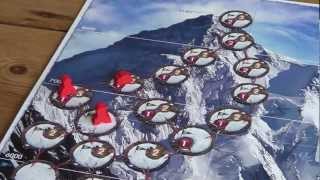
The mountain itself becomes a weapon. As climbers ascend toward the peak, the available spaces narrow, creating bottlenecks where players physically interfere with each other. You might block an opponent from advancing, or they might prevent you from retreating to your tent. This isn't a backstabbing game, but rather an emergent consequence of limited space. Players also compete for vital acclimatization cards in their decks and struggle against harsh weather that damages climber health based on altitude. Every turn is both about your own puzzle and about watching where opponents position themselves.
The K2 Experience
Desperate Survival
K2 creates a unique feeling at the table that reviewers describe as "clinging on." The game makes players feel perpetually underprepared, racing against dwindling resources and brutal environmental conditions. Even when playing carefully, climbers regularly die, forcing you to accept losses as part of the narrative. This isn't failure in the traditional sense, but rather the authentic difficulty of the climb itself. The push-your-luck mechanics mean that even experienced players feel the pressure to risk death in pursuit of the summit.
Interactive Puzzle
Unlike many modern euros where players largely execute their own plans, K2 forces constant awareness of opponent positions and current weather threats. You cannot fully plan your turn in advance because the board state changes after every other player's turn. The mountain's narrow passages mean that someone's blocking move becomes your crisis. This interactivity keeps tension high throughout, making K2 feel dynamic and unpredictable rather than predictable.
What Makes K2 Stand Out
Thematic Integration of Mechanics
K2 deserves credit for mechanics that feel inseparable from the mountaineering theme rather than pasted on top of it. The weather forecast system lets players plan strategically while honoring the unpredictability of mountains. Acclimatization cards are a genuine deck-management puzzle rather than a flavor gimmick. The spacing on the mountain physically represents the altitude danger. The tents that protect climbers feel like real gear rather than abstract tokens. Every system reinforces the core fantasy of a desperate race up a killer peak.
Elegant Simplicity Behind Deep Strategy
The rules are straightforward: play cards, move climbers, manage cold, descend safely. Yet this simple system generates incredible depth and creates situations where every move matters. The game plays consistently across skill levels, meaning both casual players and highly competitive ones can enjoy it in the same session, though tournament-level K2 takes three hours while casual games finish in 90 minutes. Players new to the game grasp the goal immediately, but returning players discover new strategic nuances with each climb.
Potential Drawbacks
High Player Interaction Can Slow Pacing
Because other players' positions matter so much to your decisions, K2 invites table analysis and careful consideration. While this creates engagement, it can also lead to analysis paralysis at higher skill levels. The constant shifting board state means you cannot plan far ahead, which frustrates some player types who enjoy plotting their entire turn strategy in advance.
Climber Death and Losing
The game's design embraces climber casualties as thematic and expects players to enjoy the experience even when their mountaineers perish. Some players struggle with the pushing-your-luck aspect, preferring games where they have tighter control over outcomes. K2 rewards calculated risk-taking, but calculated risks can still fail, and not all players find that failure satisfying.
If You Enjoy K2
You should try Mount Everest, which uses the same core system as K2 but adds regional weather variations and route tokens that let you create paths not printed on the board. The expansion introduces landslide mechanics as a new weather type and lets you peek at the weather deck to plan further ahead. The changes feel natural rather than overcomplicated, respecting what made K2 work while adding fresh decisions. Other games that capture a similar mix of spatial puzzle, push-your-luck, and survival tension include Descent: Journeys in the Dark for dungeon-crawling adventure and Ziggurat for competitive area control with environmental pressure.
What Reviewers Are Saying
"K2 does such a great job of capturing the feeling of leaving the house or for risk takers of climbing a mountain, I've never played a game where someone didn't have a climber die. It's a modern classic of a board game."
— Actualol
"It's about how far do you think you can safely get and can you get back down. There's interesting blocking ideas in it because as you get further towards the peak there are smaller spaces so not so many climbers can be on those spots, and you can actually stop people from getting back to their tent or surviving because you're in the way. Really interesting interactive game."
— Actualol
"What Lotsa adds is a new board with different weather for the different parts of the mountain, so in the normal game you have weather that will affect you based on your altitude and you really have to plan ahead. You can see the weather that's coming, can you survive it. In this one you can see which side of the mountain it will be on."
— Actualol