/pic6256515.jpg)




























Kabuto Sumo Deep Dive
What the Community Thinks About Kabuto Sumo
Reviewers describe Kabuto Sumo as a coin-pusher arcade game translated to the tabletop: players slide wooden discs onto a shared platform, trying to push their opponent's beetle wrestler off the ring before their own piece falls. Brains On Games calls it a physics game as much as a dexterity game, since players hold and push their pieces in a straight line rather than flicking them, and the outcome depends on reading how the wooden discs will react when they collide. The Cardboard Herald counts it among a favorite dexterity title and calls the base design snappy, thematic, and easy to grasp. Board Game Buzzz features it in a ranked lineup of AllPlay titles, describing it as a game their kids adore and praising its tactile pieces, even while noting a general lack of enthusiasm for dexterity games as a genre.
Not every take is glowing. All You Can Board went in with high hopes because of how the game looks set up on the table, but came away disappointed after a couple of plays, partly because a playing partner was not a fan of dexterity games; the channel still planned to give it more chances. The Board Game Garden enjoyed it enough to play it repeatedly over a single week and a half, but flagged that two-player games can drag on longer than they would like, while four-player team matches felt tighter. Board Game Spotlight's livestream group settled on a middle ground: the game is intuitive and quick to teach, but a few edge and rule ambiguities came up mid-session.
Core Mechanics That Define Kabuto Sumo
Physics-Based Pushing, Not Flicking
On a turn, a player positions a launching platform, then slides a disc onto the central ring, aiming to knock an opponent's piece over the edge. Brains On Games emphasizes that this is not the flicking of typical dexterity games; the piece is pushed and held in a straight line, so players cannot steer once the push begins. Anything a player knocks off the ring this way goes into their inventory to be pushed onto the board on a later turn, but pieces that fall by accident, from bumping the table or moving the platform, are removed from the game entirely rather than collected.
Wrestler Powers, Stacking, and Inventory
Each player takes on a bug wrestler with its own card, front and back. Brains On Games explains that the front shows an asymmetric special power and a uniquely shaped piece, while the back lists real facts about the insect. Signature moves have to be earned first, often by stacking pieces of equal height on the board, before that wrestler's unique disc becomes available to push. Board Game Spotlight's livestream showed how differently the special pieces behave once players unlock them, from pieces built for long straight pushes to oddly shaped discs that scatter whatever they hit.
The Kabuto Sumo Experience
Tactile Feel and Table Presence
Board Game Spotlight's group described the game as an abstract, super tactile design with a table presence that's hard to see from a top-down photo, since the stacked pieces sit well off the surface. Board Game Buzzz echoes that reaction, calling the pieces fun and tactile and highlighting the satisfaction of trying to push a piece the right way to knock an opponent off. That physical, hands-on quality is part of what The Board Game Garden points to when describing the game as chill enough to play on a coffee table during a TV show, while still getting players up and moving around the table to line up an angle.
Quick to Teach, Built for Families
Brains On Games recommends the game for kids age six and up, noting a junior league variant that hands out extra starting pieces instead of requiring players to earn them, aimed at younger or first-time players. Board Game Buzzz agrees that the rules split cleanly into an easy mode for kids and a slightly more involved one for adults, and singles it out as a game their whole family plays often. Board Game Spotlight's livestream summed the appeal up in similar terms: the game is intuitive, easy to teach, and quick to get to the table, which the group felt made it especially welcoming for new gamers.
What Makes Kabuto Sumo Stand Out
Insect Theme with Real Bug Facts
Beyond the wrestling framing, Brains On Games points out that each wrestler card doubles as a small piece of nonfiction, with a paragraph of facts about the real insect on the back, more detail than the bird cards get in Wingspan. Board Game Buzzz singles out the artwork as a favorite and describes the wrestler characters and their varied shapes as central to why the theme lands with their kids.
The Total Mayhem Expansion
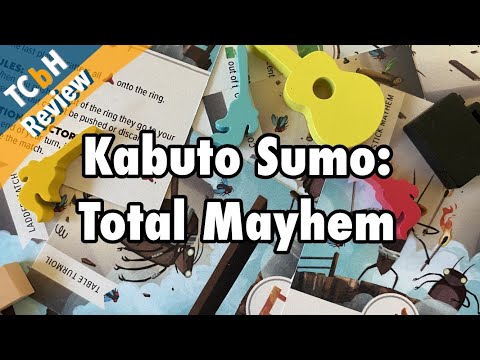
Several channels covered the Total Mayhem expansion, which adds wrestling-themed foreign objects like a folding chair, tacks, and a ladder that layer new win conditions and interference onto the same base turn structure. The Cardboard Herald reviewed it from an early prototype, disclosing that the artwork, rules, and components shown were subject to change, and praised the alternate victory conditions for helping to prevent stalemates. Ryan and Bethany Board Game Reviews, who noted the copy was provided by the publisher for review, liked that the expansion added new ways to win without changing how a turn actually works, calling it close to a must-own for existing fans.
Potential Drawbacks
Pacing Issues at Two Players
The Board Game Garden's biggest complaint is that two-player games can run long enough to make them want to end things early, even though the same group found four-player team games moved along better. Board Game Spotlight's livestream ran into a related friction point: ambiguity around edge cases, like what happens to a piece under the junior league rules, occasionally slowed the group down mid-session.
Not Every Dexterity Skeptic Is Won Over
All You Can Board went in expecting to love it based on how striking the game looks on the table, but the first couple of sessions fell flat, especially playing with someone who was not already a fan of dexterity games. Board Game Buzzz raises a similar caveat from the other direction: they are not a big fan of dexterity games generally, and while their kids love Kabuto Sumo, they ranked it lowest among the AllPlay titles covered in that video for that reason.
If You Enjoy Kabuto Sumo
Brains On Games compares the educational value of the wrestler cards to Wingspan, noting that Kabuto Sumo's insect facts run even longer than the bird card text in that game, making it a pick for players who like a side of real nature trivia with their tabletop fun.
What Reviewers Are Saying
"It looks like a dexterity game and it is sort of, but really it's a physics game. What would happen if you took the flicking, or you took most of the motor skills, out of a dexterity game? This becomes a game about physics. It's really about understanding how these wooden pieces are going to move when you push against them, and you're trying to push your opponent's piece off of the sumo wrestling ring."
— Brains On Games
"You're trying to ultimately push your opponent's beetle, they're sumo wrestler beetles, off of the ring. So you're pushing things on in hopes that their beetle will fall off. There's different objectives, different special abilities for beetles you can choose, a variable player power, and it is so much fun."
— The Board Game Garden
"I was really intrigued to buy it, and it just fell a little bit flat for me in those two plays. And again, it could have also been because the person I was playing with is not the biggest dexterity game fan; that could have impacted it. So I'm definitely going to give Kabuto Sumo more chances to to land with me."
— All You Can Board