/pic4924232.jpg)
































Kanban EV Deep Dive
What the Community Thinks About Kanban EV
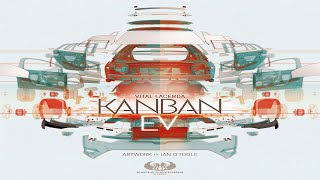
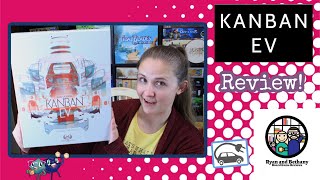
Board gaming reviewers across multiple channels recognize Kanban EV as a substantial, thematically rich economic simulation. The game resonates with players who enjoy deep strategy wrapped in authentic manufacturing flavor. Its re-implementation by Eagle-Gryphon Games with artist Ian O'Toole's redesigned visuals has elevated what was already a respected design. The consensus leans toward respect and admiration, though reviewers consistently note the game demands significant mental effort and is not intended for casual play.
Core Mechanics That Define Kanban EV
Worker Placement Meets Time Management
Kanban EV employs worker placement as its foundation, where players move a single worker token to different departments on the factory floor. Each action space offers a variable number of shifts (actions), creating meaningful decisions about placement priority. The game ingeniously balances going early with fewer actions versus going late with more available options. Players can also bank unused shifts for later deployment, adding a layer of resource management that extends beyond the current turn.
Certification and Engine Building
The certification system forms the heart of the engine-building mechanism. Each department features its own training track, and advancing along these tracks unlocks powerful abilities and permanent bonuses. Early investment in training appears less rewarding than gathering components or building cars, but the system subtly encourages balanced growth. The meeting mechanics reward players who strategically advance these tracks, creating tension between immediate production goals and long-term positioning.
The Kanban EV Experience
Sandra and Sustained Tension
Sandra, the factory manager represented as a wooden meeple, creates the game's signature tension by roaming the board and evaluating each department. Her movements are inevitable and methodical, forcing players to anticipate her arrivals and maintain training progress across multiple areas. In the "mean Sandra" mode, players lagging in any department face penalty points when she passes through. This mechanic transforms what could be a purely solitaire puzzle into a high-stakes balancing act, as every decision must account for Sandra's relentless scrutiny.
Meetings as Thematic Payoff
Board meetings occur at set intervals and shift the game's focus from production to presentation. Players deploy previously unlocked chairs at meeting spaces and pitch performance goals from their hand. The system creates genuine tension as players must decide whether to showcase their best accomplishments or hedge by playing weaker cards. These meetings provide a break from the production grind and deliver moments of creative player interaction, where positioning and timing matter as much as prior planning.
What Makes Kanban EV Stand Out
Theme That Transcends Abstraction
Unlike many economic euros, Kanban EV's theme of automotive production under just-in-time management is more than window dressing. The manufacturing processes (acquiring designs, gathering parts, assembling vehicles on a timed track, upgrading specific systems) mirror real production challenges. Players genuinely experience the tension of competing priorities and the feeling of being caught between supervisory expectations and actual work. The game captures middle management complexity with dark humor and authenticity that resonates with players familiar with operational pressure.
Scaling and Player Interaction
The game scales remarkably well across its 1-4 player range. At two players, the board opens up with more strategic maneuvering room. At four players, Sandra's movements become more strategically critical, and player interaction intensifies as workers block key spaces. Rather than feel chaotic, higher player counts create more nuanced decisions about where to place your limited worker. The game maintains tension and meaningful choices regardless of player count, a feat many heavy euros struggle to achieve.
Potential Drawbacks
Teaching and Cognitive Load
Kanban EV demands substantial teaching time and cognitive engagement. The rule book, while improved from the original release, covers considerable ground. New players must internalize five departments, multiple track systems, certification rewards, the meeting structure, and Sandra's evaluation mechanics. The game's systems are interconnected, making partial understanding insufficient. Players accustomed to lighter games may experience fatigue, and the first play often feels like learning rather than enjoying.
Fiddly Components and Production Track Overhead
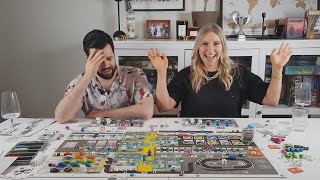
Managing player boards, tracking upgraded designs, and coordinating production line advancement involves considerable component bookkeeping. The process of testing cars, storing upgrades, and matching designs to vehicles requires clear organization. While the production insert helps, mid-game can feel cluttered as players accumulate cards, tokens, and markers. Some teaching moments around how upgrades translate to scoring consume table time that might otherwise flow more smoothly.
If You Enjoy Kanban EV
Players drawn to Kanban EV typically gravitate toward Vital Lacerda's other designs, particularly The Gallerist and On Mars, though each offers distinct puzzle challenges. CO2: Second Chance shares thematic gravitas with environmental stakes layered over economic decision-making. Food Chain Magnate shares manufacturing efficiency themes, though that game emphasizes market competition over production mechanics. Fans of thematic worker placement with meaningful constraint systems should explore Barrage for similar depth and interaction. The game serves players who prize deep systems, appreciate thematic coherence, and enjoy experiencing economic pressure as core gameplay rather than flavor text.
What Reviewers Are Saying
"The meetings are awesome because it's almost like a parody in some ways, so you can see the sort of political machinations of middle management and even though you haven't really been doing that much work you've just been going up these different meeting tracks and unlocking all these chairs, then you're kind of taking credit for everybody's work."
— Drive Thru Games
"I never felt like I had a wasted turn so even if somebody went where I was hoping to go or did what I was hoping to do I never felt like, well shoot, now I'm just gonna waste this turn. I felt like every time I was able to do something that I wanted to do."
— Ryan and Bethany Board Game Reviews
"Kanban EV is a simulation of the best humanity can ever achieve: being middle management in a car factory. To some this setting is a nightmarish depiction of humanity's hubris; to others it is just a Tuesday."
— No Pun Included