/pic6124142.jpg)









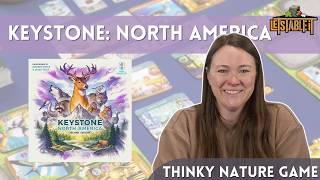











Keystone: North America Deep Dive
What the Community Thinks About Keystone: North America
Keystone: North America has caught the attention of board game reviewers with its elegant blend of accessible mechanics and surprising strategic depth. What appears on the surface as a light nature-themed puzzle game reveals itself to be a tense, decision-heavy experience that rewards careful planning and ecosystem management. Reviewers consistently praise the game's balance between approachability and crunchiness, noting that it delivers meaningful choices without overwhelming players with complexity.
Core Mechanics That Define Keystone: North America
Card Drafting and Market Selection
The core loop of Keystone revolves around drafting cards from a rotating market. Each turn, players choose between drafting a card from the available lineup or activating action cards. When drafting, players can spend synergy tokens to skip down the market line and grab the exact card they want. This creates a resource-tension mechanic where spending tokens now limits flexibility later. The action cards themselves offer utility plays, allowing players to refresh the market, gain synergy tokens, move cards on their board, or add research bonuses to existing species. The variable action tile setup ensures that which actions are available shifts between games, adding significant replay value.
Tile Placement and Ecosystem Building
The true heart of gameplay sits in card placement on a player's board. To score well, players must arrange their ecosystem cards into ascending or descending numerical sequences that share matching ecosystem symbols within rows and columns. This sounds straightforward until you attempt to execute it in a 4x4 grid where every card placement ripples outward with consequences. Players gain synergy tokens for placing cards that match ecosystem symbols on orthogonally adjacent cards, creating a feedback loop between placement decisions and resource generation. When all pieces align, the synergy cascades create satisfying engine moments, but a single misplaced card can torpedo months of planning.
The Keystone: North America Experience
Tension Beneath the Nature Theme
Reviewers note that Keystone subverts expectations around nature games. Instead of delivering a relaxing, meditative experience, the game surprises players with tense decision-making and deeply thoughtful gameplay. Turn after turn demands careful consideration of long-term plans versus immediate opportunities. The analysis paralysis potential is real, as players deliberate how to maximize scoring or avoid ruining their strategy with one poorly placed card. Even experienced players can find themselves paused mid-turn, weighing options that have no clearly correct answer.
Precise Two-Player Balance
Multiple reviewers emphasize that the two-player version feels intentionally crafted for exactly this player count. The game shines brightest at two players, where the card market dynamics and direct player interaction through market competition feel purposeful. One reviewer noted that while the game can accommodate higher player counts, the base experience is fundamentally a two-player experience, and it shows in every design decision.
What Makes Keystone: North America Stand Out
Thematic Integration with Real Biology
The game incorporates genuine biological science into its scoring system. Keystone species, the animals and plants that hold outsized importance in their ecosystems, appear in the deck as scoring multipliers. This is not merely thematic window dressing. The game reinforces the fact that keystone species are extremely vital to their environments, teaching players about real ecological relationships while they optimize their point engine. The second edition features improved artwork that elevates the nature theme, with reviewers noting the art is absolutely gorgeous and draws people to the table.
Surprising Strategic Depth in a Compact Package
Despite sitting in the medium lightweight category and running 30 to 60 minutes once everyone knows the rules, Keystone delivers substantial strategic choices. The combination of card drafting, action selection, and placement optimization creates a decision space that far exceeds what the ruleset suggests. Reviewers went in expecting a light, beautiful tableau builder and emerged from a much deeper decision space than anticipated. The variable secret objectives add another layer, as players must balance chasing their hidden goals against the universal scoring available through ecosystem rows and columns.
Potential Drawbacks
Luck of the Draw Can Limit Strategy
While strategic depth abounds, there remains quite a bit of luck involved in card availability. If you are hunting for a specific card to complete your ecosystem, you might not see it before the game ends. This can occasionally derail carefully laid plans through no fault of your own. The open market system means that even with synergy tokens to skip cards, sometimes the right creature simply never appears.
Expansion Considerations and Rule Complexity
The coastal expansion introduces new mechanisms for spending synergy and additional scoring through conservation centers, offering more flexibility in point generation. However, opinions on the expansion split among reviewers. Some prefer the streamlined feel of the base game without the added layers, while others appreciate the expanded strategic options. The expansion is not essential to enjoying the core experience, making it a "table preference" decision rather than a necessary addition.
If You Enjoy Keystone: North America
Fans of strategic tile placement games, puzzle-like card management, and nature-themed mechanics should find much to appreciate. The game shares DNA with titles like Mini Rails, Mini Express, and Lagoon in its compact-yet-crunchy design philosophy. If you love games where every point matters and meaningful decisions come fast, Keystone delivers. For those interested in solo experiences, the included field journal campaign offers a narrative-driven alternative where players face progressively challenging scenarios. The game also shines for players who appreciate educational components, as the real science underlying the ecosystem mechanics adds depth beyond the mechanical puzzle.
What Reviewers Are Saying
"We went in expecting a light, beautiful tableau builder and got a much deeper decision space than we were expecting."
— Let's Table It
"It is based on real science, it's really puzzly, and the solo game is absolutely fantastic with the field journal using a narrative that's in the book."
— Good Time Society
"When you're trying to create like one, two, three, four in a 4x4 grid it becomes very very complicated, and it becomes very very crunchy and it but extremely replayable."
— kovray