/pic1195438.jpg)
In this game, you play a powerful lord and his faithful companion engaged in a fight for influence throughout time. The game proceeds simultaneously over three different periods. You start the game in the Middle Ages, on the first of the three game boards (that of the commanderies). With 4 action cards in hand per turn, you have seven turns in which to develop your domains by building various types of military, religious, and civil buildings. Depending on their size, certain buildings are moved in time, which means that they are transferred to the same place on the priories board (Renaissance period) and on the brotherhoods board (modern period), in ruins for military and religious buildings (castles, abbeys…).
Thanks to the watch makers' invention, and with enough money, you can make your two adventurer pawns travel in time… Because if the construction of certain buildings can be profitable, taking over domains on the various boards is essential, since it will allow you to earn bonuses on the 4th and 7th turns and to move ahead of your opponents.
Playing with time is not without consequences, and it can produce surprising results! To give just one example, an abbey created on the priories board could be destroyed by a castle built later in the game in the same place but on the commanderies board, and then moved to the other board… The abbey finally never existed!
On the 4th and 7th turns, each controlled domain generates profits for the players depending on the board. On the the commanderies board, a player who controls a domain militarily, i.e. the one with the biggest military building, will receive the value of the civil buildings in this domain in profits. On the priories board, it is the religious control that will be taken into account. On the brotherhoods board, the players who have best populated the civil buildings and restored the ruins will secure the best profits.
The possibility of destroying and regrouping buildings to unite or divide domains provides a strong and permanent level of interaction between the players.

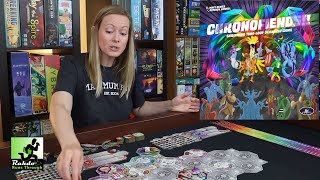
- Challenging and fun cooperative gameplay.
- Interesting time-looping mechanic with shrinking time per loop.
- Asymmetrical characters with unique and powerful abilities.
- Modular board that creates a different experience each game.
- Satisfying character progression through skill improvement.
- Engaging turn order system based on time remaining.
- Replayable with multiple scenarios.
- Potential for bad luck with shuffling could lead to feeling like the game was played in vain.
- Can be problematic if too many 'chronopi' encounters deplete time excessively.
- Takes up a lot of table space as the station grows.
- time looping
- space station
- Oblivion
Mechanics (from transcript analysis)
- Action Point Allowance System — Players spend 'time' to perform actions, influencing turn order.
- asymmetrical player powers — Each player character has unique abilities and stats.
- cooperative play — Players work together towards a common goal, winning or losing as a group.
- Dice Rolling — Used to determine the movement of the 'chronopi' (enemies).
- Modular Board — The game board is built by placing tiles representing rooms as players explore.
- Set Collection — Players need to find specific 'boost' tiles (e.g., training manual, station schematics) to complete objectives.
- skill progression — Players gain skill points that improve their abilities and provide discounts over multiple time loops.
- Tile Placement — New rooms are discovered and placed on the board.
- time loop — The game is played in loops. When time runs out or specific conditions are met, the game resets for another loop with less overall time.
- Time Track — A turn order is determined by who has the most time left on the track. Actions cost time, and time decreases with each loop.
- Variable player powers — Characters have distinct abilities, affecting gameplay.
Video topics + discussion points
Quotes (from this video)
- Hey everybody. Today Roto runs through Chronofi.
- you're going to hear me say time a lot, but we have a turn order time track.
- This is still pre-production, so keep that in mind.
- Everything takes time in this game.
- If you're hit by a chronopi, this is what I've been talking about. Remove the highest piece of the time track and your character token is immediately moved back to the detention facility. Yikes.
- We need the schematics to win the game.
- So, it's time for me to head into my final thoughts, which are coming up right now.
- The longer you go, the shorter time gets, but the stronger you get.
References (from this video)

- Uninspiring after initial plays
- Time travel
Mechanics (from transcript analysis)
- Card Play — The host mentions connecting cards, suggesting card-based gameplay.
- Time travel — The game's theme involves time travel.
Video topics + discussion points
Quotes (from this video)
- We're literally trading our life essence for money to pay for things
- Imagine how much art and creativity and Imagination there would be if this country had healthare for where you didn't have to take a job you hate so you can have health care
- I think that he will never I think that he's 70 years old man I not else at least it doesn't appear that way I think that he will I think that he will finish it I think he'll finish this book but there's zero chance he will he will write a dream of spring zero chance
- I just didn't want to have to you know turn into where I'm just doing collections instead of doing something I actually love to do which is the game design stuff
- You know you know what's crazy that Main Avenue Mexican Village you know exactly the one uhuh that is now the best uh uh comic book slash role playay gam slash uh uh game store in town called Paradox comics and cards