
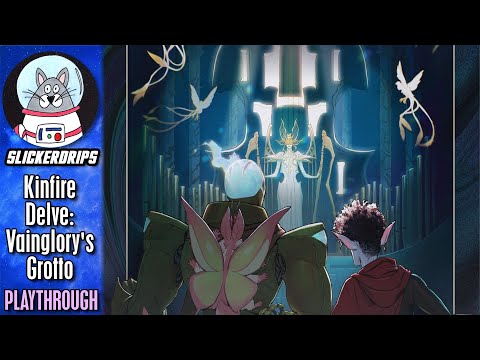
Kinfire Delve: Vainglory's Grotto is a tactical and cooperative card game for 1-2 players. As Seekers, you will fight your way through the well deck of challenge cards to reach Vainglory, the master of the well, and face her in an epic final battle.
To defeat Vainglory, you'll battle and puzzle your way through her well deck of 57 challenge cards before facing her final gauntlet. On your turn, attempt a challenge by playing a matching skill card and rolling the dice. Add enough progress tokens to a challenge and you'll be richly rewarded. But fail and you'll face the penalty by losing health, discarding cards, or being forced to return cards to the well deck.
Even when it's not your turn, the cards in your hand can be played to boost your teammate's action. But be cautious–emptying your hand means gaining exhaustion and suffering effects that can lose you the game.
Survive long enough to reach the bottom of the well and reveal Vainglory's final form. Break through her gauntlet of protectors in order to face and defeat her once and for all and win the game.
—description from publisher

Images

- Fantastic, easy to get into, quick to play.
- Puzzly dungeon delve works so well.
- Lots of cool things can happen and cool combos.
- Failure can sometimes be a blessing in disguise.
- Replayability with different characters, obstacles, and versions of the master.
- Solo play is engaging, with options for different characters and scaling.
- Multiplayer coordination adds depth.
- Offers a good balance between strategy and dice luck.
- Can be worrying at times.
- Reliance on dice can be a factor.
- Attaching too many cards to the master can significantly increase difficulty.
- Protecting the world from the returned Starless Knights and re-emerged myths by venturing out from Dinlux with kinfire lanterns to disperse the energies of the wells of Atios, which are places where normal rules don't apply and reality is warped by each well's master.
- Dinlux, a town known to possess a Kinfire lighthouse, where members of the seeker's guild venture out wielding kinfire lanterns to protect from the returned Starless Knights who twist landscapes and swallow cities.
- The game's narrative is conveyed through introductory lore about the Starless Knights, the town of Dinlux, the wells of Atios, and the specific mission to Vain Glory's Grotto, a playful and capricious being who treasures beauty but conceals dangers. This lore is presented as an address from Guildmaster Lero to the player, setting up the player's mission.
Mechanics (from transcript analysis)
- Card Attachment — Some cards, particularly those associated with the master or events, can be attached to the master, increasing difficulty or affecting gameplay.
- Card Play — Players use skill cards which provide progress and special effects. Cards can be played as a main action or as boosts to increase progress.
- Challenge Resolution — Players attempt challenges by gaining progress through playing skill cards and rolling dice. Challenges have a difficulty level that must be met or exceeded by progress.
- Deck Depletion — The core objective involves depleting a large deck of cards by completing challenges, with the win condition being defeating the master after the deck is depleted.
- Dice Rolling — Skill dice are rolled to contribute progress towards challenges. A light/darkness die is also used, with 'light' being versatile and 'darkness' hindering progress.
- event cards — Special event cards can be drawn from the deck, introducing unique situations or challenges that must be dealt with.
- Exhaustion — Taking an exhaustion card allows players to draw more cards but typically comes with a negative effect or penalty.
- Hand Management — Players start with a hand of cards and can draw more by taking an 'exhaustion' card, which has negative effects. Managing the hand size and card usage is important.
- Health/Damage System — Players have a shared health pool, and failing challenges or specific game effects can cause damage, leading to a loss condition if health reaches zero or another condition is met.
- Lanterns — Players activate a lantern, which is a powerful item providing significant progress or special abilities, but it is exhausted after use and may not be easily recharged.
- Master/Boss Encounters — The ultimate goal is to defeat a master, who has specific abilities and can be affected by challenges and game events.
- Player scaling — The game adjusts starting hand sizes and other elements based on the number of players (solo, 2-player, 3-player, 4-player).
Video topics + discussion points
Quotes (from this video)
- This is a dungeon delving kind of card game for one to two players.
- The whole point of the game is to get through this deck.
- This puzzly dungeon delve, it works so well.
- It's up to you how much you want to leave it to the dice as well.
- Sometimes a failure can be a blessing in disguise.
References (from this video)

- Engaging puzzle with strong thematic flavor and tactile art
- Satisfying, tense dice/card interplay when luck lines up with smart play
- Solid solo experience with clear sense of progression and risk management
- Dice luck can derail runs and force significant setbacks
- The rule set and board-state interactions (consumed/exhaustion, attached cards) are complex and may overwhelm new players
- Long play sessions and intense decision points can be draining
- Dark fantasy exploration, perilous trials, boss battles, and looping wells.
- A fantasy dungeon/well descent into a realm called Vain Glory's Grotto.
- Story-focused solo gameplay with boss guardians and deck-driven progression.
- Marvel Champions
- Arkham Horror: The Card Game
- Star Wars Unlimited
- Pursuit of Happiness
- The Game of Life
Mechanics (from transcript analysis)
- Attached cards and multiple Glory variants — Vain Glory has multiple variants; certain attached cards influence challenges and penalties when combatting or progressing against Vain Glory.
- Boosts and tactical decision-making — Cards can be used as boosts to increase attack or mitigate penalties, influencing risk-reward decisions and card economy.
- Color-mated card play — You must choose a card from your hand that matches the color of the target; white cards can serve as wilds, blue and other colors have specific uses.
- Combat: Dice — Combat is resolved by dice rolls whose results are modified by boosts and color-matched cards; wilds and color constraints affect outcomes.
- Dice-driven combat with boosts — Combat is resolved by dice rolls whose results are modified by boosts and color-matched cards; wilds and color constraints affect outcomes.
- Exhaustion and consumed cards — Failing challenges often generates exhaustion cards; some cards are consumed and can lead to a potential loss if too many are in play.
- Hand Management — Players manage a hand of cards, discarding and drawing to maintain options; running out of cards forces drawing from an exhausted deck with consequences.
- Hand management and draw/discard dynamics — Players manage a hand of cards, discarding and drawing to maintain options; running out of cards forces drawing from an exhausted deck with consequences.
- Matching — You must choose a card from your hand that matches the color of the target; white cards can serve as wilds, blue and other colors have specific uses.
- Multi-Use Cards — Cards can be used as boosts to increase attack or mitigate penalties, influencing risk-reward decisions and card economy.
- Well/depth progression — Defeat guardians to delve deeper into the Well; the bottom of the Well presents final challenges and rewards; clearing layers progresses toward the victory condition of defeating Vain Glory.
Video topics + discussion points
Quotes (from this video)
- The board game Garden we love it all
- I'm really enjoying it so far
- The dice are forever in my favor now
- This is the most stressful thing ever
References (from this video)

Mechanics (from transcript analysis)
Video topics + discussion points
Quotes (from this video)
- this game is designed by Kevin Wilson and published by incredible Dream Studios who are helping sponsor this playthrough
- this is a fully Cooperative card game where players work together to try to get to the very bottom of the well and defeat its Master
- we're going to delve down this entire deck of cards that represent the depth of the well
- the lanterns we haven't really discussed yet but they're a very strong uh skill card
- Vain Glory has been defeated
- this is a two-player game which is actually the first in a series of games that can be combined to play with up to four players