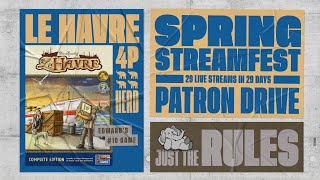
Le Havre box art

Le Havre

Game ID: GID0187813
Collection Status
Description

In Le Havre, a player's turn consists of two parts: First, distribute newly supplied goods onto the offer spaces; then take an action. As an action, players may choose either to take all goods of one type from an offer space or to use one of the available buildings. Building actions allow players to upgrade goods, sell them or use them to build their own buildings and ships. Buildings are both an investment opportunity and a revenue stream, as players must pay an entry fee to use buildings that they do not own. Ships, on the other hand, are primarily used to provide the food that is needed to feed the workers.

After every seven turns, the round ends: players' cattle and grain may multiply through a Harvest, and players must feed their workers. After a fixed number of rounds, each player may carry out one final action, and then the game ends. Players add the value of their buildings and ships to their cash reserves. The player who has amassed the largest fortune is the winner.

Year Published
2008
Transcript Analysis
Browse transcript mentions, sentiments, pros/cons, mechanics, topics, quotes, and references.
Total mentions: 13
This page: 13
Sentiment: pos 12 · mix 0 · neu 0 · neg 1
Mentions per page
Top
Showing 1–13 of 13
Video JziRYNuxTYg All You Can Board analysis at 1:01:52 sentiment: positive
video_pk 62453 · mention_pk 154978
All You Can Board - Le Havre video thumbnail
Click to watch at 1:01:52 · YouTube ↗
Overall sentiment (raw)
positive
Pros
  • Deep Rosenberg economic design
  • Two-player friendly with potential for three or more players
Cons
  • Long setup and heavier playtime
  • Complex loan/Economy interactions can be challenging
Thematic elements
  • economic engine-building and logistics
  • Port city economy and resource management
  • economic simulation with long-term planning
Comparison games
  • Gricola
Mechanics (from transcript analysis)
  • resource/loan management — Managing loans and resources to grow the economy and infrastructure.
  • worker placement — Workers are placed to perform actions and develop the economy.
Video topics + discussion points
No key topics recorded for this video.
Quotes (from this video)
  • I want to see better board game boards.
  • the trend I'd like to see stop is laziness and cutting corners.
  • crowdfunding used as a marketing tool.
  • I personally want to own more of my stuff and not have to worry about being beholden to something being shut down.
  • board games are this like persistent nostalgic thing that have always existed that you can't really you can digitize them and make these digital versions but we haven't seen them explode.
  • it's the FOMO hub of our hobby.
References (from this video)
No references stored for this video.
Video 1fXi5cwfbvM Allies or Enemies top_100_list at 1:35 sentiment: positive
video_pk 61190 · mention_pk 153848
Allies or Enemies - Le Havre video thumbnail
Click to watch at 1:35 · YouTube ↗
Overall sentiment (raw)
positive
Pros
  • depth of strategy
  • flexible long/short game modes
  • tight economy design
Cons
  • potentially heavy for new players
  • long teaching/playing time
Thematic elements
  • economic management and logistics
  • port city Le Havre in a historical, resource-driven economy
  • long-form economic engine with strategic planning
Comparison games
none
Mechanics (from transcript analysis)
  • engine building — players optimize resources to build an efficient port economy
  • engine-building — players optimize resources to build an efficient port economy
  • Resource management — carefully allocate and convert goods into value-generating actions
  • resource_management — carefully allocate and convert goods into value-generating actions
  • variable_setup/long vs short game — two game lengths that alter card availability and buildings
Video topics + discussion points
No key topics recorded for this video.
Quotes (from this video)
  • it's the long game versus the short game
  • it's a really fun dice puzzle
  • the depth grows the more you play
  • it's a legacy you can actually finish in a campaign
References (from this video)
No references stored for this video.
Video 71ombaYqLQs general_discussion at 1:03 sentiment: positive
video_pk 59636 · mention_pk 152170
Le Havre video thumbnail
Click to watch at 1:03 · YouTube ↗
Overall sentiment (raw)
positive
Pros
  • dense economic decision space
  • appeals to fans of Rosenberg-style heavy euros
Cons
  • heavy logistics can be daunting for some players
Thematic elements
  • economic engine-building and resource management
  • Port city economy in a harbor town
  • system-driven, European-style
Comparison games
  • Caverna
  • Agricola
Mechanics (from transcript analysis)
  • economic engine-building — players manage cargo, goods, and infrastructure to maximize efficiency
  • engine building — players manage cargo, goods, and infrastructure to maximize efficiency
  • Resource management — players balance intake and expenditure of diverse resources
Video topics + discussion points
No key topics recorded for this video.
Quotes (from this video)
  • I even saw wingspan there translated in Japanese which I really really wanted with all the expansions that was freaking awesome to see
  • I managed to find Scout in multiple places
  • I would definitely have to pick one game from that day and Le Havre would have been it if that managed to fit in my luggage
  • Scythe oh my God in a Japanese how it just looks so cinematic for some reason
  • the brand new Agric 15 Edition… there were so many updated titles
References (from this video)
No references stored for this video.
Video gwKYaKc0BvU Board Gaming Doctor general_discussion at 22:45 sentiment: positive
video_pk 37974 · mention_pk 114135
Board Gaming Doctor - Le Havre video thumbnail
Click to watch at 22:45 · YouTube ↗
Overall sentiment (raw)
positive
Pros
  • strong thematic coherence with port trade
  • deep engine-building possibilities
Cons
  • hegemonic play experiences can vary
  • teaching curve can be challenging
Thematic elements
  • economic engine-building and resource conversion
  • port city economy and shipbuilding
  • systems-driven with a pragmatic flavor
Comparison games
  • Agricola
  • A Feast for Odin
  • Oranienburger Kanal
Mechanics (from transcript analysis)
  • Resource management — track and upgrade resources on a rotating wheel
  • resource wheel — track and upgrade resources on a rotating wheel
  • worker placement — allocate workers to perform port-specific actions
Video topics + discussion points
No key topics recorded for this video.
Quotes (from this video)
  • the feeding mechanism exemplified and represented this thought that his games are easy to learn and hard to master basically
  • thematic integration is Peak when it comes to U Rosenberg games
  • the arc of gameplay is very unique to me and the reasons that I think about this include say Agricola
  • the chess-like nature of his games particularly with games such as caverna fields of ARL
  • cozy theme such as farming and still and have a session where you come out of it either winning or losing
References (from this video)
No references stored for this video.
Video gwKYaKc0BvU Board Gaming Doctor general_discussion at 27:42 sentiment: positive
video_pk 37974 · mention_pk 114128
Board Gaming Doctor - Le Havre video thumbnail
Click to watch at 27:42 · YouTube ↗
Overall sentiment (raw)
positive
Pros
  • innovative resource tracking via the wheel
  • tightly integrated theme and mechanics
  • varied strategies via different ship-building paths
Cons
  • can be long and heavy for some groups
  • teaching can be challenging
Thematic elements
  • economic management and resource conversion
  • port economics, shipbuilding, and trade
  • economic simulation with a strong pragmatic flavor
Comparison games
  • Agricola
  • A Feast for Odin
  • Fields of ARL
Mechanics (from transcript analysis)
  • Resource management — track and upgrade resources across a rotating wheel for efficiency
  • resource wheel — track and upgrade resources across a rotating wheel for efficiency
  • worker placement — place workers to gain resources, build ships, and manage the port
Video topics + discussion points
No key topics recorded for this video.
Quotes (from this video)
  • the feeding mechanism exemplified and represented this thought that his games are easy to learn and hard to master basically
  • thematic integration is Peak when it comes to U Rosenberg games
  • the arc of gameplay is very unique to me and the reasons that I think about this include say Agricola
  • the chess-like nature of his games particularly with games such as caverna fields of ARL
  • cozy theme such as farming and still and have a session where you come out of it either winning or losing
References (from this video)
No references stored for this video.
Video xWjXtFnwe50 Board Game Garden top_10_list at 6:16 sentiment: positive
video_pk 28856 · mention_pk 84712
Board Game Garden - Le Havre video thumbnail
Click to watch at 6:16 · YouTube ↗
Overall sentiment (raw)
positive
Pros
  • Aesthetic, thematic integration of harbor life
  • Satisfying progression and upgrades
Cons
  • Complex for newcomers
  • Can be crunchy and lengthy
Thematic elements
  • fishing, goods trading, and building up a harbor
  • port town and resource logistics in a harbor town
  • economic strategy with thematic flavor
Comparison games
  • Caverna
  • Agricola
Mechanics (from transcript analysis)
  • stocking and upgrading goods — manage inventory and improve facilities to fulfill orders
  • worker placement — place workers to harvest resources and upgrade capabilities
  • Worker placement / resource conversion — place workers to harvest resources and upgrade capabilities
Video topics + discussion points
No key topics recorded for this video.
Quotes (from this video)
  • these are games from you know 1990 something all the way up to I think the most recent one is 2013
  • I really want to try Agricola because Francis and I have played Caverna we absolutely love Caverna
  • the fisherman theme that's why we tried News Fjord as well because we loved that theme
  • Onirim ... a solo game where you shuffle through your dreams and open doors
  • Robinson Crusoe ... you are trying to survive on an island cooperatively
  • Hanamikoji is absolutely beautiful and I would love to try it
  • CV is one that I would love to try the art is absolutely adorable
References (from this video)
No references stored for this video.
Video OX1rhDo-xxE Unknown Channel top_100_list at 2:37 sentiment: positive
video_pk 11811 · mention_pk 87996
Unknown Channel - Le Havre video thumbnail
Click to watch at 2:37 · YouTube ↗
Overall sentiment (raw)
positive
Pros
  • innovative take on a classic euro arcade
  • aesthetic components
Cons
  • rule complexity may be intimidating for newcomers
Thematic elements
  • economic resource management
  • 19th-century port city
  • economic simulation
Comparison games
  • Agricola
Mechanics (from transcript analysis)
  • building_purchase — Construct buildings that grant abilities.
  • Resource management — Acquire and convert goods to build and earn points.
  • resource_management — Acquire and convert goods to build and earn points.
  • turn_based_actions — Sequence actions to optimize income.
Video topics + discussion points
No key topics recorded for this video.
Quotes (from this video)
  • Rising Sun is absolutely fantastic.
  • La Havre broke the cycle of Agricola clones and gave us something brand new.
  • Ra was given a deluxe reprint not that long ago.
  • The Voyages of Marco Polo is a dice placement game.
References (from this video)
No references stored for this video.
Video th3b3uWJtX8 Harvest Trilogy Discussion comparison_discussion at 0:47 sentiment: positive
video_pk 10170 · mention_pk 120186
Harvest Trilogy Discussion - Le Havre video thumbnail
Click to watch at 0:47 · YouTube ↗
Overall sentiment (raw)
positive
Pros
  • simpler rule set relative to Agricola but with rich strategic depth
  • more forgiving pacing, allowing longer-term planning without constant pressure to feed
  • enjoyable five-player experience with good flow
Cons
  • some players find it less interactive than Agricola
  • card variability can introduce tempo swings that feel stochastic to some
Thematic elements
  • resource accumulation and ship/market-based revenue
  • port and trading town where goods are produced and shipped
  • economic optimization with a flexible, market-driven approach
Comparison games
  • Agricola
  • At the Gates of Loyang
Mechanics (from transcript analysis)
  • card_based_actions — cards and actions determine available options each round, shaping strategy per shuffle and draw.
  • open_market_and_shuffling_mechanics — availability of actions shifts with cards and market demands, creating dynamic decision points.
  • Resource management — players convert resources into ships, markets, and income through trading and building.
  • resource_allocation_and_trade — players convert resources into ships, markets, and income through trading and building.
Video topics + discussion points
No key topics recorded for this video.
Quotes (from this video)
  • It's the thing that I like more about La Havre than something like Agricola is that Agricola feels again like you're always trying to avert disaster.
  • You have to feed your people or you're going to have to create more food every time, but you never feel like there's a panic.
  • It's a constant struggle against time because it gets you have to feed them more and more and more often.
References (from this video)
No references stored for this video.
Video OFtWnTbxmdw Peaky Boardgamer rules teach at 0:26 sentiment: positive
video_pk 6068 · mention_pk 18055
Peaky Boardgamer - Le Havre video thumbnail
Click to watch at 0:26 · YouTube ↗
Overall sentiment (raw)
positive
Pros
  • deep economic engine with meaningful decisions
  • rich thematic integration with shipping, port operations
  • variety of buildings and ships providing strategic options
  • clear rules progression via board setup and round cards
  • works well with mid-to-long play sessions
Cons
  • long setup and heavy topic for new players
  • rules complexity and potential for confusion
  • long play time for higher player counts
Thematic elements
  • economic management, shipping, resource production
  • Port of Le Havre, a French port town
  • procedural, instructional
Comparison games
none
Mechanics (from transcript analysis)
  • construction/building upgrades — Buildings and ships with varying costs and effects; upgrades flip to enhanced sides.
  • loan and finance — Loans can be taken to cover shortages with penalties at end of game.
  • market/offer spaces — Supply and offer spaces where players claim goods, pay costs, and activate buildings.
  • Resource management — Players collect and convert goods (fish, coal, wood, etc.) to build and upgrade in their town.
  • round cards and phase structure — Rounds are determined by round cards and progress through seven turns per round.
  • scoring and end-game — End scoring based on built cards and remaining francs.
  • variable player count scaling — Game length and elements scale with player count.
Video topics + discussion points
No key topics recorded for this video.
Quotes (from this video)
  • I really love this game.
  • The game is played over a specific number of rounds as dictated by the round card.
References (from this video)
No references stored for this video.
Video MvUAri5EAbw Pam's Game Design top_10_list at 29:19 sentiment: positive
video_pk 5644 · mention_pk 16753
Pam's Game Design - Le Havre video thumbnail
Click to watch at 29:19 · YouTube ↗
Overall sentiment (raw)
positive
Pros
  • Rich engine-building with subtle tension
  • Multiple viable paths to victory
Cons
  • Can be finicky with rules and edge-cases
  • Not ideal for four players due to interaction structure
Thematic elements
  • resource management, shipping logistics
  • port city / economic harbor
  • industrial, macro-management
Comparison games
none
Mechanics (from transcript analysis)
  • engine-building — Layered actions build up efficiency and output over the course of the game.
  • Resource management — Players gather resources and manage a budget of actions to develop their harbor.
Video topics + discussion points
No key topics recorded for this video.
Quotes (from this video)
  • one of the biggest things you know as being a good game designer you want to give players interesting choices
  • Gamers or people in general they want to feel rich they want to feel powerful they want to feel smart
  • there's value in playing terrible games
  • you can create a system that can be re-themed to different things to make more money
  • it's like watching film... you break it down to see how they do it
  • this is a monumental feat of game design
References (from this video)
No references stored for this video.
Video --kWaNv_Wlc Three Minute Board Games top_10_list at 7:28 sentiment: positive
video_pk 5448 · mention_pk 16223
Three Minute Board Games - Le Havre video thumbnail
Click to watch at 7:28 · YouTube ↗
Overall sentiment (raw)
positive
Pros
  • Quick acceleration
  • Critical early decisions
  • Easy to pick up due to limited decision points
Cons
none
Thematic elements
  • Resource collection and shipping
  • French harbor town
  • Economic simulation
Comparison games
none
Mechanics (from transcript analysis)
  • Resource management — Collecting resources and dominating industry
  • worker placement — Limited actions as boat sails the market canal
Video topics + discussion points
No key topics recorded for this video.
Quotes (from this video)
  • Do not adjust your set
  • This list is quite different to last year's and I think that mostly reflects what an absolute 2020 has been
  • My subjective opinion is biased skewed irrational and probably wrong
  • It is very political all war games are political
  • So say we all
  • What am I doing with my life
  • Squishy squishy squish squish squish
References (from this video)
No references stored for this video.
Video JVDpniY8kcw Before You Play playthrough at 0:00 sentiment: positive
video_pk 3043 · mention_pk 8880
Before You Play - Le Havre video thumbnail
Click to watch at 0:00 · YouTube ↗
Overall sentiment (raw)
positive
Pros
  • Rich engine-building and resource-management
  • High variability through a stack of special buildings
  • Strong two-player balance and pacing
  • Theme-integrated mechanics (ships, harbor, markets) with meaningful decisions
Cons
  • Long playtime; can be time-consuming to finish a full game
  • High complexity; risk of analysis paralysis for new players
  • Late-game resource synthesis can be brutal and expensive
  • Primarily designed for 2-5 players; 2-player is very different from larger games
Thematic elements
  • economic engine-building through resource conversion, building, and shipping
  • harbor city; ships, buildings, and exchange in a port setting
  • harbor management with evolving technology and supply chains
Comparison games
  • Agricola
  • At the Gates of Loyang
Mechanics (from transcript analysis)
  • building ownership and entry costs — Entering a building requires paying a cost (often food) to the owner; buildings can be bought or entered with varying fees.
  • Card-driven actions — Players use buildings and cards to perform actions or access specific effects; only one action per turn.
  • harvest and feeding cycle — End of round harvesting and mandatory feeding introduce ongoing resource pressure; players must manage food to survive rounds.
  • resource management and upgrading — Resources can be collected, stored, and upgraded (e.g., wood to charcoal, coal to coke) to increase energy value and options.
  • ships and shipping line — Ships provide food and end-game scoring; shipping lines allow selling resources for points with energy costs.
  • special buildings — A stack of special buildings adds variability and can dramatically alter strategy; not all are present in the short version.
Video topics + discussion points
No key topics recorded for this video.
Quotes (from this video)
  • this is basically a card game in which we are going to be working at a harbor
  • it's a big economic game
  • the ships are very important
  • it's a long game
  • two-player is the sweet spot
References (from this video)
No references stored for this video.
Video Ttpw1MBgVjc Adam Porter (inferred from speaker) analysis at 19:17 sentiment: negative
video_pk 133 · mention_pk 409
Adam Porter (inferred from speaker) - Le Havre video thumbnail
Click to watch at 19:17 · YouTube ↗
Overall sentiment (raw)
negative
Pros
  • Immediately identifies as Lookout game
Cons
  • Blank space at bottom serves no purpose
  • Zoomed-out art style makes characters look small
  • Avatar (man carrying crate) doesn't look fun
  • Dog doesn't look happy
  • Great game deserves better cover
  • Doesn't draw players in
Thematic elements
  • Economic development
  • Harbor town
  • Pastoral
Comparison games
none
Mechanics (from transcript analysis)
  • worker placement — Harbor development game
Video topics + discussion points
No key topics recorded for this video.
Quotes (from this video)
  • The box cover makes a promise to the customer
  • Every box cover tells me what I'm going to be doing and how I'm going to be feeling
  • This artist is one of the best board game artists working in the industry right now
  • This is how you do it
  • This cover is a mess
  • Striking iconic design
  • The box cover is not selling the game
References (from this video)
No references stored for this video.
Transcript Navigation
Top
Showing 1–13 of 13
View on BoardGameGeek