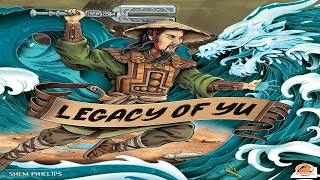

































During the reign of Emperor Yao, the people of ancient China were constantly plagued by deadly floods along the Yellow River. Eager to put an end to the devastation, Yao selected Gun, one of his officials, to devise a plan. After nine years of failed attempts using dams and dikes, Gun's employment came to a questionable end. After his passing, Yu inherited his father's work. Learning from Gun's failures, Yu set out to construct a series of canals to direct the surging river into nearby fields and smaller waterways.
Legacy of Yu is a solo-only, fully-resettable, nonlinear campaign game in which you step into the role of the legendary hero of the Xia Dynasty, Yu the Great. It will be your job to build the canals ahead of the impending flood, while also defending your growing village against neighboring barbarian tribes. With each game, stories will be shared and new gameplay elements added. The campaign features a self-balancing system which adapts to how well you are doing. The campaign ends once you either win or lose seven games.
—description from the publisher
Mechanics (from transcript analysis)
Video topics + discussion points
Quotes (from this video)
- Legacy of You was a little bit of an impulse buy.
- No regrets.
- New state, new house, new games.
References (from this video)
- Simple mechanic
- works with fewer dice
- Not very interesting
- Rolling Realms
Mechanics (from transcript analysis)
- simple numeric drafting
Video topics + discussion points
Quotes (from this video)
- it's exactly the same as the original Rolling Realms but there is a bunch of stuff that's different
- I feel like one of the big reasons this game even exists is because it's kind of the big box for Rolling realm
- I will say that it is not waterproof we learned that the hard way
- this is our first one back in London so let's see if this sticks or not
- what we're going to do from now on is I think just mix it in with the rest of the Rolling Realms
- Meadow has this terrific drafting mechanism where you're putting your little number arrows
- Planet Unknown is probably my favorite of all the games represented
- this would have been in the fourth category but we played it just recently again and it grew on me
- I like this one a lot
References (from this video)
- Playthrough length is quick (often under 20 minutes in the session described)
- Satisfaction when systems come together and progress occurs
- Narrative elements and lore cards add thematic flavor even in defeat
- Punishing and occasionally pun-driven, with heavy interaction between resources and card effects
- Frequent misplays or confusing interactions that derail momentum
- Advanced phases/events (e.g., large card discards) can abruptly end a turn with little warning
- Array
- Fantasy frontier
- Let's Play commentary
Mechanics (from transcript analysis)
- Building / Construction — Players spend resources to construct buildings or improvements (e.g., canal, rider, outpost).
- Campaign progression / Legacy mechanics — The run includes defeat cards and fortuity cards that shape ongoing narrative and future games.
- Card-driven actions / deck management — Actions and resource gains are filtered through cards, with discards, draws, and top-of-deck decisions affecting outcomes.
- Combat / defense against barbarians — Barbarians attack and players defend using cards and resources; some effects block or mitigate damage.
- deck manipulation — Actions and resource gains are filtered through cards, with discards, draws, and top-of-deck decisions affecting outcomes.
- Harvest phase — At the start of a turn, the player reveals and processes a sequence of actions including resource harvesting and provisioning decisions.
- Legacy game — The run includes defeat cards and fortuity cards that shape ongoing narrative and future games.
- worker placement — Players place workers (laborers, riders) to collect resources and advance building or defense actions.
- Worker placement / resource allocation — Players place workers (laborers, riders) to collect resources and advance building or defense actions.
Video topics + discussion points
Quotes (from this video)
- "I will start with the Harvest phase"
- "this is terrible"
- "Huge misfly there because these don't include"
- "I lost the game immediately when that happens"
- "I'm finding these games to be quicker and quicker honestly as I play like my first few games were like 30 minutes 40 minutes and now this one's like less than 20 which is crazy but I guess it could just be that I'm learning how to play more quickly too"
- "I am still enjoying this I'm getting the satisfaction of you know getting things to work"
- "I'll tweet if I end up winning this game at least one time"
- "thanks for watching"
- "I guess I'll go ahead and do that"
- "this is crazy"
- "I have no workers left"
- "I lose the game immediately when that happens"
References (from this video)
- strong solo/campaign experience
- replayable through multiple scenarios
- engaging narrative progression
- solo-focused may limit group play appeal
- resource conversion and progression
- solo, resettable campaign across eras
- campaign-driven, scenario-based progression
Mechanics (from transcript analysis)
- campaign_progression — play through scenarios with evolving cards and goals.
- deck_building — acquire and manage a deck of actions/resources across sessions.
- Resource management — convert and manage resources to progress toward goals.
- resource_conversion — convert and manage resources to progress toward goals.
Video topics + discussion points
Quotes (from this video)
- Earth is a fantastic bang for your buck.
- Tableau building with simultaneous play is great.
- I love this game so so much.
- I could talk about this for hours on end because I love this game so so much.
- I hate the way the game looks but I absolutely love the game play.
- Please ignore the look of it, try Concordia, I promise you you will enjoy it.
- Stardew Valley is a cooperative game, a great one to bring to the table if you have people in your life who aren't into board games.
- Cartographers is one of my favorite role and write games and will always have a special place in my heart.
- Near and Far is a campaign game; Francis and I have played through quite a few maps and we love this game.
- Tapestry is probably one of my favorite games right now; it's just so satisfying to me.
References (from this video)
- tight solo euro pacing with quick sessions
- strong sense of progression and variety across campaigns
- fast, accessible solo play compared to larger euros
- not fully simulated AI opponent may feel abstract
- campaign scoping may limit replayability once finished
- solo euro with evolving cards and story-driven change
- Campaign euro with light legacy-like elements and a narrative thread through a storybook
- storybook-driven progression with modular changes between games
- Gloomhaven (boss-like progression, but not solo-only)
- Maki
Mechanics (from transcript analysis)
- Campaign progression — Storybook elements and cards entering and leaving play across sessions.
- card-driven decisions — Cards come and go, affecting what happens in future games; no AI opponent.
- mini-conditions for victory — Clear win/lose condition but with evolving state and quick playtime per session.
Video topics + discussion points
Quotes (from this video)
- AP doesn't exist in a Solo game; only a analysis paralysis isn't a problem when no one's waiting for you to finish your turn
- it's all very simple but the puzzle itself is crunchy and interesting
- the puzzle itself is brilliantly constructed but solving it leaves me a little bit cold
- No better solo only game than Final Girl; it's my number one
References (from this video)
- immersive, story-driven campaign
- portable campaign that resets each run
- campaign ending can be bittersweet; ends the story
- can be long to complete in a single sitting
- campaign survival with multi-path outcomes
- survival canal-building, coastal threat
- branching campaigns with evolving cards
Mechanics (from transcript analysis)
- lose a turn — flood, cards run out, or barbarians are overwhelming; three loss paths.
- Resource management — manage cards and resources to build canals before the flood.
- resource management / canal-building — manage cards and resources to build canals before the flood.
- three-way lose conditions — flood, cards run out, or barbarians are overwhelming; three loss paths.
Video topics + discussion points
Quotes (from this video)
- this is a wonderful little puzzle game
- it's easy to get to the table
- I absolutely love this game
- Legacy of You has captured my heart
References (from this video)
- Campaign-driven replayability
- Long-term narrative engagement
- Requires commitment across multiple sessions
- Legacy mechanics can be unfamiliar to some players
- Legacy/campaign-driven gameplay
- Contemporary family/individual journey with evolving outcomes
- Story-driven, continuing narrative through sessions
- Agricola
- Just One
Mechanics (from transcript analysis)
- choice-driven progression — Player decisions influence long-term outcomes and game state.
- legacy mechanics — Campaign progression where choices persist and shape future sessions.
Video topics + discussion points
Quotes (from this video)
- Eight copies of just one.
- Top family board game that gives you the warm and fuzzy feelings.
- A Gricola. Yeah, you got to really remember why you're together as a family.
- Isn't that solo only? Yeah, that's cuz you get to play with you and you.
References (from this video)
- Adds a neat numeric layer to the trio
- Pairs well with the other two games for variety
- Rules can be intricate; not a campaign game; could be overwhelming for some
- personal record-keeping & numerical progression
- numbers puzzle with ascending order
- abstract puzzle
Mechanics (from transcript analysis)
- ascending-row/column placement — place numbers to create ascending bottom line; combine two numbers for placements; resources gained
Video topics + discussion points
Quotes (from this video)
- This game is so fun.
- This is like one of the games that I often like lose myself in, if that makes sense.
- Rolling Realms Redux is a really good addition.
- I got a score of 41.9.
- Meadow is really fun because you are writing a number one through four on any of these little fences here.
References (from this video)
- Variety of mechanics at play
- Balanced gameplay
- Engaging solo experience
- Streamlined setup that keeps focus on the game
- Urban planning, water management, and balance between resources and risk
- A small town facing flood risk where players build canals to manage water and protect inhabitants.
- procedural/analytic with emphasis on balance and resource flow
Mechanics (from transcript analysis)
- Balance/risk management — Maintaining equilibrium between growth and the risk of town flood, driving strategic decisions.
- Resource management — Overseeing multiple resource types and directing them toward canal construction and flood prevention.
- risk management — Maintaining equilibrium between growth and the risk of town flood, driving strategic decisions.
- Streamlined setup — A design approach that minimizes setup overhead to keep players focused on gameplay.
- Worker deployment — Assigning workers to tasks related to canal building and infrastructure maintenance.
- worker placement — Assigning workers to tasks related to canal building and infrastructure maintenance.
Video topics + discussion points
Quotes (from this video)
- Legacy of You is a solo game with a lot of different mechanics in this one.
- The objective is simple. You are trying to build the canal so that this small town avoids flooding.
- The game really is about being balanced.
- I cannot tell you how much fun I've been having with this game.
- I have been pleasantly surprised with how fun this game is.
- Part of the appeal of this game, too, is just that there's a lot of different mechanics at play.
- The game feels so streamlined where I don't need to focus so much on setup.
- It's not getting in its own way.
- I can just focus on the game itself.
References (from this video)
- Positive personal experience through a campaign-style game
- Hard to finish campaigns; speaker is halfway through
Mechanics (from transcript analysis)
Video topics + discussion points
Quotes (from this video)
- I still absolutely love this design
- the AI system is so smart
- it's on the totally table Todo list
- Frost Punk is incredible
- I absolutely plan to get to the table this year
- the slide puzzle mechanism I love
- Weather Machine remains one of my favorites
- Sleeping Gods no reason to believe that I won't love this one as well
References (from this video)
- Rich, varied mechanics and a strong solo emphasis
- Campaign structure that resets for replayability
- Story passages add flavor without overpowering gameplay
- Can be heavy/complex for a solo game
- resource management, deck-building, and campaign progression
- solo campaign in a town facing floods and barbarians
- story-driven with readable passages
Mechanics (from transcript analysis)
- Deck building — Acquire characters to build a more powerful deck/engine.
- deck-building — Acquire characters to build a more powerful deck/engine.
- engine building — Chain actions for better efficiency over the game.
- engine-building — Chain actions for better efficiency over the game.
- Resource management — Balance resources to progress and defend against threats.
- story-driven events — Story passages trigger as you lose or win, influencing the game state.
- worker placement — Place workers to gather resources and build canals.
Video topics + discussion points
Quotes (from this video)
- I really enjoy Flip 7. It's a game that I always take with me.
- The game itself plays very quickly.
- There's a lot to think about.
References (from this video)
- Rich, story-forward campaign flow with evolving story cards and a history system that links games together
- Tight integration of resource management and canal-building that creates a race against flood and barbarians
- Dynamic color-based mechanics (outposts) that add strategic flexibility and variance across plays
- Significant rule density and a potentially steep learning curve for new players
- Heavy reliance on deck order and resource draw, which can feel luck-dependent
- Extended playtime and setup can be a barrier to quick sessions
- Community resilience under disaster, infrastructure development (canal construction), resource juggling, and persistent threats from barbarians.
- A frontier camp building a canal under the looming threat of a flood, set in a river valley with evolving story-driven events.
- Story-driven campaign with a progression of events accessed via a story deck and a log of history/boons for future games.
Mechanics (from transcript analysis)
- Canal construction / modular layout — The board is built in sections; completing canal spaces yields rewards but advances flood threats if left unfinished.
- Deck building — Each round you must play all cards from your hand; you can exhaust, discard, or tuck cards to shape future income and deck composition.
- deck-building / hand management — Each round you must play all cards from your hand; you can exhaust, discard, or tuck cards to shape future income and deck composition.
- Modular board — The board is built in sections; completing canal spaces yields rewards but advances flood threats if left unfinished.
- Outposts / color conversion — Outposts enable color-aliasing (white/blue) to meet barbarians’ required colors and unlock new strategic options.
- Resource management — Manage laborers, shells, provisions, wood, brick, and food to pay costs and drive building and defense.
- story-driven events — Story deck and storybook drive the campaign, with history/filed cards affecting future games and potential boons.
- Threat tracking and defense — Barbarians accumulate in a row and attack; players decide to defend, bribe, or risk losing cards and momentum.
- Trading — Trade spaces allow conversion between resources (e.g., shells to brick/wood/provisions) to access needed costs.
- Trading / exchange spaces — Trade spaces allow conversion between resources (e.g., shells to brick/wood/provisions) to access needed costs.
- worker placement — Players deploy townsfolk/workers to build canals, huts, farms, and other sites, unlocking actions and resources.
Video topics + discussion points
Quotes (from this video)
- Spoiler free so if you don't want to see any of the story elements you need to get out right now
- the canal is complete and the flood threat shifts the narrative
- I think we're barely holding on as barbarians stack up
- we must survive this round and build more huts to open up space
References (from this video)
- Strong solo-focused design
- Multi-use cards with varied applications
- Replayable campaign with a clear progression
- Natural integration of story elements without derailing core loop
- Not ideal for players who dislike heavy card/resource management
- Campaign mode increases difficulty when you win, which may frustrate some
- Pace can be slow for players seeking multiplayer emphasis
- Canal-building, flood control, resource management, and threat mitigation in a narrative context
- An ancient river valley where flooding must be managed by building canals and defending against barbarians
- Storybook campaign with resolved cards revealing entries
- Paladins of the West Kingdom
- Hadrian's Wall
Mechanics (from transcript analysis)
- Barbarian combat — Barbarians attack and must be defeated using provisions and workers
- Campaign progression — Campaign ends when win/loss piles run out; difficulty scales in campaign mode
- card management — Cards are both a resource and a threat; managing hand and discard piles is central
- Combat: Damage Based — Barbarians attack and must be defeated using provisions and workers
- Multi-use cards — Cards provide multiple possible actions and win conditions (also act as hit points)
- Narrative/story elements — Resolving cards reveals entries in a storybook that affect ongoing play
- Resource conversion — Various resources (wood, clay, shells, provisions) are converted to advantages and actions
- Resource management — Various resources (wood, clay, shells, provisions) are converted to advantages and actions
- Timed pressure / flood mechanic — The flood pressure increases, requiring canal spots to be built before being overtaken by waves
- worker placement — Place workers to gain rewards and unlock new actions
Video topics + discussion points
Quotes (from this video)
- this one is for the solo gamers and the core gameplay is what you would expect from a garphil game
- multi-use cards and lots of resource conversion
- the timer of the game where you have to keep building canal spots to outrun the flood which summons more barbarians is brutal and you will never feel like you have enough time
- at its core it's a card and resource management game if that isn't your jam you won't like it
- legacy of yu it's barbarian whack-a-mole
- the best thing about this game is the multi-use cards, many different things you can do with them and they're also your hit points
- all up if you like solo games and want a tight game with a resettable and replayable campaign check this one out
- the story elements are introduced naturally and while they change the game up they don't seem to transform the core gameplay loop into something really weird
- if you are someone who sulks when they lose a game i have bad news for you
- for another solo option try hadrian's wall
References (from this video)
- Unique deck building where you avoid picking up cards
- Every action is a choice between multiple options
- Story-driven campaign
- Interesting mechanic where drawn cards are the timer
- Excellent for solo
- Extremely choice-heavy gameplay
- Complex rules explanation
- Unique mechanics require learning
- Historical
- Canal Building
- Chinese
- Resist
Mechanics (from transcript analysis)
- Campaign
- Choice-driven
- Deck building
- Narrative choice
- Resource management
- Work replacement
- worker placement
Video topics + discussion points
Quotes (from this video)
- which games do you enjoy the most solo so we can add and adjust these rankings if we agree
- the hype train is real here
- it's the best survival game that we have played
- if I could make a deal with God continue run off the field and switch places with Hadrian
- everything you do is choice between at least two different things
- I didn't think I'd like it as much solo as I did
- it's the easiest to play I think from all of these
- we're all about the story here
- you do feel like a researcher there
- all of these fantastic games that we love to play solo
References (from this video)
- Campaign depth and evolving mechanics with narrative progression
- Clear setup and tutorial pacing for a campaign-driven game
- Canal-building and slot-based actions create a satisfying strategic arc
- Heavy rules to learn; the campaign has many moving parts
- Campaign length can be lengthy and may require persistence
- canal-building, flood management, community resilience
- Ancient China during floods
- campaign/storybook-driven
Mechanics (from transcript analysis)
- Barbarian encounters and bribery — Barbarian cards attack; players may spend resources to bribe barbarians and avoid damage, though barbarians themselves are not removed.
- Building and spaces — Construct huts, farms, and outposts, each placement revealing bonuses and potentially unlocking additional action spaces.
- Campaign/story deck and storybook — A story deck (numbered 0-69 and a universal story deck) guides campaign progression; the storybook provides secret information and instructional text when dictated.
- Canal building — Construct six canals left-to-right; canal cards populate specific spaces and unlock new action spaces and bonuses when built.
- Flood mechanism — A flood piece advances each round; if it reaches or exits the board, or if it covers certain spaces, the player loses.
- Harvest phase — Each round begins with resource collection (workers, shells, provisions, etc.) and is enhanced by Farms and Outposts; yields can be augmented by Townsville cards and previously built structures.
- Resource management — Multiple resource types (clay, wood, shells, provisions, etc.) and worker colors must be managed across turns and actions.
- Townsville cards usage — Townsville cards provide resources, actions, or draws. Slots can be opened by constructing buildings; cards can be deployed beneath slots for ongoing harvest bonuses.
- Trading — Trading options exist with shells and other resources; canal progression unlocks additional trading possibilities.
- Turn structure — Rounds proceed through Harvest, Take Actions, and End phases; players may perform multiple actions per round until they choose to stop.
Video topics + discussion points
Quotes (from this video)
- The game is now ready to start.
- To win the campaign you must construct all six canals on the board.
- The Campaign will be adding new mechanics new rules maybe different setup but also new objectives that you will need to satisfy.
- You can lose in three different ways.
References (from this video)
- delivers a unique solo-campaign experience
- clear, thematic storytelling with a surprising amount of depth
- engaging canal-building premise with strategic choices
- solo focus may limit group play appeal
- some players may find the pacing slower due to setup
- Canal construction and resource management across a campaign arc
- Solitary canal-building universe with a campaign flavor
- Story-rich but played in a solo-oriented manner
Mechanics (from transcript analysis)
- Deck building — Deck choices influence pacing and resource flow.
- deck-building — Deck choices influence pacing and resource flow.
- solo campaign structure — A series of connected scenarios with evolving challenges.
- worker placement — Abstracted resource management with action selection.
- worker-placement adaptation — Abstracted resource management with action selection.
Video topics + discussion points
Quotes (from this video)
- the story is fantastic
- production wall used through the roof
- tons to do if you're a sucker for Space theme
- it's a huge campaign game
- it's the only game you can't really get right now because it was just on Kickstarter
- my favorite solo game hands down this year
- it's a two-player card game
- the odds are always in your favor
- it's a drafting game
- every action does that