



















































Let's Go! To Japan Deep Dive
What the Community Thinks About Let's Go! To Japan
Let's Go! To Japan consistently resonates with board gamers for its elegant combination of light drafting mechanics and thematic immersion. Reviewers praise the game as a gateway experience that welcomes new players while offering surprising strategic depth beneath its breezy exterior. The universal acclaim centers on how smoothly the game integrates theme with mechanics; players are genuinely planning a dream vacation rather than executing abstract card placement. Meeple University describes the experience as smooth and engaging, while the Discriminating Gamer calls it a tremendous package that delivers light, interesting, and highly competitive gameplay in a compact timeframe.
Core Mechanics That Define Let's Go! To Japan
Card Drafting and Tableau Building
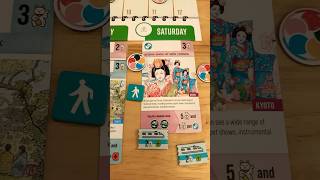
The heart of Let's Go! To Japan is its streamlined drafting system spanning exactly 13 turns. Players draw from Tokyo and Kyoto decks, selecting which cards to keep and which to pass to opponents. Unlike typical drafting games, players place their chosen cards directly into their personal itinerary across six days, choosing not just which card to play but where on their board it belongs. This placement carries weight: cards can go on top of existing stacks, in the middle, or at the bottom, and once placed, the order cannot be rearranged. Each day can hold up to three cards, with the bottom card serving as the highlight of the day. The pivotal design element is that only the bottom card's special bonus scores unless matched conditions are met, creating a puzzle around which cards end up where.
Set Collection and Icon Matching
Success requires collecting matching icons to complete objectives tied to each day's theme. The game randomizes these themes at the start (shopping day, temple day, food day), and players spend the drafting phase positioning cards to align with both their personal icon collection strategy and the highlight card requirements. Matching two or three icons on a given day unlocks bonus rewards including mood advancement, research tokens for additional card draws, train tickets, or an extra walk card. This icon-driven system means that every placement decision echoes forward through the scoring phase, transforming the seemingly casual card placement into a network of interdependent choices.
The Let's Go! To Japan Experience
Breezy Gameplay That Respects Your Time
The game delivers genuine accessibility without patronizing experienced players. Meeple University's preview spotlights how quickly players grasp the core loop: draw cards, choose one, place strategically, repeat. Setup is minimal, teach time is straightforward, and gameplay moves briskly through its 13-turn structure. The Discriminating Gamer emphasizes that this relative brevity transforms what could be a tedious scoring phase into something engaging. Since most tracking happens during the final resolution, players experience a satisfying payoff when all the scattered pieces suddenly coalesce into clear points. The flow never drags; even with four players, turns execute quickly.
Thematic Immersion Through Mechanisms
Jamie from Stonemaier Games highlights the integration of theme and mechanics as exceptional: players are not executing a pattern but genuinely orchestrating a vacation. Travel between Tokyo and Kyoto demands train tickets (a constant tension), mood fluctuates based on expensive restaurants and calming temples, and the specific locations illustrated on cards (Fushimi Inari Shrine, Nishiki Market, photo sticker booths) anchor decisions in Japan's real geography. The narrative emerges naturally through card text and thematic flavor. One reviewer noted that the meal-heavy start to a vacation, the fatigue of travel, and the desire to visit temples afterward all reflect genuine vacation rhythms. Tim Chuon emphasizes this experience, noting that everyone makes their own best Japan itinerary, creating personal stories within the game's framework.
What Makes Let's Go! To Japan Stand Out
Strategic Depth Disguised by Accessibility
The game's greatest achievement is how it hides meaningful decisions within a light framework. On the surface, players select cards and place them. Beneath, they wrestle with order-of-operations puzzles: does this card belong on top to be scored, or should it be hidden to protect the highlight card? Should players chase a specific icon set or remain flexible? When should research tokens be used to see more options? The Discriminating Gamer captures this tension perfectly: not a fan of drafting games generally, but found genuine enjoyment in the puzzle of placement and the delayed scoring reveal. Jamie notes that the game delivers substantial turns within a constrained action space, with players accomplishing something meaningful with each placement despite the simplicity of the action itself.
Gorgeous Production and Aspirational Theme
The artwork and production quality elevate the experience beyond the mechanics. Our Family Plays Games opens the box to find premium components and beautiful wrapping cloth (furoshiki-style, mirroring Japanese gift-wrapping traditions). The cards feature evocative illustrations of actual Japanese locations and activities, from rescue cat cafes to board game shops in Akihabara to ryokan stays. The thematic immersion is intentional and thorough. Jamie from Stonemaier notes that the theme integration is "incredibly clever and smooth," and the game brings happiness to teach and play repeatedly. The colorful, culturally grounded artwork ensures that Let's Go! To Japan appeals visually even to players unfamiliar with Japan.
Potential Drawbacks
Limited Direct Player Interaction
The Discriminating Gamer identifies the game as effectively multiplayer solitaire: while players do pass cards that might affect opponents' options, direct competition or negotiation is minimal. Some reviewers expressed a wish for greater take-that elements or decisions that explicitly benefit one player while harming another. Once each player begins executing their private itinerary, they largely ignore what others are doing. For players who thrive on conflict and negotiation, the cooperative feel of individual optimization might feel shallow. The game prioritizes a relaxing experience over cutthroat competition, which enhances its gateway appeal but limits engagement for players seeking confrontation.
Extended Scoring Phase
The Discriminating Gamer notes that approximately half the game is spent drafting and half scoring. While the scoring is enjoyable and illuminating, some players may find the extended resolution tedious, especially with four players. Each day's resolution involves moving mood tokens, advancing experience tracks, checking conditions, and tallying bonuses. Though relatively quick for a scoring phase, it is substantial enough that players expecting a brisk 30-minute game should plan for 45 minutes to an hour. The asymmetric solo mode also changes scoring slightly, which reviewers found slightly confusing on first play.
If You Enjoy Let's Go! To Japan
Fans of Let's Go! To Japan should explore games that emphasize simultaneous tableau building and light drafting. Stonemaier Games' Jamie recommends Guild of Merchant Explorers, Wingspan, Castles of Burgundy, and Sagrada as kindred spirits, all featuring card or tile placement with set collection elements and accessible learning curves. Seven Wonders offers a more complex drafting experience with simultaneous play, while Libertalia delivers tense passing mechanics. The Discriminating Gamer suggests that anyone appreciating the drafting puzzle and thematic resonance might explore deeper engine-builders like Tapestry or Wingspan, which reward careful planning with escalating returns. Dixit appeals to players who love the beautiful illustration style.
What Reviewers Are Saying
"You're planning this trip by drafting cards and it's a really smooth simultaneous draft where you're drafting these cards. You're inserting them into the different days of the week as you wish. You don't have to start on Monday. You can jump all the way to Friday. And you're trying to create some sets for each day. You're trying not to jump back and forth between Kyoto and Tokyo too much. It's just an incredibly clever, smooth combination of theme and mechanisms."
— Stonemaier Games
"This game, you're doing a lot with each turn and yet the game moved along at a pretty good pace. There wasn't all that much downtime between turns despite how much I was doing on my turn, how much other players were doing on their turns. The gameplay is a fun puzzle with a rewarding action system that makes every turn feel meaningful."
— Stonemaier Games
"I really actually enjoyed that and then we get to the scoring part and you're figuring out how everything's coming together and it's fun because you don't know how it's going to happen. It's a fun part of the game because like those tokens don't move until scoring so you don't know where everything's going to be until scoring and it's kind of like you got the puzzle out there now you got to decipher the puzzle."
— The Discriminating Gamer